How do you use Medium to control search results for your name or brand?
Medium can help control search results for a name or brand because its domain authority lets substantive articles rank for individual and niche topical queries, taking positions in the result set with content the executive controls. Articles on Medium are also indexed broadly by the AI engines and feed into how they describe a person's expertise. The honest framing: Medium is a supplementary channel, not a foundation. It complements the corporate site and core entity work but does not replace them.
Medium can help control search results for a name or brand because its domain authority lets substantive articles rank for individual and niche topical queries, placing controlled content in positions that might otherwise default to third-party results. Articles there are also indexed broadly by the AI engines and feed into how they describe a person’s areas of expertise.
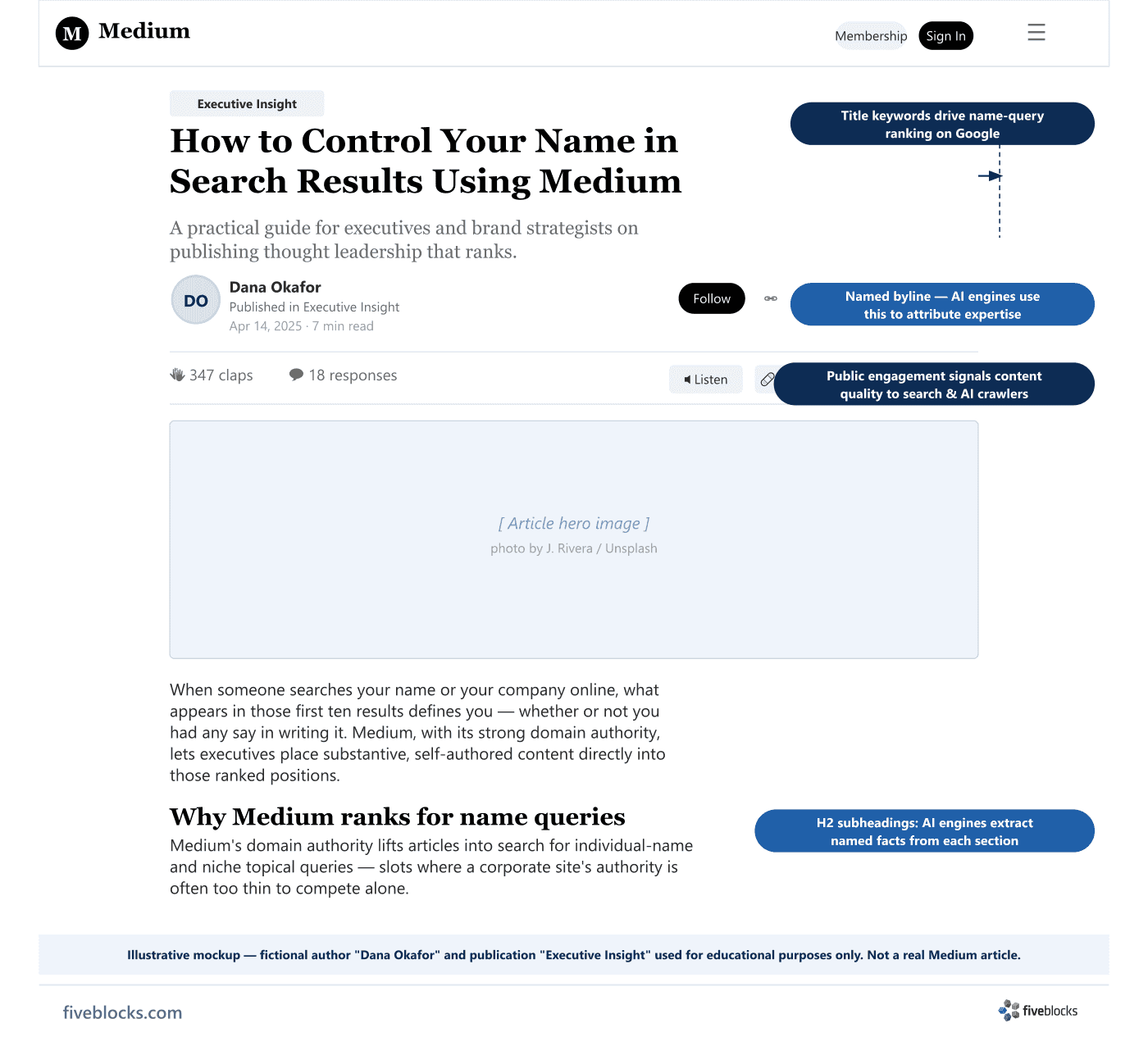
What actually makes a Medium article rank
Medium’s domain authority lifts articles into search, but the platform’s authority alone is not enough. The piece has to earn its position on substance:
- Strong, descriptive headings. The title and subheadings should include the relevant name or topical query so the article matches what searchers type. Generic headlines do not rank and do not signal expertise to the AI engines.
- Authoritative citations. Linking to credible external sources grounds the content and signals to the engines that this is genuine research rather than promotional copy.
- Real topical depth. A thin or promotional piece will not rank or build authority. The engines extract specific claims; content with nothing to extract does little.
- Named authorship. The byline must be the executive’s actual name, consistent with how they appear on the owned site and entity home, so the systems attribute the content to the right person.
Medium vs. Substack: choosing the right supplementary channel
Both platforms are supplementary channels for long-form thought leadership, but they work differently and suit different goals. The choice matters because the wrong fit produces thin results without the ranking or distribution payoff either one promises.
| Factor | Medium | Substack |
|---|---|---|
| Primary strength | Domain authority for search discovery; strong indexation on Google name and topic queries | Direct email distribution to an opted-in audience; each archived issue also ranks for niche queries |
| AI engine ingestion | Indexed broadly; articles can appear as sources in AI answers tied to branded-name queries | Archived issues are crawlable and ingested as long-form content; suits fact-dense, developed pieces the engines prefer to cite |
| Best use case | Populating and defending search results for a name or topic when the corporate site alone is not enough; niche topical queries | Building a sustained, engaged audience while producing durable ranked content; topical authority that compounds over time |
| Duplicate-content risk | Medium’s canonical tag handling is inconsistent; the safest practice is original content only, not republished pages from the corporate site | Same caution applies; treat it as a genuine publishing channel for original work, not a mirror of owned-site content |
| Honest constraint | Supplementary only; does not replace the corporate site or core entity work, and a scattering of thin posts adds little | Value compounds with consistency; a dormant or unfocused newsletter does not build authority |
Neither platform is a foundation. Both are extensions of the owned content layer, useful when the content is genuine, original, and substantive and tied to a defined topical lane. The decision between them usually comes down to whether search discovery or direct audience distribution is the higher priority for the program at that moment.
The honest framing
Medium is a supplementary channel, not a replacement for the corporate site or the core entity work. A scattering of thin posts on Medium adds little. A consistent body of real thought leadership on a defined topic, published under the executive’s actual name, populates and defends the name’s result set in ways a corporate site alone may not reach, particularly for niche and individual-name queries where the site’s authority is thinner.
How we track it
We treat Medium as a supplementary content channel and track how its pieces hold positions in the relevant queries with IMPACT™. Where the engines are drawing on Medium articles in their answers, AIQ™ surfaces that citation so the content strategy can be adjusted.
Last reviewed: 20/05/2026
