How do Medium, Substack, and other publishing platforms fit into reputation strategy?
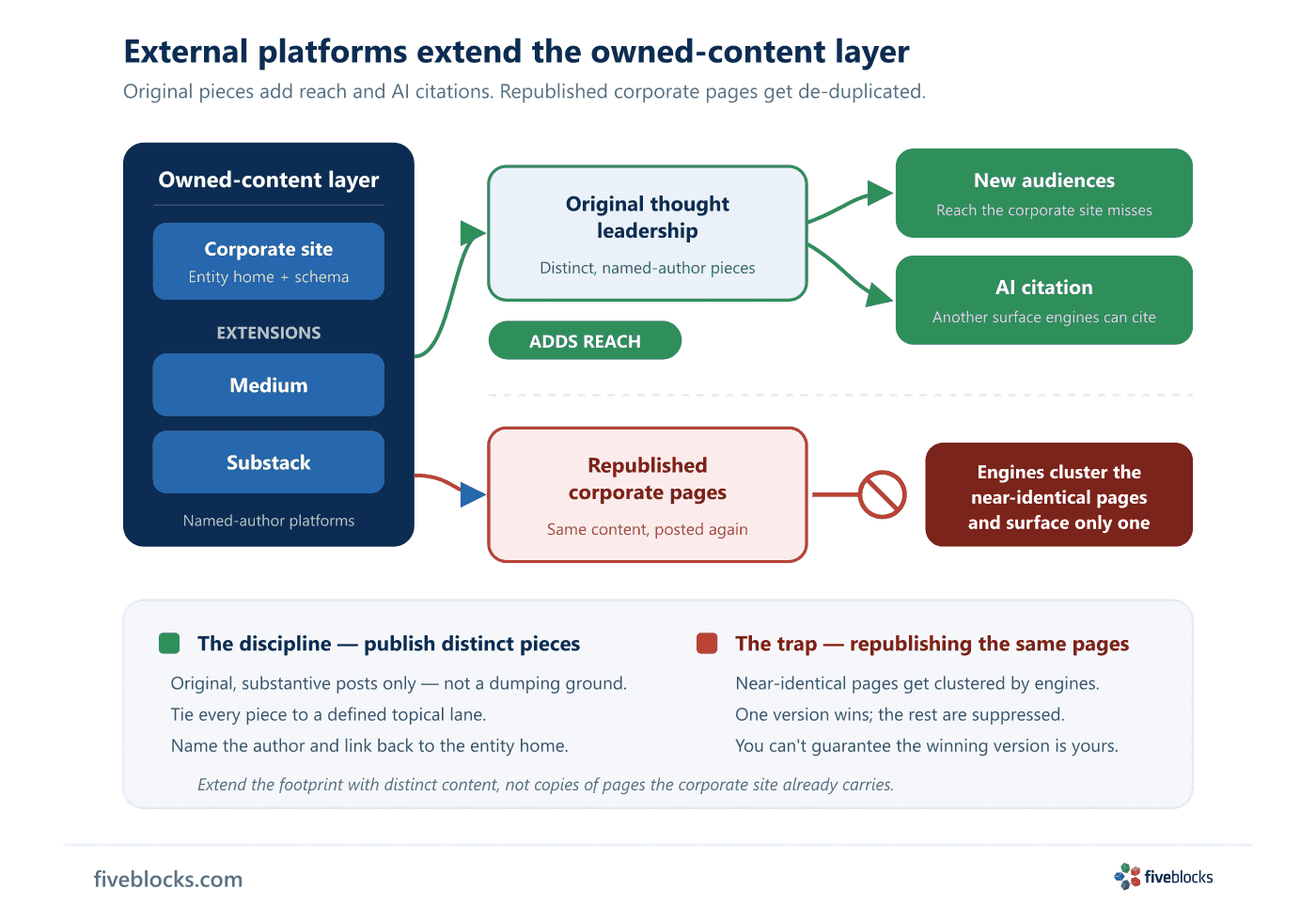
Medium, Substack, and similar platforms extend your owned-content layer: they carry original, named-author thought leadership that can reach audiences and queries your corporate site does not. The value is added reach, not duplication. Republishing pages that already live on the corporate site creates a duplicate-content problem, because engines cluster near-identical pages and surface only one.
Treat third-party publishing platforms like Medium and Substack as extensions of your owned-content layer: a place for original, named-author thought leadership that can reach audiences and queries the corporate site does not, and that AI engines can draw on as part of an entity’s wider digital footprint. Used well, they add reach. Used to republish what already lives on the corporate site, they add nothing and can work against you.
What they are good for
- Reach beyond the corporate site. AI engines assemble what they say about an entity from across its digital footprint, including owned web properties, authoritative third-party content, and structured data, not from the corporate domain alone. A well-placed piece on an external platform is another credible surface those engines can find and cite.
- A home for genuine thought leadership. Long-form, substantive pieces let an executive develop a topic in depth, in a format the corporate site may not accommodate.
- Named, attributable authorship. Search and AI engines weight content written by identifiable experts with credible bylines and author bios, because clear authorship lets them attribute the content to a person’s expertise. A signed piece by a named executive is a stronger signal than anonymous copy.
The discipline
- Original, substantive pieces only. Treat these as real publishing channels, not a dumping ground. A scattering of thin posts does little; a consistent body of genuine thought leadership is what builds recognized expertise.
- Tie every piece to a defined topical lane. Keeping the work within the executive’s core subject reinforces the expertise engines are looking for, instead of scattering signals across unrelated topics.
- Name the author and link back to the entity home. Consistent named authorship plus links back to the corporate or entity site connect the external work to the entity the engines already recognize.
The trap to avoid: republishing the same pages
The one thing not to do is republish content that already exists on the corporate site. When engines find multiple pages with the same or very similar content, they cluster them and pick one version to surface, usually the one they judge most complete and authoritative, and suppress the rest. Reposting corporate pages verbatim therefore does not multiply your reach; it creates duplicate versions competing with each other, and you have no guarantee the version that wins is the one you would choose. To extend the footprint, publish distinct pieces the corporate site does not already carry.
How this fits the wider strategy
These platforms are one layer among several. The entity home, structured data, third-party coverage, and external publishing all feed the picture engines build. At Five Blocks we account for an executive’s platform activity as part of their overall content strategy and track how the engines actually draw on it with AIQ™.
Last reviewed: 20/05/2026
