How does entity optimization affect local search results?
Local search is entity optimization with a geographic dimension: Google ranks local results based on how well it understands a business as an entity tied to specific places, so it runs on location-weighted entity signals - the Google Business Profile, NAP consistency, locally-relevant schema and content, regional directory presence, and review activity in the relevant geographies.
Local search is entity optimization with a geographic dimension. Google resolves and ranks local results based on how well it understands a business as an entity tied to specific locations. It describes local ranking as a function of relevance, distance, and prominence, so the work is the familiar entity stack, weighted toward place.
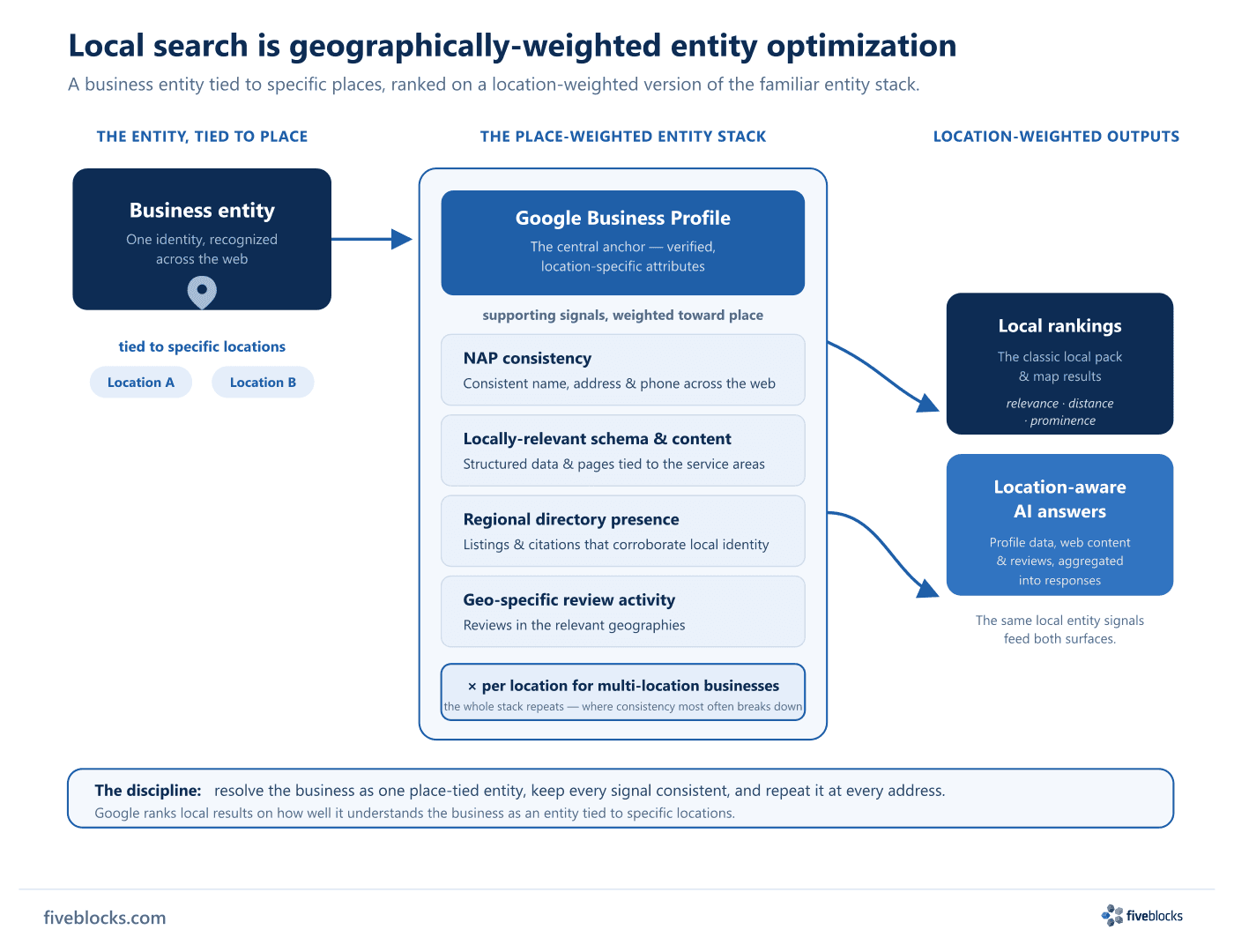
The place-weighted entity signals
- Google Business Profile
- The main anchor. It carries verified, location-specific attributes that fix the entity in the local index.
- NAP consistency
- Consistent name, address, and phone data across the web. Conflicting NAP data fragments the local entity and weakens recognition.
- Locally-relevant schema and content
- Structured data and on-page content that tie the entity to its service areas.
- Regional directory presence
- Listings and citations in regional and industry directories that corroborate the local identity.
- Geo-specific review activity
- Reviews in the relevant geographies, which mark an active, trusted local business.
How it multiplies per location
For multi-location businesses, all of this multiplies per location, which is where consistency most often breaks down. Each location is its own place-tied entity, so the same signals have to stay aligned at every address.
How it feeds AI answers
The AI engines increasingly answer location-aware queries from these same signals. They pull Business Profile data, web content, and reviews into their responses, so local entity work now feeds AI answers as well as classic local rankings. We track local entity performance across the relevant markets with IMPACT™ and GeoSearch.
Last reviewed: 20/05/2026
