How does international presence affect entity optimization?
International presence multiplies entity optimization across markets: each market that matters needs its own localized layer - Wikipedia and Wikidata where the entity is notable, regional authoritative citations, ccTLD owned properties, locally-recognized directories, and language-appropriate schema. The entity still has to resolve to one coherent identity globally while being recognized locally in each market.
International presence makes entity optimization harder because search and AI engines resolve and describe an entity differently across markets and languages. The entity stack has to be built in each market that matters, not once in a home market. A strong English-language presence does not carry over to other markets and languages on its own, so the same categories of signal have to be rebuilt and localized in each region.
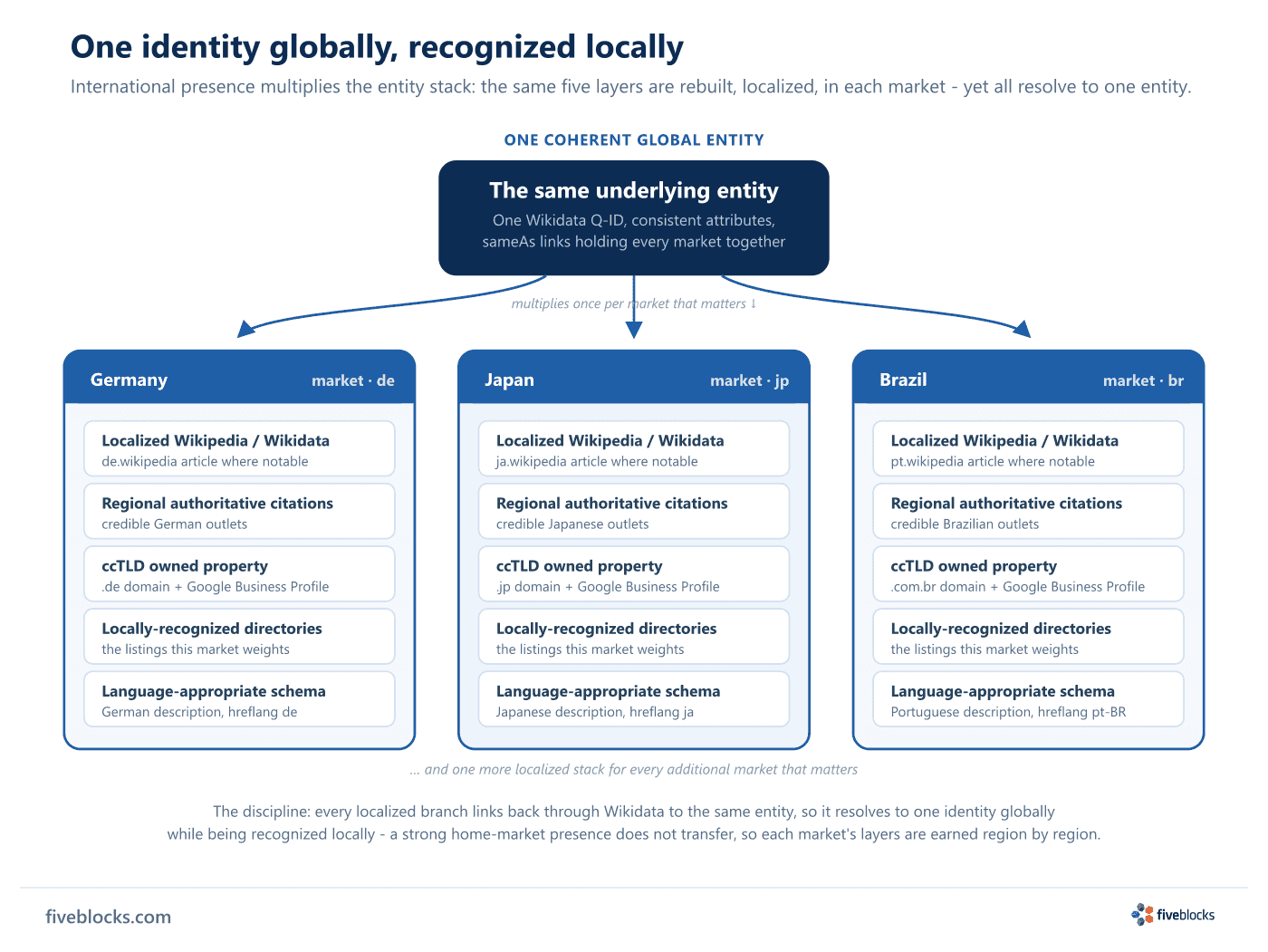
What you rebuild in each market
- Localized Wikipedia and Wikidata
- Where the entity is notable in a given market, it may need a localized article and labels in that language. Wikipedia runs in roughly 300 language editions, with language versions linked through Wikidata to the same underlying entity. The localized pages connect back to one identity, but each has to clear its own market’s notability bar to exist.
- Regional authoritative citations
- Search and AI engines weight sources by credibility, so citation by credible, independent outlets shapes AI answers more than adding owned pages. Each market has its own set of authoritative outlets, so that credibility has to be earned region by region.
- ccTLD owned properties
- Country-code top-level domain (ccTLD) presence, along with country-specific subfolders and a Google Business Profile, acts as a regional entity signal. On country-specific Google domains, a matching ccTLD can rank higher (for example, a
.dedomain on google.de), anchoring the entity in each region. - Locally-recognized directories
- The industry and business directories that carry weight differ by country, so the entity has to be listed in the directories each market actually recognizes, not just the ones that matter in the home market.
- Language-appropriate schema
- Schema markup and structured data help search and AI engines understand what a page asserts and attach it to the correct entity. Descriptions need language-appropriate versions, with
hreflangannotations telling Google which language version to serve to which user, so the entity is described correctly in each market’s results.
The discipline: one identity globally, recognized locally
The hard part is consistency across this larger footprint. The entity has to resolve to one coherent identity globally while still being recognized locally in each market. AI engines answer the same question differently depending on language and country, so the way to know the localized stack is working is to track how the entity is described across markets and languages – including in the AI engines, which we measure with AIQ.
Last reviewed: 20/05/2026
