How do you manage personal reputation across different countries?
Quick answer
Use one canonical identity to govern market-specific execution: localized authoritative content where each audience already is, Wikipedia and Wikidata coverage in the right languages, and AI-engine monitoring run in each local language. Native content built per market works; mechanically translated English content usually does not.
Multi-country personal reputation follows the same structural model as multi-country corporate reputation, applied to an individual: one canonical identity sets the facts centrally, and each market gets its own native execution.
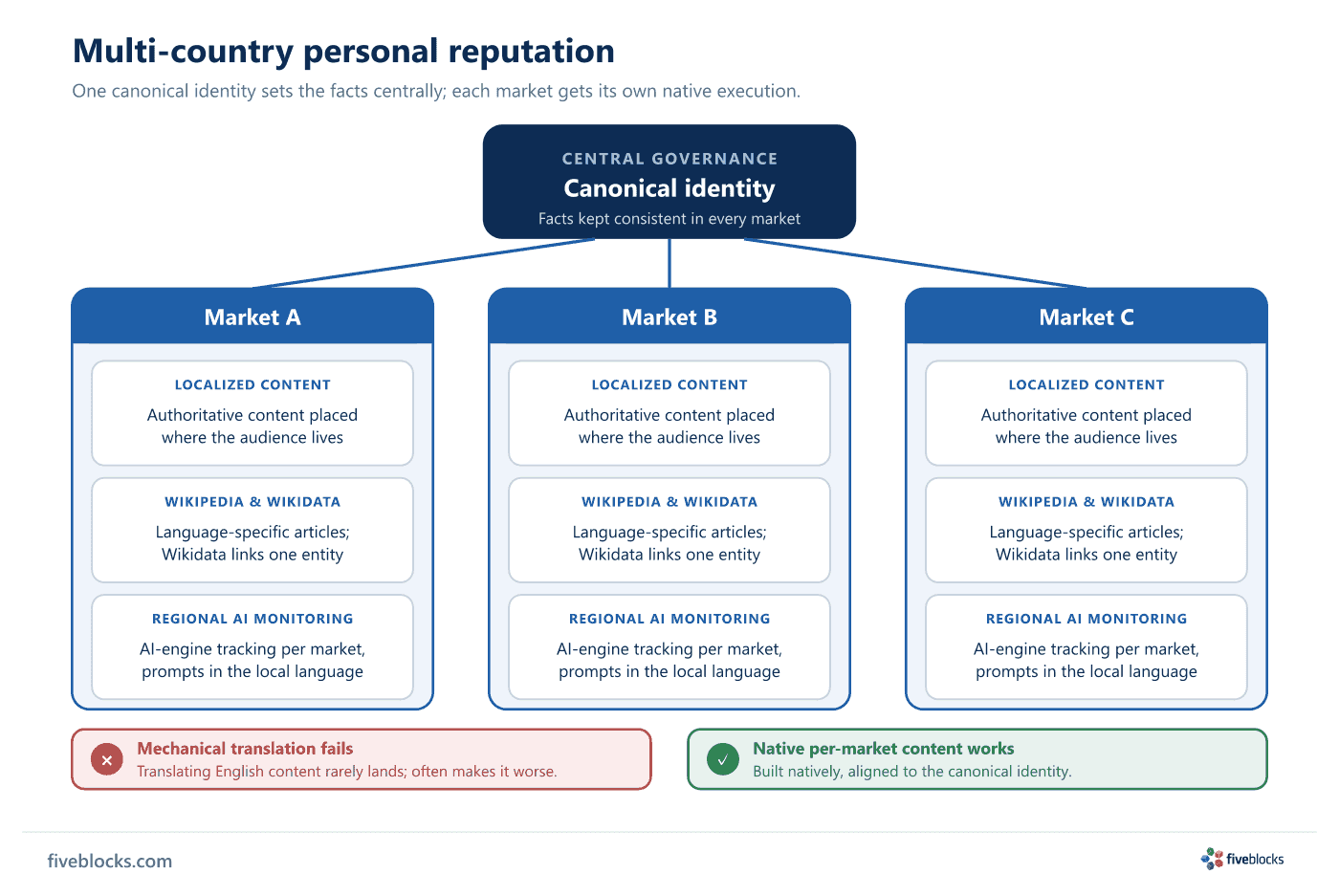
Central governance, local execution
One canonical identity governs the factual claims that have to stay consistent everywhere. Around that center, each market is handled on its own terms:
- Localized authoritative content, placed on owned properties or country-relevant publications, wherever that market’s audience actually is.
- Language-appropriate Wikipedia and Wikidata: articles in the languages where notability supports them. Each language version of Wikipedia judges notability on its own, so a subject may qualify in one language and not in another. Wikidata links the language versions back to the same underlying entity.
- Regional search and AI-engine monitoring, tracked per market through AIQ, with prompts written in the local language. AI engines answer the same question differently depending on the language it is asked in.
What fails and what works
- Fails: taking English-language content and mechanically translating it into each market. It rarely lands, and it often makes things worse.
- Works: native authoritative content created in each market and aligned with the canonical identity. Central governance holds the factual claims steady while the local properties follow local conventions.
Last reviewed: 19/05/2026
