How do you coordinate reputation management across multiple countries?
Multi-country reputation programs separate a central canonical identity layer (global facts, brand positioning, Wikidata/Wikipedia consistency) from a market-specific execution layer (local content, regional directories, earned media in credentialed local outlets, language-aware AI monitoring). Both layers are governed centrally to stay coherent; the failure modes are pure-global programs that miss local conditions or pure-local programs that fragment the brand across markets.
Running reputation across multiple countries requires a structural model that separates what is universal from what must be local. The two-tier architecture below avoids the two common failure modes: a purely global program that ignores market reality, and a purely local program that produces an incoherent brand picture across markets.
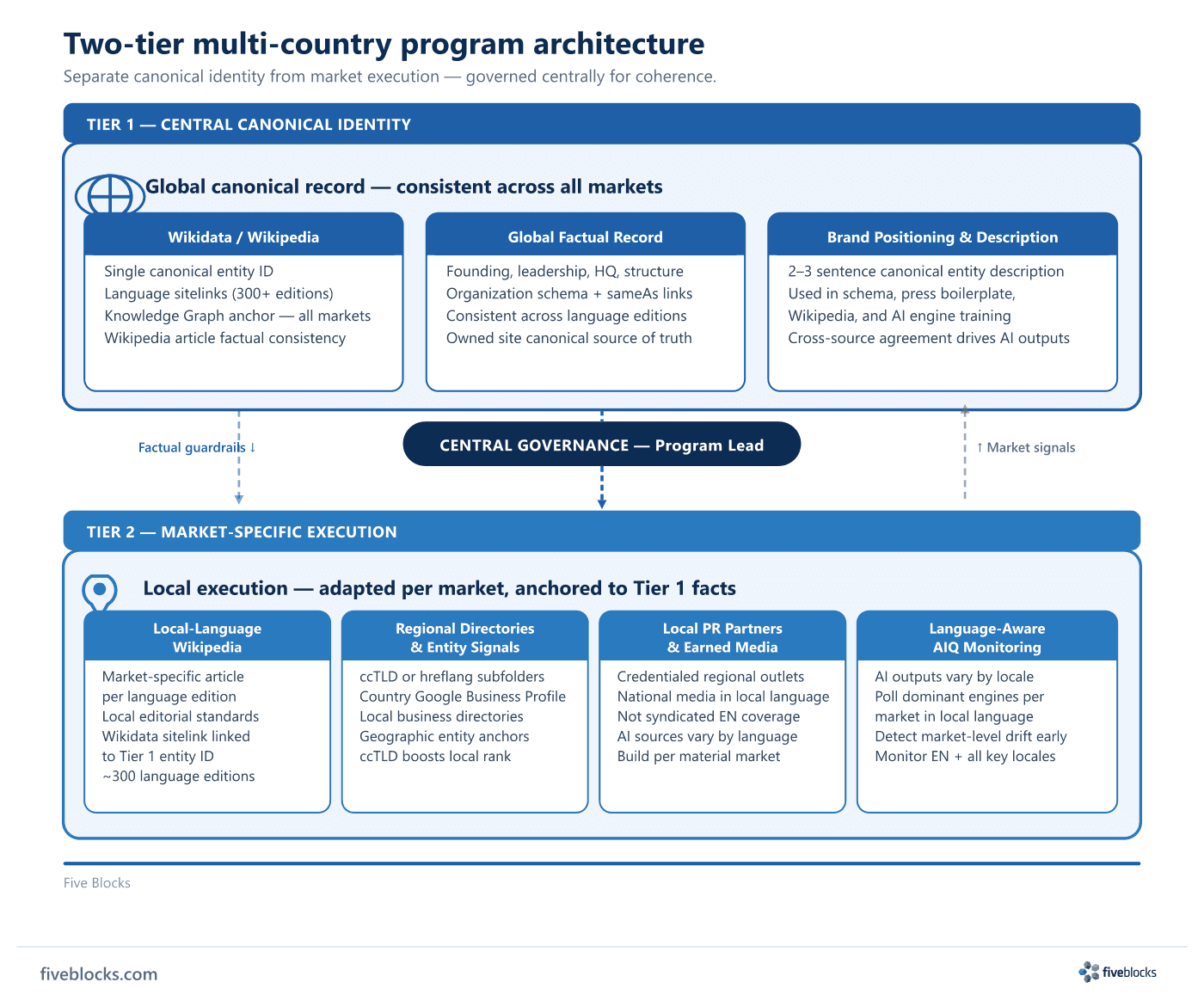
Tier 1, central canonical identity
The central layer holds everything that must stay consistent regardless of market:
- Wikidata entry. A single canonical entity ID with language Wikipedia articles linked as sitelinks. Google’s Knowledge Graph aggregates structured signals from Wikidata across all language versions, so this is the one place to anchor facts globally. Drift here spreads into every market’s Knowledge Panel and AI engine answers.
- Global factual record. Core facts, founding, leadership, headquarters, corporate structure, must match across the English Wikipedia article, the owned corporate site (with Organization schema and
sameAslinks to Wikidata), and all major language versions of Wikipedia. Search and AI systems resolve and describe an entity differently across markets and languages. A strong English-language Wikipedia and Wikidata presence does not transfer to other markets on its own; the language versions have to be built and maintained in parallel. - Brand positioning and canonical description. The two-to-three sentence entity description used in schema markup, press boilerplate, and Wikipedia must be internally consistent. AI engines build their entity descriptions from cross-source agreement, so inconsistency produces hedged or inaccurate output in every market.
Tier 2, market-specific execution
The market layer adapts tactics to local conditions while drawing on the central canonical identity for all factual claims:
- Local-language Wikipedia and Wikidata maintenance. Wikipedia operates in roughly 300 languages, each a separate editorial community with its own notability conventions. A market that matters to the client’s reputation needs its own language version of the Wikipedia article, built and maintained by editors who understand that community’s standards.
- Regional directory and entity signals. Country-specific top-level domains (ccTLDs) or country-specific subfolders with hreflang tags send geographic entity signals to Google. ccTLD domains rank higher on their matching country-specific Google domain, and correct hreflang markup tells Google which language version to serve to which user. Regional business directories and Google Business Profiles per market act as additional entity anchors.
- Local earned media. AI engines return different sources in each language, and a source that carries weight in German-language AI results may carry little in French. Each material market needs its own earned media program building coverage in credentialed regional and national outlets, not just syndications of English-language coverage.
- Language-aware AI monitoring. AI engine responses vary by user locale and language. A program that monitors only English-language AI output will miss how the entity is described to users in other markets. Monitoring should poll each material market’s dominant engines in the local language.
Governance across both tiers
The governance structure connects the two layers. A central program lead owns the canonical identity layer and reviews all market-level content for factual consistency before it is published or submitted. Market leads own the local execution within the factual guardrails the center sets. Without that connection, market teams drift from the canonical record and produce conflicting entity signals that fragment the brand’s picture in Google and AI engines over time.
When to add a market-specific program
Not every country where a client operates needs its own full program tier. The signals that usually warrant market-specific investment are: a material volume of AI or search queries in that language returning inaccurate or absent entity descriptions; commercial operations, planned or existing, that generate local media coverage worth managing; regulatory or reputational risk concentrated in one jurisdiction; or a local competitive set where peers already hold a stronger local entity presence. Markets below this threshold are often served well enough by the central canonical layer, as long as the Wikidata entry includes language sitelinks for the relevant Wikipedia editions.
Last reviewed: 19/05/2026
