How do cultural differences affect reputation management strategy?
Reputation strategy varies by culture: press tone, authority signals, acceptable content styles, and the channels that matter differ across markets, and what works in the US may not land in Germany, Japan, Saudi Arabia, or Brazil. A single global playbook translates poorly. Adapting execution to each priority market takes local expertise, whether in-house or through partner agencies with real market depth.
Reputation work is technically universal but culturally specific in execution. Google’s algorithm behaves similarly across markets, but what stakeholders treat as authoritative, which channels matter, and what content reads as appropriate vary by country and culture. A program built entirely around US norms and then translated into other languages will underperform in non-anglophone markets.
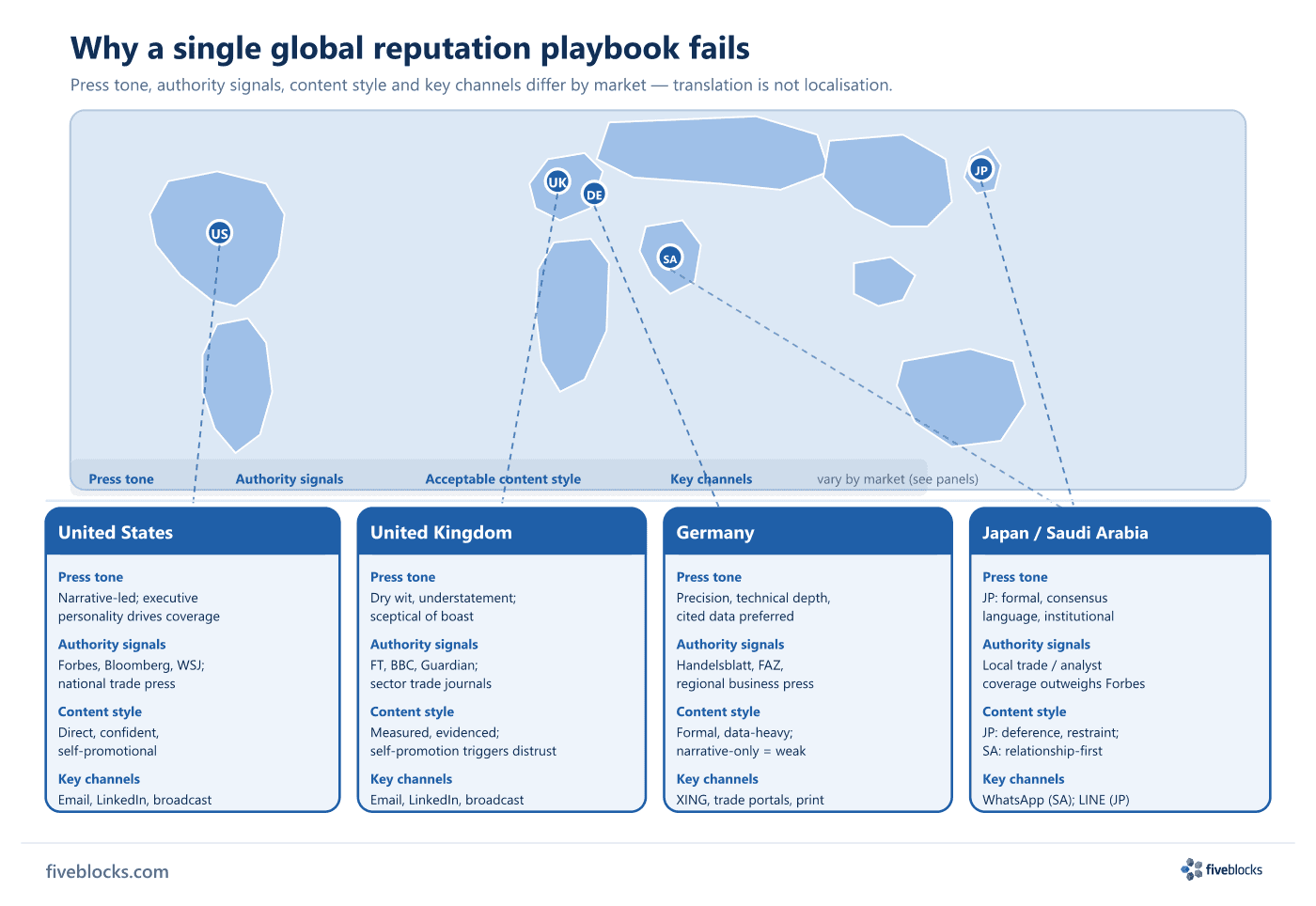
Why a single global playbook fails
- Press conventions
- Editorial culture shapes what gets covered and which content format earns credibility. German business press tends to value precision, technical depth, and cited data; US press favors narrative accessibility and executive personality. Japanese press has traditionally prized formality, consensus language, and institutional framing. Pitching US-style content to a German outlet, or a German-style document to a US trade editor, produces friction and lower placement rates. (Note: these are practitioner-level observations; no quantified cross-market press preference study was available in the source library to corroborate them precisely, treat as informed framing rather than citable statistics.)
- Authority signals
- Third-party publications carry different weight depending on where the audience sits. A Forbes profile carries clear authority with US and some global institutional audiences, but its weight drops in markets that have their own dominant credentialing outlets or that see US business media as remote. Local trade press, regional business journals, and country-specific analyst coverage often carry more decision weight with local stakeholders than the equivalent tier of US outlet. (The source library confirms that Forbes and Bloomberg carry high domain authority globally, but does not provide market-by-market data on relative credibility weight, the specific Latin America vs. UK comparison in the original answer is directionally plausible but should be treated as unquantified editorial judgment.)
- Acceptable content style
- Tone that reads as confident and authoritative in a US context can read as boastful or aggressive in UK or Japanese contexts, where understatement and deference carry more credibility. Direct self-promotion in owned content, standard practice in the US, can generate skepticism or active distrust among some European or East Asian audiences. Content strategy has to be calibrated to local conventions, not translated from a US template.
- Key channels
- The platforms that hold stakeholder attention differ by market. WhatsApp groups act as a significant information channel in Brazil and Saudi Arabia in ways they do not in the US or UK, where email, LinkedIn, and broadcast outlets dominate professional communication. Regional social platforms, messaging apps, and local news aggregators each have their own reach, and a program designed around US-centric channels never sees them. (The source library contains WhatsApp’s terms of service but does not provide quantified data on WhatsApp’s share of professional communications in Brazil or Saudi Arabia, these channel observations are directionally supported by widely reported market-penetration patterns but were not independently verified through the source library.)
- Search and AI engine behavior
- Google resolves and describes entities differently across markets and languages. Country-code domains (.de, .fr, .jp) apply local ranking signals, and different Wikipedia language editions have their own editorial communities and standards that diverge from the English Wikipedia. A strong English-language entity presence does not automatically transfer to German, French, or Japanese search results. AI engines also apply language and locale context when forming responses, so per-market monitoring through tools like AIQ™, running prompts in the local language, is needed to understand what stakeholders in each priority market are actually seeing.
How to adapt to local markets
- Commission local expertise, not translations. The right model has local practitioners informing execution, whether in-house people with real market depth or partner agencies with established credibility in the target market. Translating a US playbook is not a substitute for local editorial judgment.
- Map the credentialing ecosystem per market. Identify which outlets, directories, association memberships, and third-party citations carry authority with local stakeholders before deciding where to invest earned media efforts.
- Audit channel assumptions. Confirm which communication and information channels actually reach decision-makers in each priority market; do not assume US-centric defaults transfer.
- Run per-market Wikipedia and entity work. Each language Wikipedia is a distinct editorial environment. Wikidata and schema work that supports English-language entity recognition has to be extended with language-appropriate Wikipedia articles and local directory citations to work across markets.
- Monitor in-language. SERP tracking and AI engine monitoring should run in the local language and from local geographic contexts, so the program sees what local stakeholders see rather than an approximation from a US vantage point.
Last reviewed: 19/05/2026
