How do you handle negative content that appears in foreign language search results?
Foreign-language negative content requires an end-to-end localized response: competing content written natively and placed in credentialed local outlets, source-level engagement conducted in the local language and through local editorial norms, and AI narrative monitoring run with prompts in the target language. Translated English-language material rarely lands well in foreign markets and often makes the situation worse.
Negative content in a foreign-language market needs the same core method as negative content in English, plus cultural and linguistic specificity at every stage. The work runs in the local language from start to finish. Translating an English-language response into the target language is rarely enough and often counterproductive.
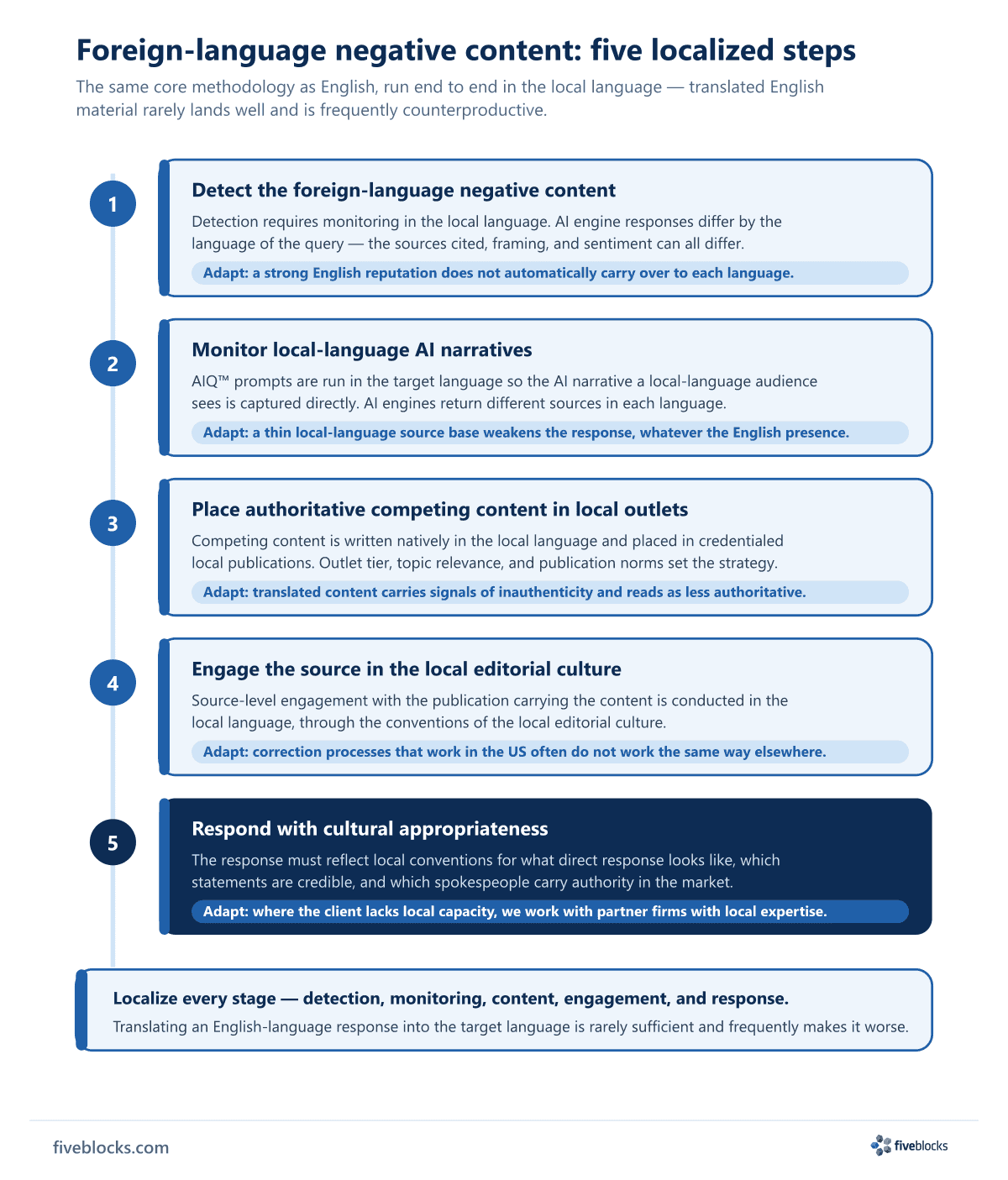
Step 1, identify the foreign-language negative content
Detection requires monitoring in the local language. AI engine responses differ materially depending on the language of the query. The sources cited, the framing, and the sentiment can all differ from what an English-language search surfaces. A strong English-language reputation does not carry over on its own; each language environment has to be monitored on its own terms.
Step 2, monitor local-language AI narratives
AIQ™ prompts are run in the target language to capture the AI narrative a local-language audience actually sees. AI engines return different sources in each language, and a strong English-language presence does not guarantee an accurate response in French, German, Spanish, or any other language if the local-language source base is thin.
Step 3, place competing content in local outlets
Competing content is written natively in the local language and placed in credentialed local publications. Content translated from English almost always reads as inauthentic and is less likely to be treated as authoritative by local editors, local-language AI engines, or local audiences. The outlet tier, topic relevance, and publication norms of the target market determine the placement strategy.
Step 4, engage at the source in the local editorial culture
Source-level engagement with the publication that carries the negative content is done in the local language and through the conventions of the local editorial culture. Correction and engagement processes that work in the United States often do not work the same way elsewhere. Relationship norms, what counts as a credible rebuttal, which statements matter, and which channels matter all vary by country.
Step 5, respond with cultural appropriateness
The response has to reflect local conventions for what direct response looks like, what kinds of statements are credible, and which spokespeople hold authority in the market. Where the client has no local capacity, we work with partner firms that have deep local expertise.
Last reviewed: 19/05/2026
