How do search results differ between Google.com and international Google domains?
Google.com and country-specific Google domains apply local ranking signals, so the same query returns different results across markets. The same brand query on google.com (US), google.de (Germany), and google.co.jp (Japan) can rank different URLs, surface different language Wikipedia versions, and weight different local citation patterns. Multinational reputation programs need per-market monitoring through GeoSearch and IMPACT™.
Google serves country-specific results that often diverge from the US picture. The same brand query on google.com from a New York IP, on google.de from a German IP, and on google.co.jp from a Japanese IP returns different SERPs, because each domain applies its own market-specific ranking signals.
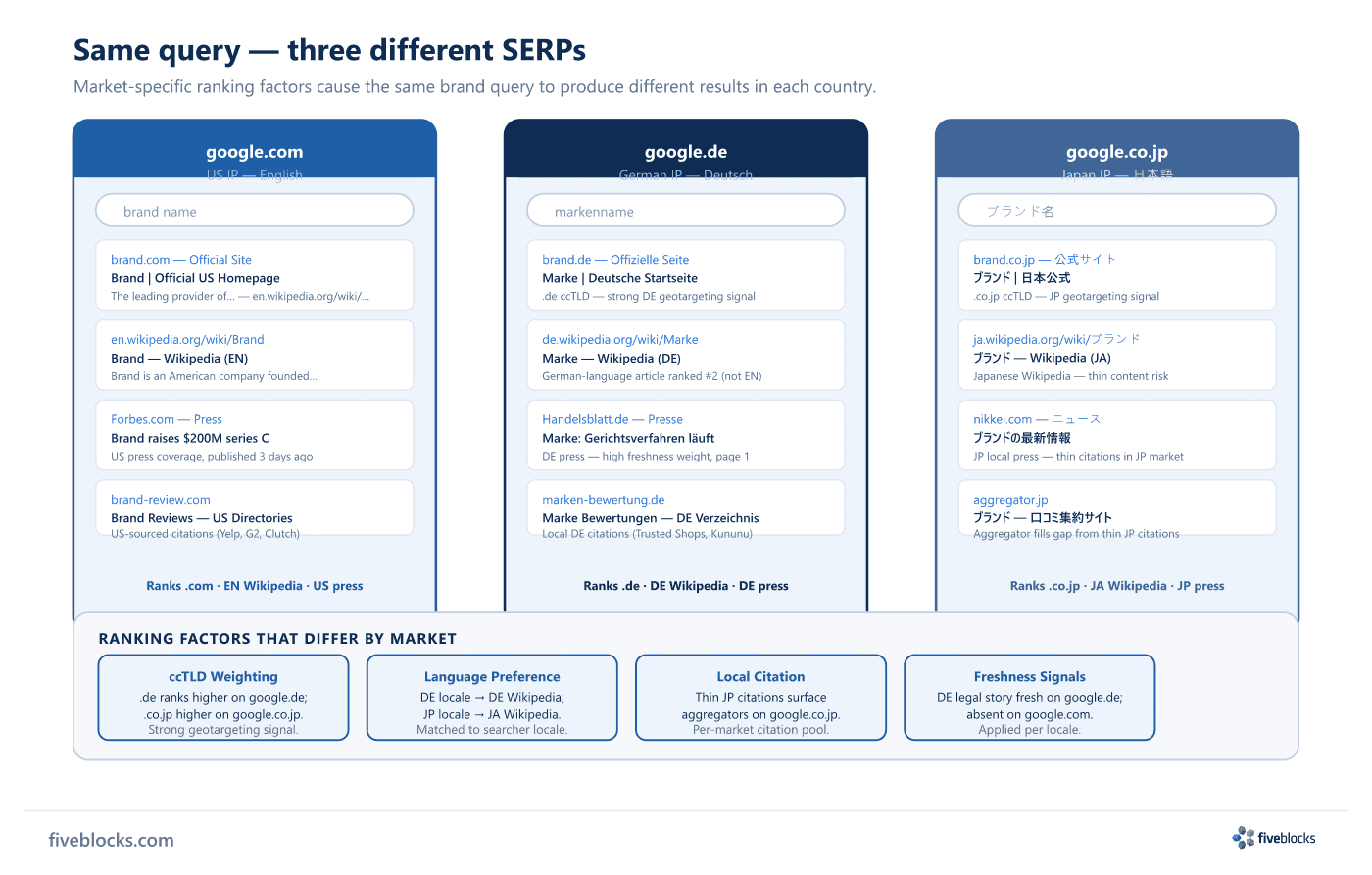
Ranking factors that differ by market
- ccTLD weighting
- Google has confirmed that local domain names tend to perform better in their home market. A
.dedomain ranking on page one of google.de may not rank at all on google.com, and the reverse holds too. Google treats country-code top-level domains as a strong geotargeting signal, so the brand’s own domain and its third-party coverage compete under different conditions in each country. - Language preference
- Google matches content language to the searcher’s locale settings and physical location. A query on google.de in German surfaces the German-language Wikipedia article and German press coverage ahead of English equivalents; the same name query in English on google.com surfaces the English Wikipedia and English-language press. A brand can have a clean narrative in one language version of Wikipedia and a contested one in another.
- Local citation and content prevalence
- Each market has its own pool of regional press coverage, local directory citations, and market-specific content. A brand with strong German media coverage will rank that coverage prominently on google.de. If the brand has thin local citation in Japan, google.co.jp may surface aggregators or less authoritative sources where the brand has no presence.
- Freshness signals
- Google applies freshness weighting per locale. A legal matter covered mainly by German press has a different freshness profile on google.de than on google.com, where that coverage may be absent or ranked much lower.
- Physical location of the searcher
- Both the country domain and the user’s physical IP location shape results. A German user searching from Italy sees a blend of signals from both countries. So the same investor running diligence from different locations can encounter different reputation pictures for the same entity.
What this means for reputation programs
An investor base across Europe, Asia, and the Americas forms different first impressions of the same company or executive. A contested article that ranks on page one of google.de but not on google.com means London-based and Frankfurt-based analysts see a different picture than their New York counterparts. A program that tracks only the US picture misses most of a multinational client’s search footprint.
The per-market monitoring response
GeoSearch simulates the country-specific Google view from any source location, so the program can see what a German user, a Japanese user, or a Brazilian user actually encounters for priority queries. IMPACT™ covers 69 countries, 23 languages, and 500 locations, giving daily readings per market rather than a single aggregated global figure. AIQ™ adds the AI engine dimension: AI engines also vary their responses by user locale and language, so a brand described well in English-language AI responses may be described very differently, or not at all, in German or Japanese ones. Monthly reporting covers per-market SERP and AI narrative progress separately.
Last reviewed: 19/05/2026
