How do you manage search results across different geographies?
Quick answer
Manage geographic search by viewing Google as a searcher sees it in each market, then closing the gaps per market: regional content where the audience needs it, country-specific domains or subfolders, local entity signals, and language-aware AI monitoring through AIQ. Progress is reported per market.
Google’s results differ by country, city, language, and device, so a multi-market reputation program has to track each market on its own rather than reporting from a single location. Start by seeing each market as a local searcher sees it, then build market-specific strategies only where the data shows they are needed.
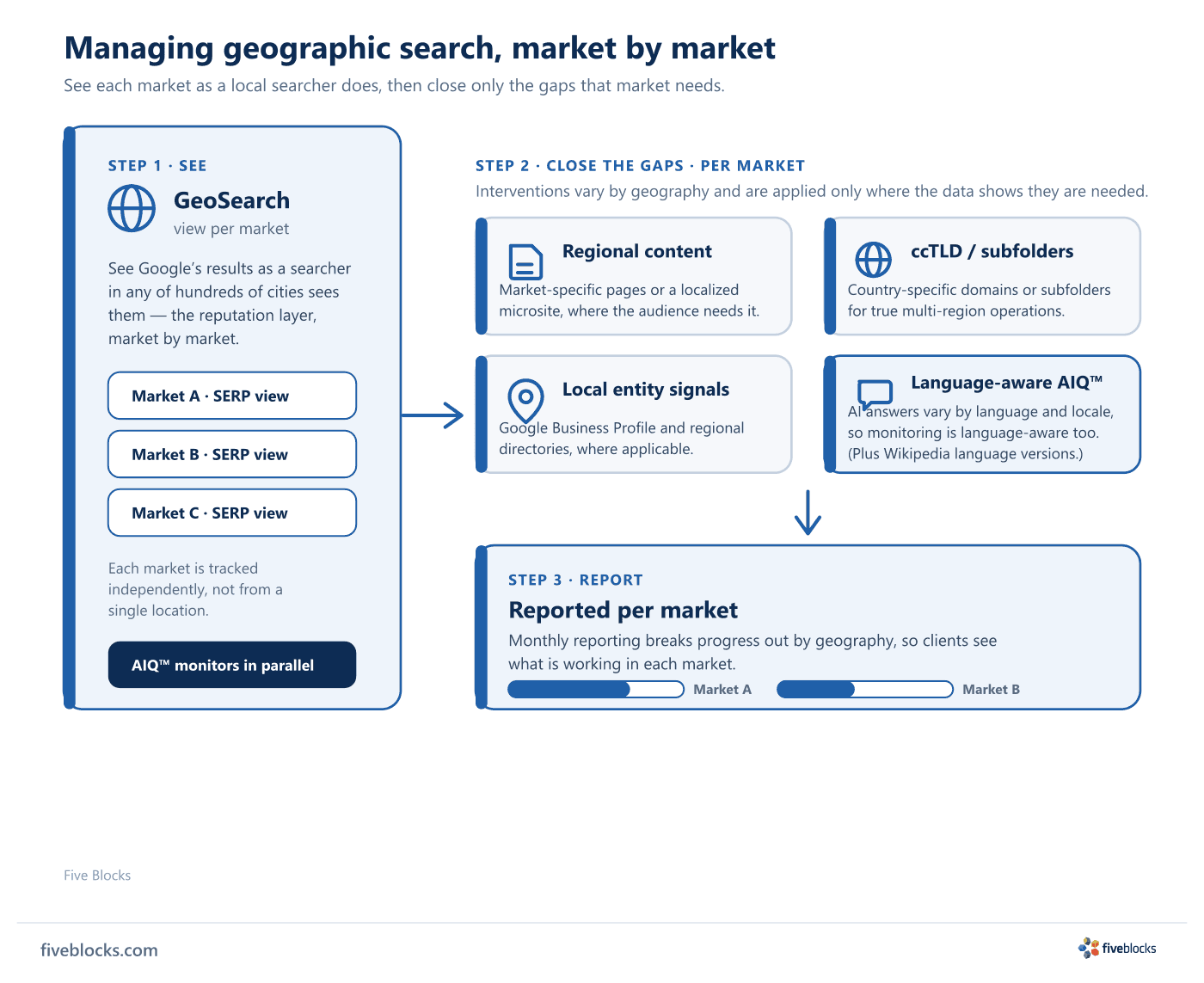
How the approach works
- See Google in each market. We use GeoSearch to view the SERP as a searcher in any of hundreds of cities sees it, so we know what the reputation layer actually looks like market by market.
- Target the gaps per market. The interventions vary by geography and are applied only where needed (see below).
- Monitor AI engines in parallel. AIQ runs alongside the search work, because AI responses also vary by language and locale.
- Report per market. Monthly reporting breaks progress out by geography so clients can see what is working in each market.
Market-specific interventions
- Regional content: market-specific information on the corporate site, or a localized microsite, where the audience needs it.
- Country-specific domains or subfolders: ccTLDs or subfolders for true multi-region operations.
- Local entity signals: Google Business Profile and regional directories where applicable.
- Wikipedia language versions: language-version work where notability supports it.
Last reviewed: 19/05/2026
