What is Five Blocks’ approach to geographic search management?
Five Blocks uses GeoSearch and IMPACT to track Google results across 500 cities, 69 countries, and 23 languages, then plans and runs a separate strategy for each location and language. Results in Paris in French and Berlin in German differ from results in the US in English.
Reputation on Google is not one result; it is hundreds of different results, one per market. A search run from Paris in French, Berlin in German, or New York in English returns different pages, different SERP features, and a different threat profile for the same brand. Five Blocks uses GeoSearch and IMPACT™ to track and manage that complexity, covering 500 cities, 69 countries, and 23 languages.
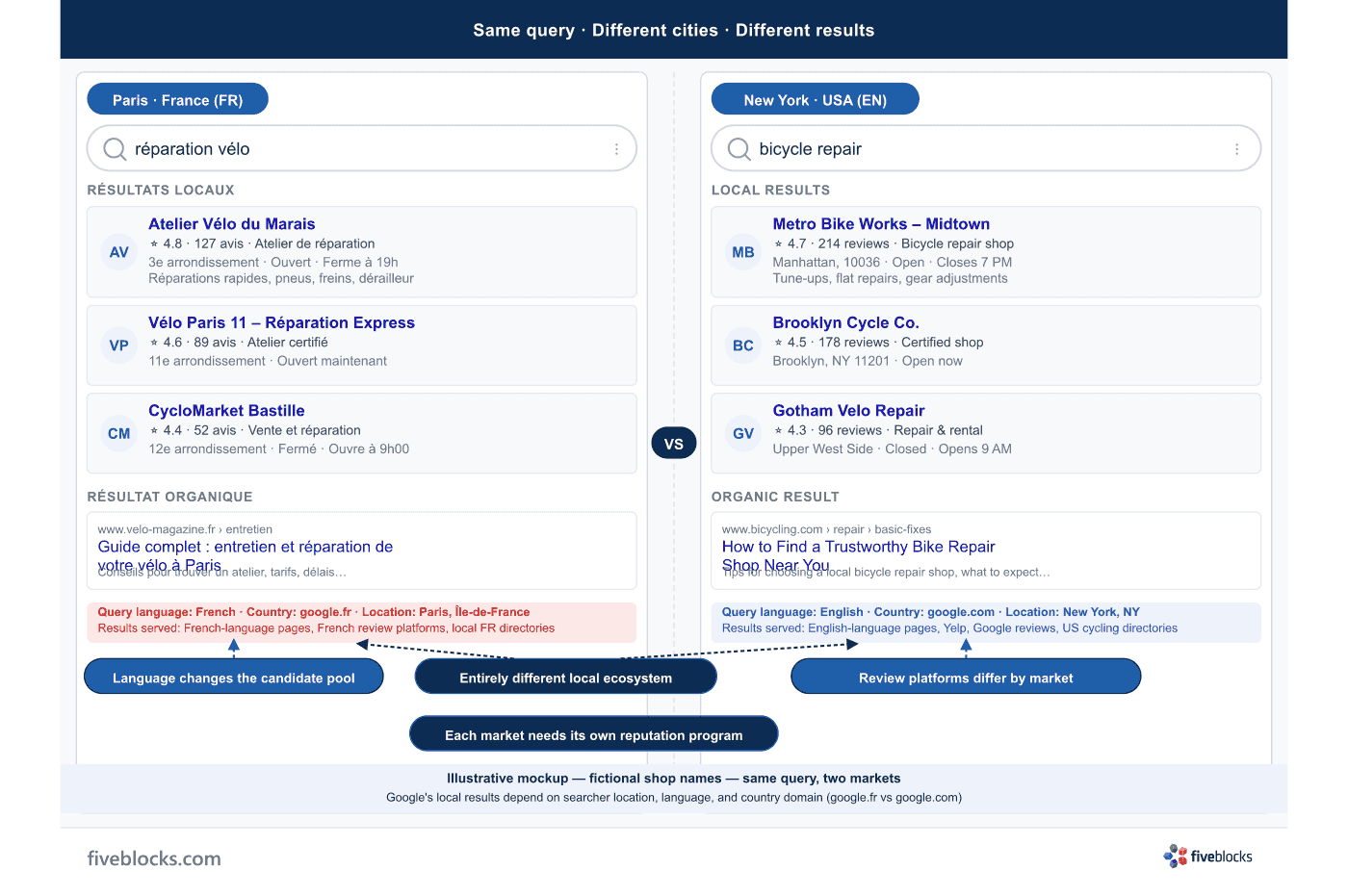
Why results differ by market
Google’s ranking algorithm factors in the searcher’s physical location, the language of the query, and country-specific signals when deciding what to surface. Google itself confirms: “Searching for bicycle repair shops would show different results to a user in Paris than it would to a user in Hong Kong.” A few mechanisms drive the variation:
- Language matching: Google tries to surface pages in the language of the searcher, so a French-language query returns a different candidate set than an English-language query for the same brand.
- Country-code domains (ccTLDs): On country-specific Google domains, matching ccTLD pages (e.g., .de on google.de) get a ranking preference over generic domains.
- Regional entity signals: Country-specific subfolders, hreflang tags, and local Google Business Profiles all affect which version of a page surfaces in each market.
- Local content ecosystems: The third-party press, directories, and review platforms that rank vary by country, so the threat profile differs even when the brand is the same.
How Five Blocks manages geographic reputation
For each priority market, Five Blocks sets up dedicated tracking in the local language at the city level, for example Paris in French or Berlin in German, and treats each one as a separate program rather than a variant of a single English-language campaign. The workflow for each market has four parts:
- Market-specific SERP mapping: IMPACT™ runs continuous geo-specific queries and classifies every ranking URL by ownership, SERP feature, and competitive position for that location and language.
- Language-layer diagnostic: The threat and opportunity profile is assessed on its own per market. A result that is neutral in English may be hostile in German or absent in French.
- Market-specific intervention: Content, entity, and authority work is planned to the standards of the local search environment, including hreflang implementation, ccTLD signals, and sourcing in local-language outlets the engines weight in that market.
- AI narrative by market: AI engines also respond differently to the same prompt depending on language and user location, so the AIQ™ monitoring layer is configured per language alongside the Google tracking.
What this means for global brands: A SERP that looks clean from New York can carry hostile results in Frankfurt or return thin, inaccurate AI responses in French. Geographic reputation management means treating each priority market as its own diagnostic and intervention program, not as a translation of the English campaign.
Last reviewed: 19/05/2026
