How does multilingual content affect search reputation?
When stakeholders search in their native language, an English-only digital footprint produces weaker results in those markets. Multilingual search reputation requires canonical translations with hreflang tags, language-specific Wikipedia articles with their own editorial communities, localized authoritative coverage, and AI monitoring run in each target language.
When stakeholders in different markets prefer to search in their local language, an English-only digital footprint returns weaker results there. A strong English Wikipedia article does not carry its strength into German, French, or Spanish searches. Each language version is a separate article, maintained by its own editorial community, and indexed as its own signal in that language’s Google market. Multilingual search reputation runs at several levels at once.
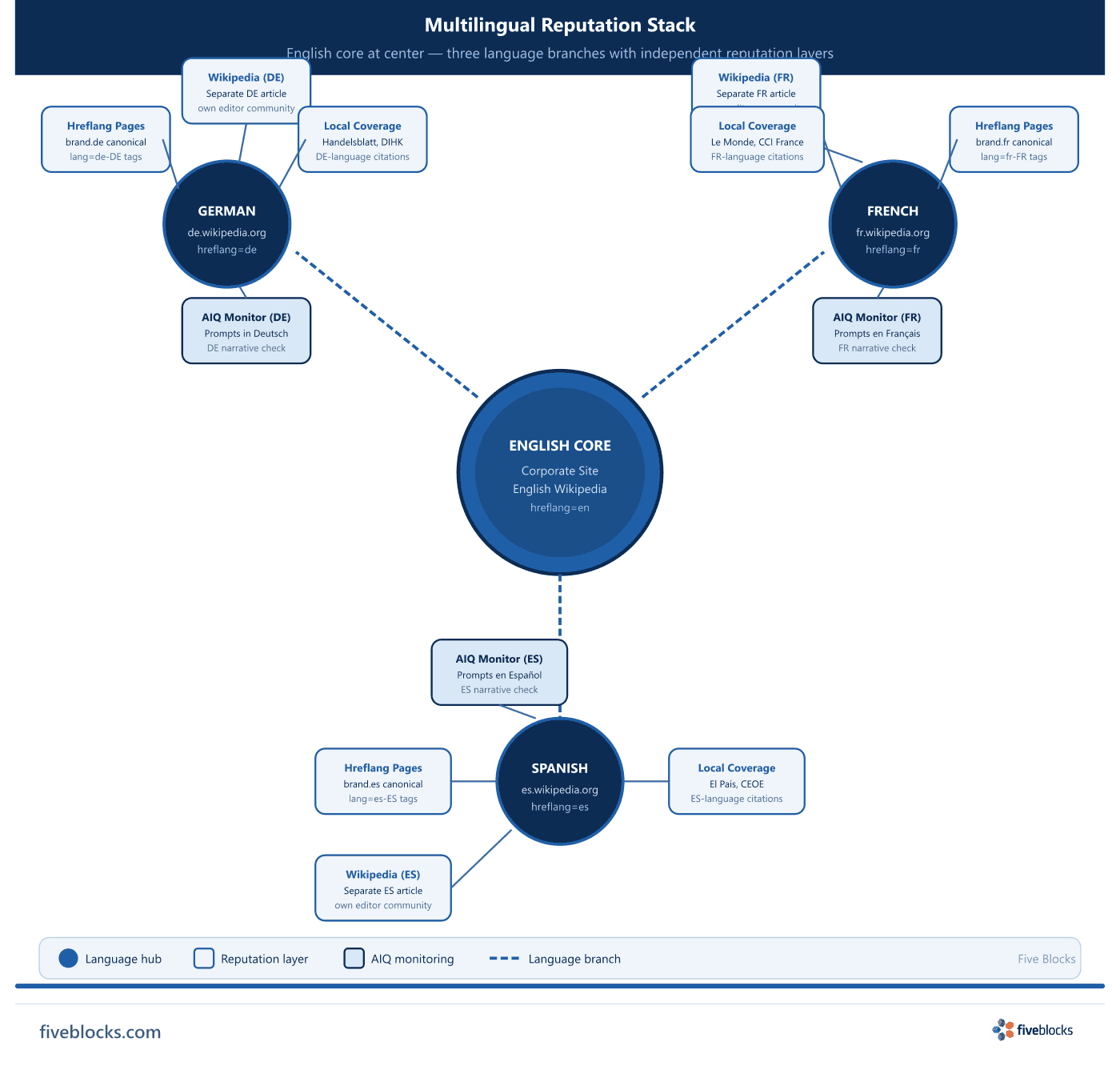
Step 1, canonical translations with hreflang tags
Translate the core pages of the corporate site into each priority language and add hreflang tags so Google knows which language version to serve to which user. Without hreflang, Google may surface the wrong language version or underweight the translated page for local searches.
Step 2, language-specific Wikipedia articles
The German, French, and Spanish Wikipedias each have their own editor communities and editorial standards. They did not simply inherit the rules of the English Wikipedia, and they have since diverged. A subject with a well-maintained English article may have a thin, inaccurate, or nonexistent article in another language, and that gap shows up directly in local AI engine responses, which draw from whichever sources exist in the query language. Build and maintain articles in the Wikipedia language editions that match priority markets, where notability and sourcing standards in those communities support it.
Step 3, localized authoritative content
Press coverage, association membership, regional directories, and credentialed third-party citations in the local language strengthen the source layer that AI engines and Google draw on for local-language queries. Translated versions of English content are weaker than natively produced local-language content; the engines weight local sourcing heavily for local queries.
Step 4, schema markup that reflects the language variant
Schema markup and structured data on each page should reflect that page’s language variant. This helps Google and AI crawlers attribute the page to the right entity across language contexts, keeping the Knowledge Panel and entity signals consistent across markets.
Step 5, AIQ monitoring in each target language
AI engines treat language as a major contextual signal: the same question asked in French returns different sources, cites different Wikipedia content, and can produce a different narrative than the same question asked in English. Run AIQ prompts in each priority language to track how the local-language AI engine response describes the entity, and to catch gaps or distortions that English-only monitoring never sees.
Last reviewed: 19/05/2026
