What is the role of domain authority in reputation management?
Domain authority is a third-party shorthand for the cumulative trust signals a domain has built up over time. Reputation work invests in it on owned domains and uses it as a placement criterion for earned coverage on already-trusted sites, rather than chasing link volume.
Domain authority is shorthand for the trust signals a domain has built up over time. It is not an official Google metric; it is a third-party concept, popularized by SEO tool vendors, that describes how much trust a domain has accumulated. Google does confirm that ranking is shaped by signals such as whether other prominent sites link to a page, the site’s overall quality, and freshness.
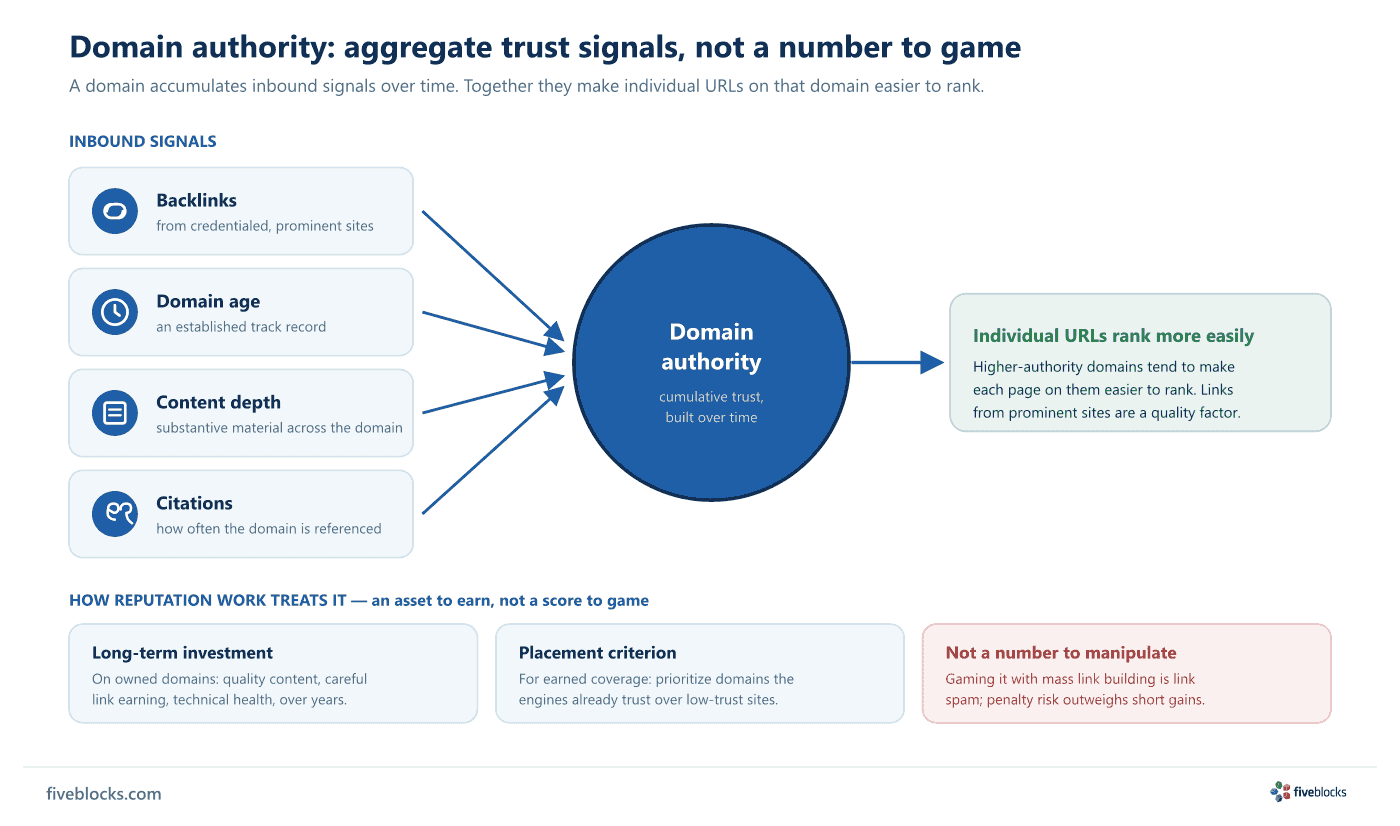
What feeds a domain’s authority
The concept is generally understood to aggregate several inbound signals:
- Backlinks from credentialed, prominent sites
- Domain age and an established track record
- Content depth across the domain
- Citation patterns and how often the domain is referenced elsewhere
Google confirms that links from prominent websites are one factor it uses to assess quality, so higher-authority domains tend to make individual URLs easier to rank. This is why coverage on an established, widely-cited outlet often surfaces ahead of comparable content on a little-known site.
How reputation work treats it
Good programs treat domain authority two ways:
- As a long-term investment on owned domains: sustained quality content, careful link earning, and technical health, built up over months and years.
- As a placement criterion for earned work: prioritizing coverage on domains the engines already trust, rather than publishing on low-trust sites.
The failure mode: treating it as a number to game
The mistake is treating domain authority as a score to inflate through volume tactics, mass link building and similar manipulation. Google’s spam policies target this directly: the engine defines link spam as “creating links to or from a site primarily for the purpose of manipulating search rankings,” and it acts against that behavior. The short-term gains from such tactics rarely outweigh the penalty risk, which is why reputation work that lasts earns authority rather than manufacturing it.
Last reviewed: 19/05/2026
