What is the role of anchor text in reputation management?
Anchor text - the clickable words in an inbound link - tells Google what the linked page is about. Natural, branded, and contextually relevant anchors build legitimate authority; exact-match commercial anchors repeated at scale trigger algorithmic penalties and degrade the entity over time.
Anchor text, the clickable words in an inbound link, is one of Google’s oldest ranking signals. The pattern of anchor text across a page’s inbound links tells Google what that page is about, which is why reputation work treats it as a discipline rather than a lever to pull.
Used naturally, anchor text does its job: a Forbes article links to the brand using the brand name, a partner site links using the founder’s name and title, an industry association links with descriptive context. The failure mode, common in old-school SEO and still found at some agencies, is exact-match commercial anchor text at scale: dozens of inbound links all saying “best executive coach” or “top investment firm.” That pattern triggers algorithmic penalties and degrades the entity.
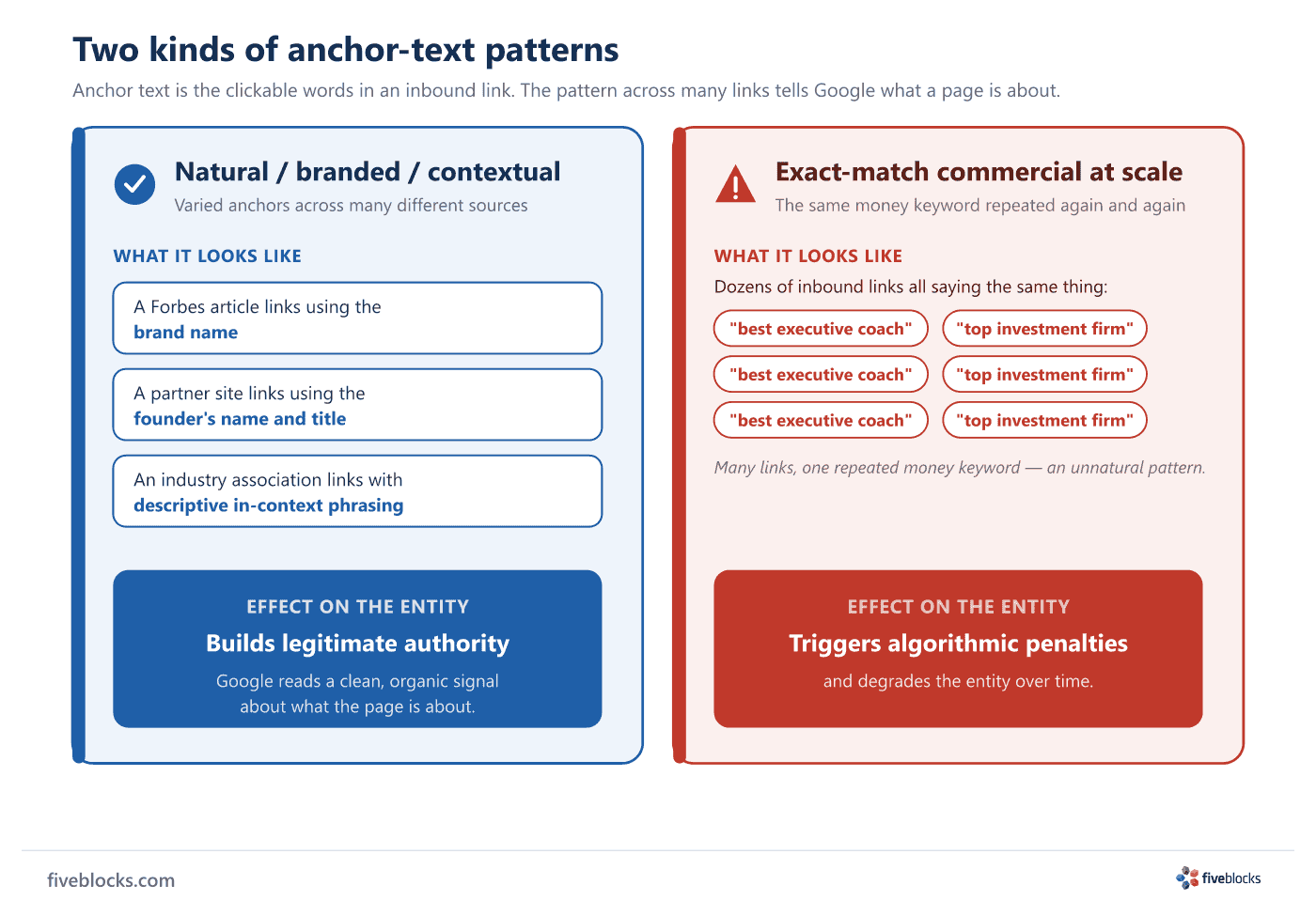
Two kinds of anchor-text patterns
| Anchor-text pattern | What it looks like | Effect on the entity |
|---|---|---|
| Natural / branded / contextual | Links use the brand name, a person’s name and title, or descriptive in-context phrasing, varied across many different sources. | Builds legitimate authority. Google reads a clean, organic signal about what the page is about. |
| Exact-match commercial at scale | Many inbound links repeat the same money keyword (“best executive coach,” “top investment firm”). | Triggers algorithmic penalties and degrades the entity over time. |
How we handle it
- Keep anchors natural, branded, and contextually appropriate on owned campaigns.
- Audit for over-optimized exact-match patterns during diagnostics on legacy footprints we inherit.
Last reviewed: 19/05/2026
