How do you build backlinks to positive content for reputation management?
Authoritative backlinks come from a few durable sources: original content that earns citation, named bylines on credentialed outlets, partner and association links that reflect real relationships, and structured PR placements. Volume tactics like private blog networks, scaled guest posts, and paid link exchanges trigger algorithmic penalties, so the discipline is to earn links through those channels and disavow manipulated ones inherited from legacy SEO work.
Backlinks are still a ranking signal, but for well over a decade Google’s algorithm has been built to tell authoritative links apart from manipulated ones. Natural, relevant links are rewarded while spammy ones are downgraded. The job is to earn links through durable, credentialed channels rather than manufacture them at volume.
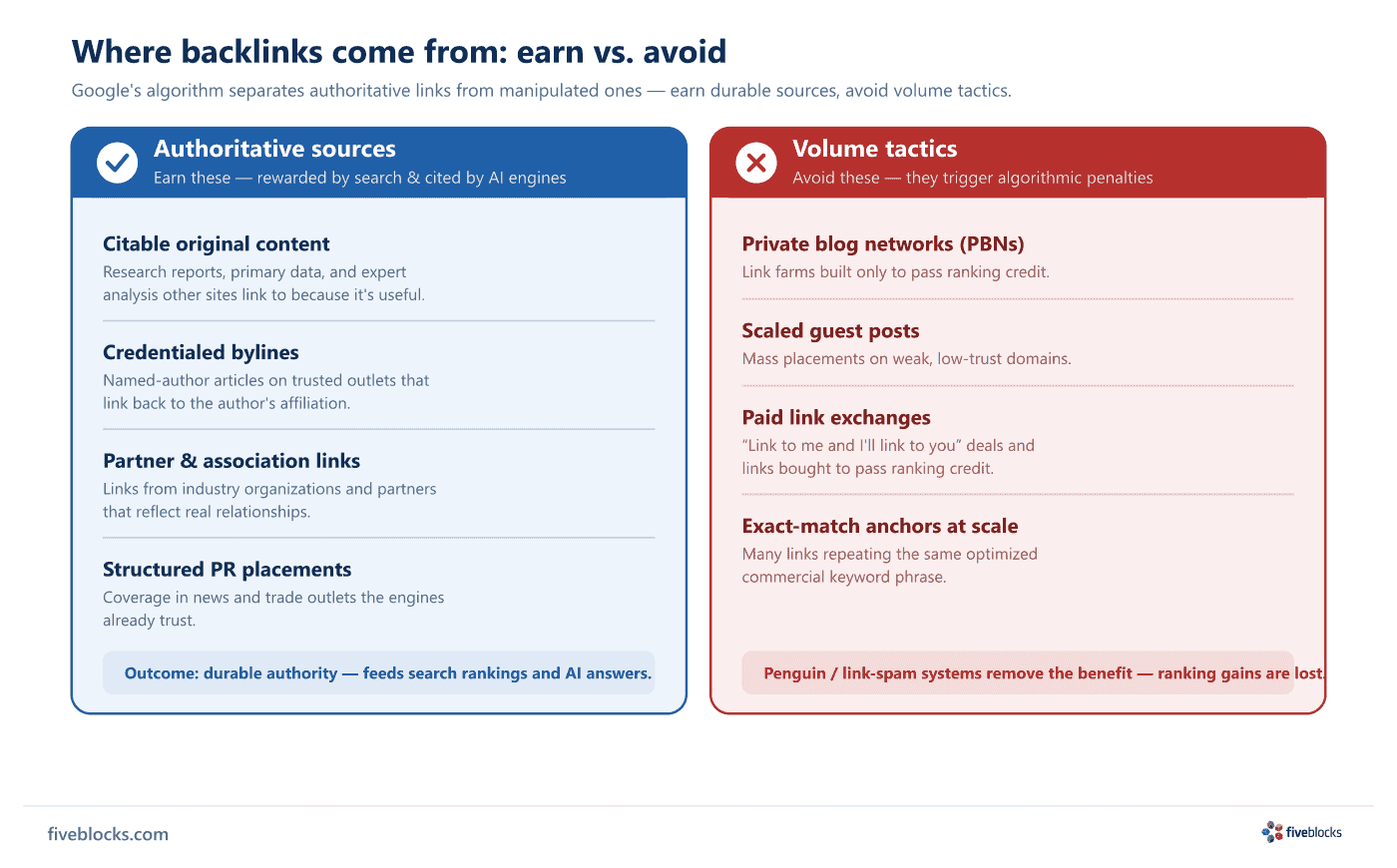
Authoritative sources vs. volume tactics
| Authoritative sources (earn these) | Volume tactics (avoid these) |
|---|---|
| Citable original content, research reports, primary data, and expert analysis that other sites link to because it is genuinely useful | Private blog networks (PBNs), link farms built only to pass ranking credit |
| Credentialed bylines, named author articles on trusted outlets that link back to the author’s affiliation | Scaled guest posts, mass placements on weak domains |
| Partner and association links, links from industry organizations and partners that reflect real relationships | Paid link exchanges, “link to me and I’ll link to you” arrangements and links bought to pass ranking credit |
| Structured PR placements, coverage in news and trade outlets the engines already trust | Exact-match commercial anchors at scale, many links repeating the same optimized keyword phrase |
Google’s spam policies are explicit on the second column: link spam is “the practice of creating links to or from a site primarily for the purpose of manipulating search rankings,” and it specifically names “excessive link exchanges” and paid links that pass ranking credit. Google’s Penguin system was introduced to penalize this kind of manipulative link building, and when its systems remove the effect of spammy links, any ranking benefit those links previously generated is lost.
Why authoritative links also feed AI engines
The durable channels work on both fronts. Properly anchored coverage on credentialed outlets can enter the source pools that AI engines retrieve from and cite, so links earned this way shape both traditional search rankings and AI-generated answers. Volume tactics on low-trust domains do not get into those source pools.
Auditing and disavowing legacy links
For clients carrying old SEO work, the diagnostic phase audits the existing backlink profile and disavows the manipulated links before building forward. Google’s disavow tool exists for this: it tells the engine which questionable inbound links to ignore. The sequence is consistent. Clean up the manipulated footprint first, then build authority through the durable channels.
Last reviewed: 19/05/2026
