What is domain strategy for reputation management?
Domain strategy in reputation work consolidates authority on the canonical entity home. Own the primary .com plus the relevant variants and country-code domains, redirect strategic mismatches and acquired variants to the canonical site so their authority consolidates rather than fragments, and use subdomains or microsites carefully for genuinely distinct programs. Scattered domains split entity signals and authority; a consolidated structure concentrates them on one home.
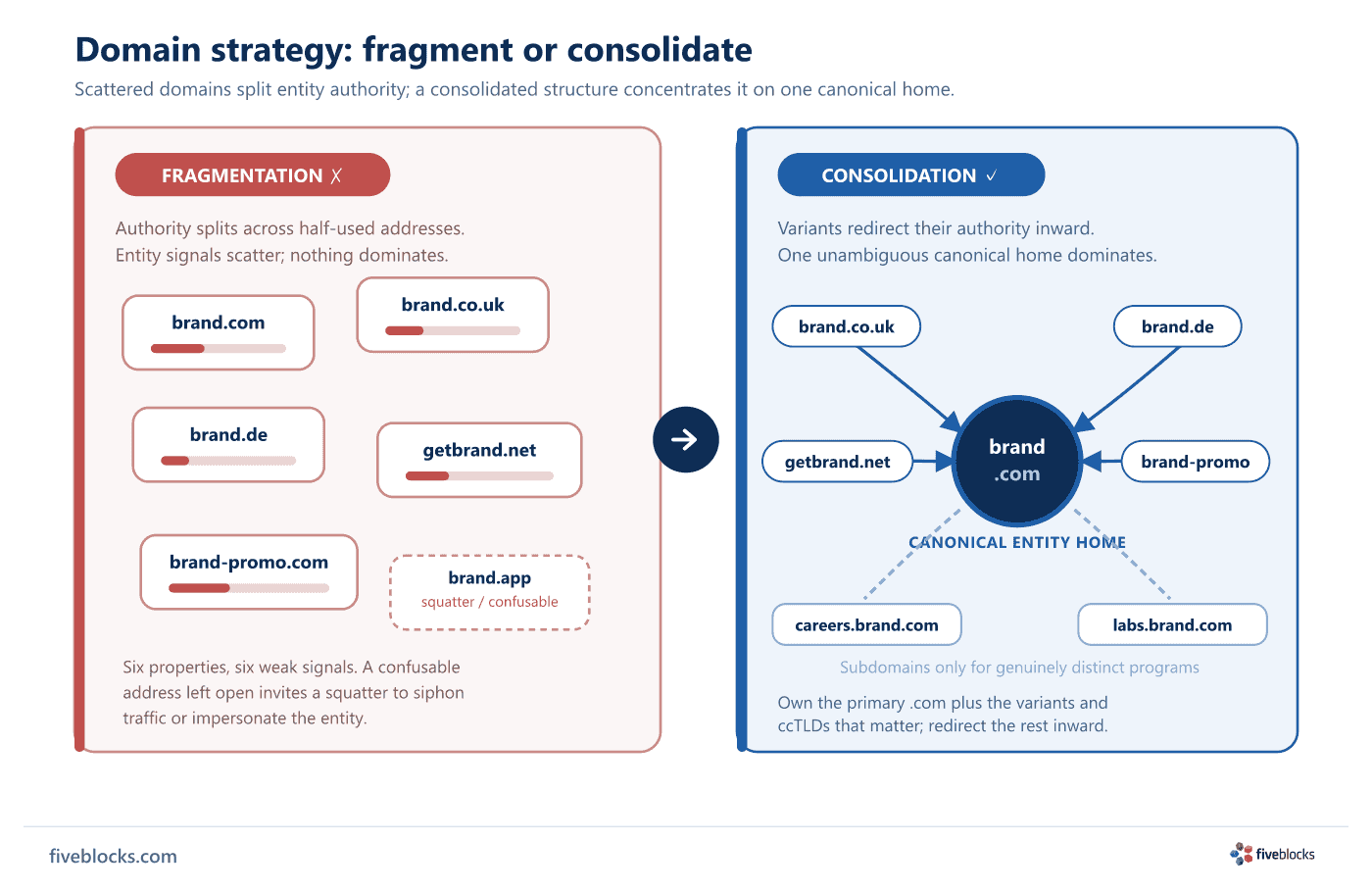
Domain strategy in reputation work consolidates authority on the canonical entity home and closes off gaps others could exploit. Scattered domains fragment entity signals and split authority; a consolidated structure concentrates it on one home. There are three moves.
1. Own the primary domain and the variants that matter
Own the primary .com along with the relevant variants and country-code (ccTLD) domains. This does two things: it protects the brand, and it stops a bad actor or squatter from occupying a confusable address that could siphon traffic or impersonate the entity.
2. Redirect strategic mismatches to the canonical site
Redirect strategic mismatches and acquired variants to the canonical site, so their authority consolidates onto the entity home rather than fragmenting across half-used addresses. Every redirected variant reinforces the one canonical destination instead of competing with it.
3. Use subdomains and microsites carefully
Use subdomains or microsites only for genuinely distinct programs, and structure them so they reinforce the main domain rather than dilute it. Too many microsites is a common mistake that weakens the entity rather than extending it.
The principle underneath
The logic is the same across all three moves: scattered domains fragment entity signals and split authority, while a consolidated structure concentrates it on a single, unambiguous canonical home. We advise on domain structure as part of building a coherent owned layer, because the goal is one strong canonical home rather than a sprawl of half-authoritative properties.
Last reviewed: 20/05/2026
