Can ORM efforts backfire and draw more attention to the negative content?
Yes. Clumsy ORM tactics such as link schemes, networks of thin sites, and keyword-stuffed pages can trigger search-engine penalties and worsen the situation rather than improve it. The same reputation goal pursued through authoritative content and legitimate channels holds up over time; manipulation or heavy-handed suppression deepens the damage.
Reputation work can backfire, and knowing the specific failure modes is part of doing it responsibly. Search engines have enforced against manipulative tactics for more than a decade. Pursue the same goal with authoritative content and legitimate channels and the results hold; use manipulation or heavy-handed suppression and you can compound the original damage.
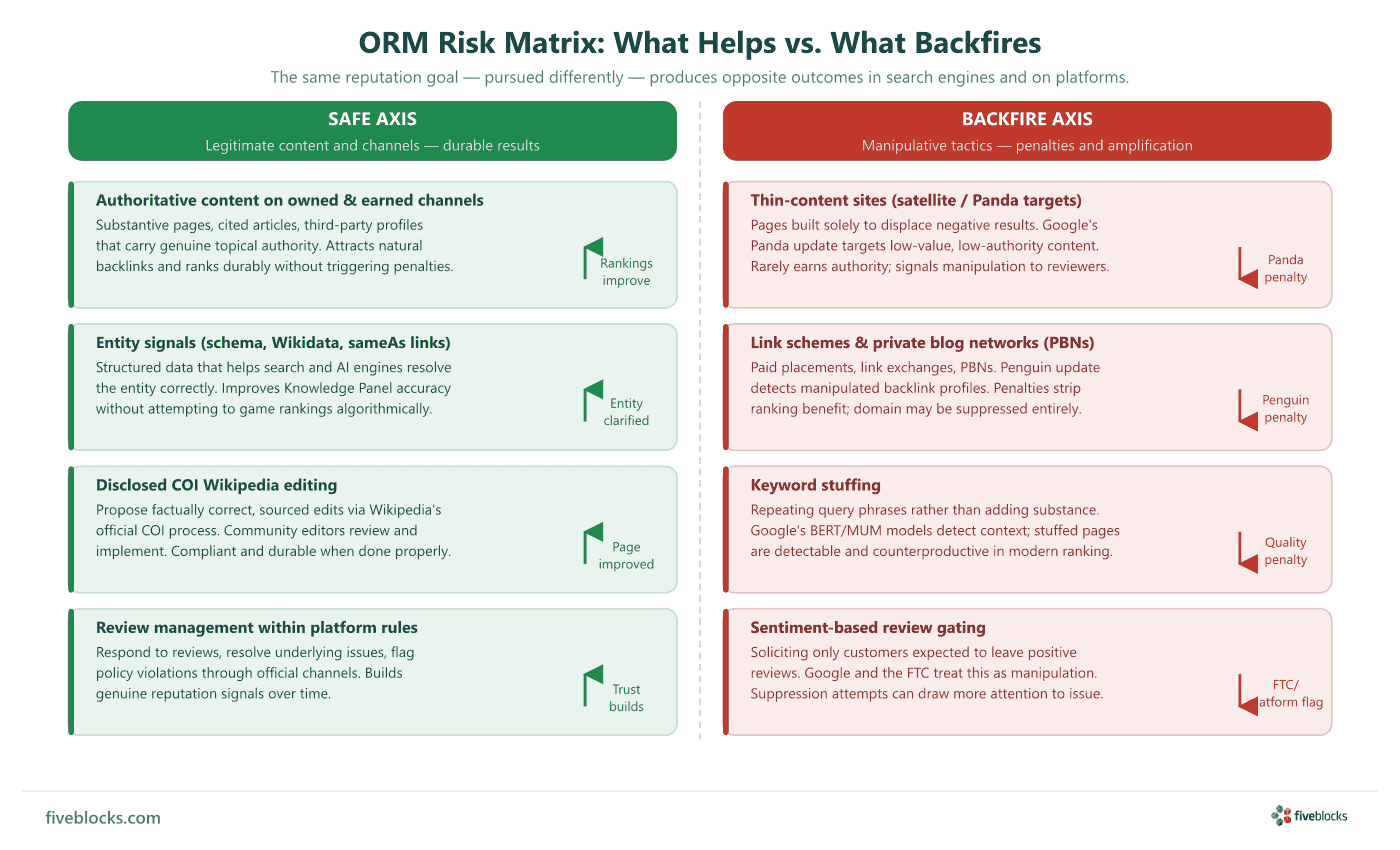
Tactics that invite search-engine scrutiny
Google’s spam policies prohibit the tactics most often associated with aggressive ORM, and violations result in ranking penalties, the opposite of what the work set out to do:
- Link schemes and private blog networks. Google’s algorithm has separated authoritative backlinks from manipulated ones for more than a decade. Volume-based tactics such as private blog networks, excessive link exchanges, and paid link placements trigger algorithmic penalties that strip the ranking benefit and can suppress the penalised domain entirely.
- Thin-content sites. Google’s Panda update and its successors target sites that are low-value or exist mainly to push content rather than inform users. Pages built solely to displace negative results rarely earn the authority needed to rank, and reviewers read them as manipulation.
- Keyword stuffing. Google’s BERT and MUM language models read context, which makes keyword-stuffed pages easy to detect and counterproductive. Repeating a query phrase instead of adding substance no longer fools a modern ranking system.
- Exact-match commercial anchor text at scale. Large volumes of inbound links with identical optimised anchor text are a classic manipulation signal. Google’s spam update guidance names guest posts and press releases with links that pass ranking credit as a violation.
The amplification risk: Aggressive suppression can draw the attention it is trying to avoid. When an attempt to remove or bury content is itself discovered, by a journalist, a platform enforcer, or a competitor, the story shifts from the original issue to the suppression effort, and the narrative grows rather than shrinks. This is most acute when the tactic is visibly heavy-handed (for example, legal threats against a small site or mass-flagging of reviews) or when it involves platforms whose policies prohibit it.
What legitimate tactics look like instead
The alternative is not passivity. It is choosing moves that search engines and platforms reward rather than penalise:
- Authoritative content on owned and earned channels. Substantive pages, cited articles, and third-party profiles that carry real topical authority and attract natural backlinks.
- Entity signals (schema, Wikidata, sameAs links). Structured data that helps search and AI engines resolve the entity correctly and surface the right information, instead of tactics that try to game rankings.
- Disclosed conflict-of-interest editing on Wikipedia. Contributing factually correct, sourced information through the platform’s own COI process, rather than undisclosed editing, which Wikipedia’s volunteer editors detect and revert.
- Review management within platform rules. Responding to reviews, fixing the underlying issues, and flagging policy violations through official channels. Sentiment-based review gating, soliciting only customers expected to leave positive reviews, is treated as manipulation by Google and the FTC.
Specialist judgment matters because the line between a legitimate tactic and a penalisable one is not always obvious. The same intent, improving how a company appears in search, leads to durable improvement with one approach and accelerated damage with another.
Last reviewed: 20/05/2026
