Why do undisclosed Wikipedia edits backfire?
Undisclosed Wikipedia edits backfire because experienced editors reliably spot the patterns, such as single-purpose accounts, promotional language, and syndicated press citations, and respond by reverting the edits in full, tagging the article, leaving a public Talk-page record, and sometimes blocking the account. The article often ends up worse than it would have through the disclosed conflict-of-interest route, which is why that slower path is the only one with a positive expected value.
Editing a Wikipedia article on behalf of a company or person without disclosing the relationship does not fail quietly. It backfires in several ways, and each one makes the next worse. Following the sequence step by step shows why the disclosed conflict-of-interest route, slower as it is, is the only approach with a positive expected value.
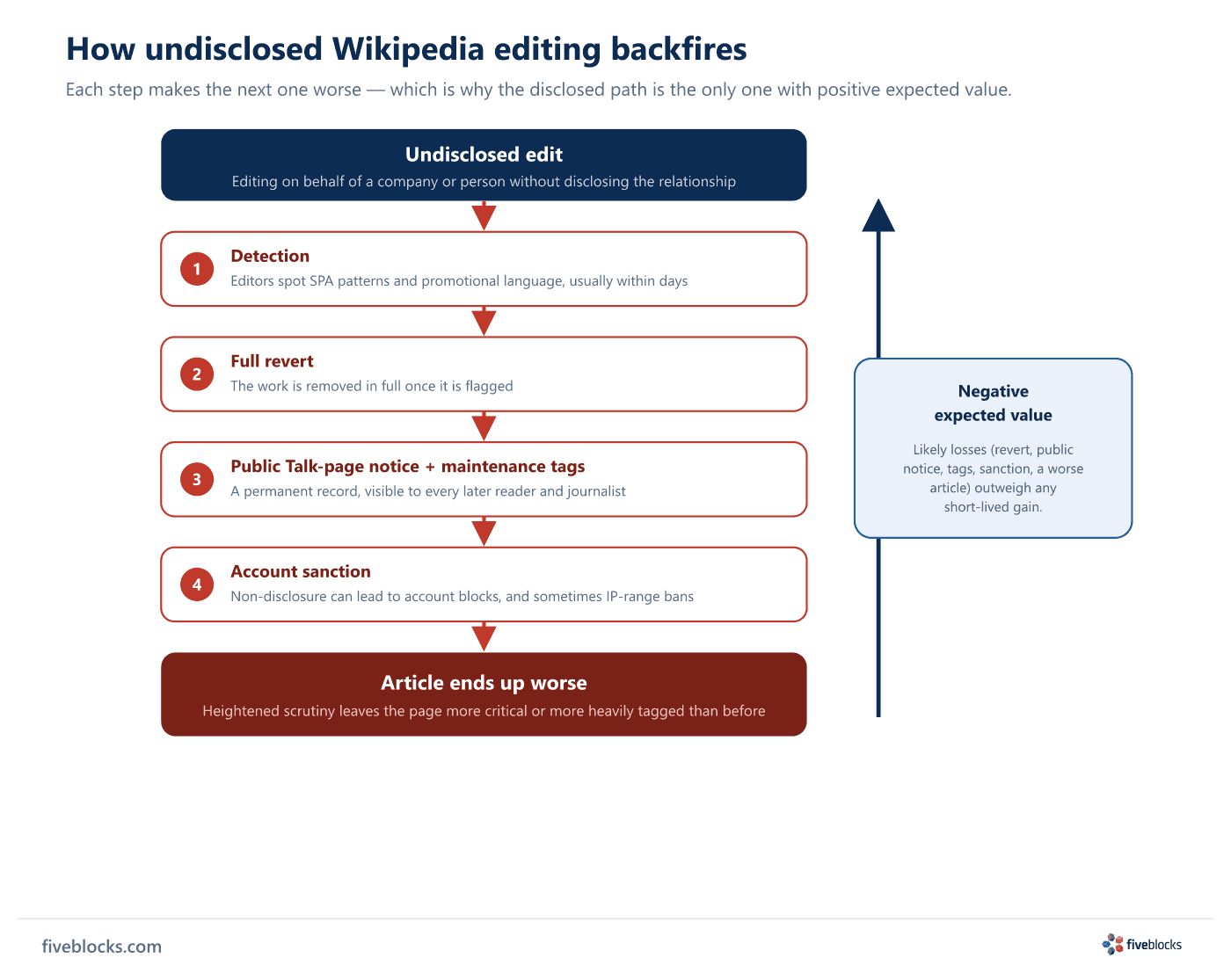
How undisclosed editing backfires, step by step
- Detection is consistent. Experienced editors recognize the patterns, such as single-purpose accounts editing one company’s article, promotional language, syndicated press citations, and suspiciously coordinated edits, and routinely catch them within days.
- The edits get reverted in full. Once flagged, the work is removed, often with a public Talk-page notice naming the suspected undisclosed editor and explaining why it was taken down.
- The article gets tagged. Maintenance notices go up that every later reader can see, signaling that the page has been edited by someone who did not follow the rules.
- The Talk page becomes a permanent record. The detection is logged where future editors, and journalists, can find it, so the episode outlasts the reverted edit.
- The account may be blocked. Non-disclosure of paid editing can lead to account blocks and, in some cases, IP-range bans.
- The article often ends up worse. Because the community now has reason to scrutinize every claim, the page can be left more critical or more heavily tagged than if the change had been proposed properly in the first place.
The cost-benefit math points the same way every time. The expected value of undisclosed editing is negative, because the likely outcomes (revert, public notice, tags, a blocked account, a worse article) outweigh any short-lived gain. The disclosed conflict-of-interest route, proposing the change on the Talk page with reliable sources and letting independent editors decide, is slower, but it is the only path with a positive expected value.
Last reviewed: 19/05/2026
