What are the biggest mistakes companies make with Wikipedia?
The biggest Wikipedia mistakes companies make are undisclosed paid editing, promotional tone, direct edits by interested parties, ignoring the Talk-page process, treating Wikipedia like a press channel, and engaging editors confrontationally, each of which tends to get the work reverted and the article scrutinized.
Six mistakes recur across companies that try to manage their own Wikipedia articles, and each carries a consistent consequence: most often the work gets reverted and the article ends up under closer community scrutiny than before.
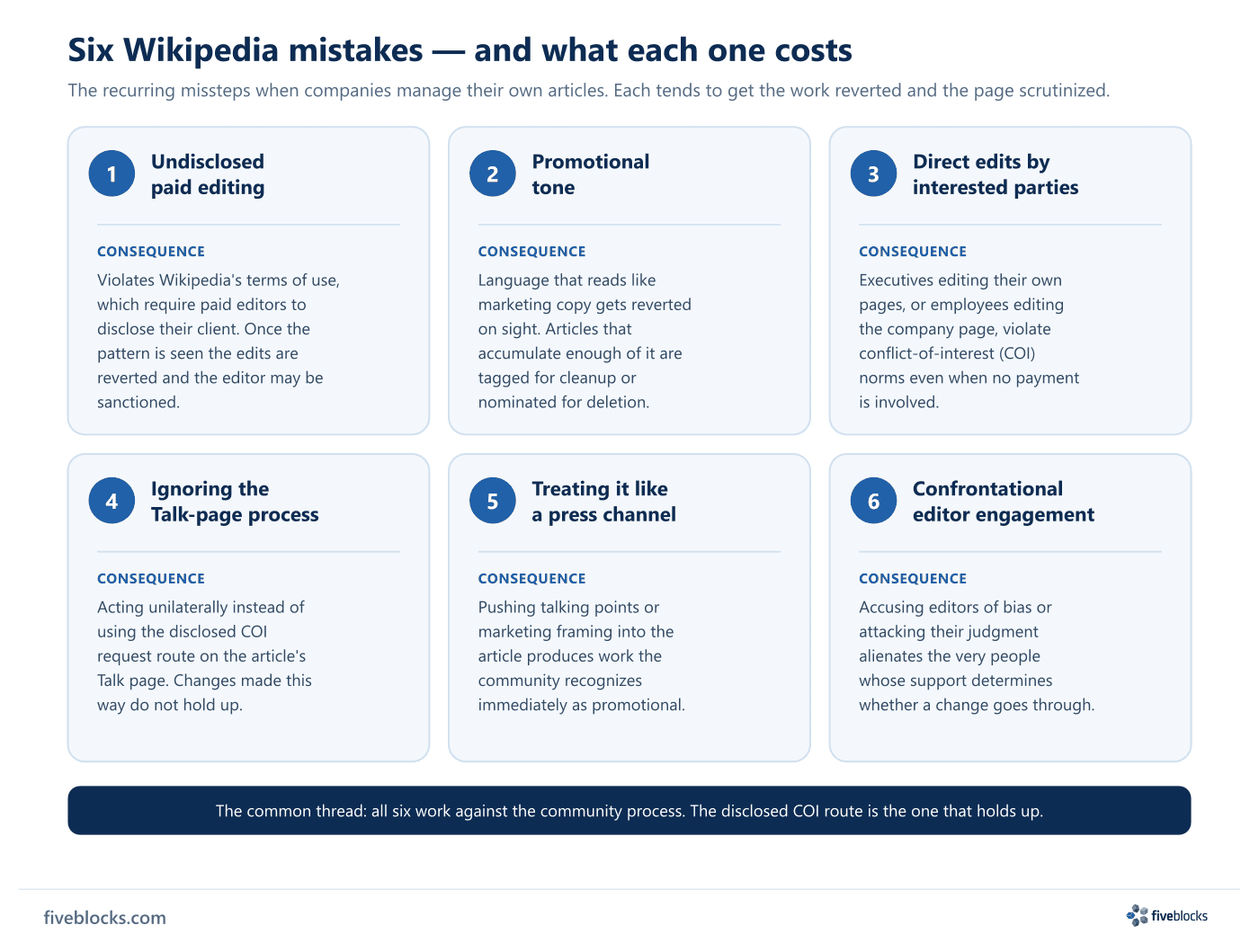
The six recurring mistakes
- 1. Undisclosed paid editing
- Editing on behalf of a company or client without disclosing the paid relationship. Wikipedia’s terms of use require paid editors to disclose their employer, client, and affiliation; failing to do so violates that policy, and once the pattern is recognized the edits are reverted and the editor may be sanctioned.
- 2. Promotional tone
- Language that reads like marketing copy gets reverted on sight, and articles that accumulate enough of it get tagged for cleanup or nominated for deletion.
- 3. Direct edits by interested parties
- Executives editing their own pages, or employees editing the company page, violate the conflict-of-interest (COI) norms even when no payment is involved.
- 4. Ignoring the Talk-page process
- Proposing changes through edit summaries or unilateral action rather than through the disclosed COI request process on the article’s Talk page.
- 5. Treating Wikipedia like a press channel
- Trying to get talking points into the article or framing things in marketing language produces work the community recognizes immediately as promotional.
- 6. Engaging editors confrontationally
- Accusing editors of bias or attacking their judgment alienates the people whose support determines whether a proposed change goes through.
All six work against the community process instead of with it. The disclosed COI route, where you disclose the relationship and propose sourced changes on the Talk page rather than editing directly, is the approach that holds up instead of getting reverted.
Last reviewed: 19/05/2026
