What is Wikipedia’s paid editing disclosure policy?
Wikipedia's paid-editing policy (WP:PAID) requires anyone compensated to edit on a subject's behalf to disclose the relationship publicly in three places, their user page, their Talk-page contributions, and their edit summaries, naming the employer, client, and any affiliation. Non-disclosure is a serious violation that can lead to account blocks and IP-range bans.
Wikipedia’s paid-editing policy (WP:PAID) is a short rule that any reputation firm working on Wikipedia needs to follow. Its core requirement is disclosure: any editor who is paid, or compensated indirectly, to edit on behalf of a subject must publicly disclose that relationship, and the disclosure must name the employer, the client, and any relevant affiliation.
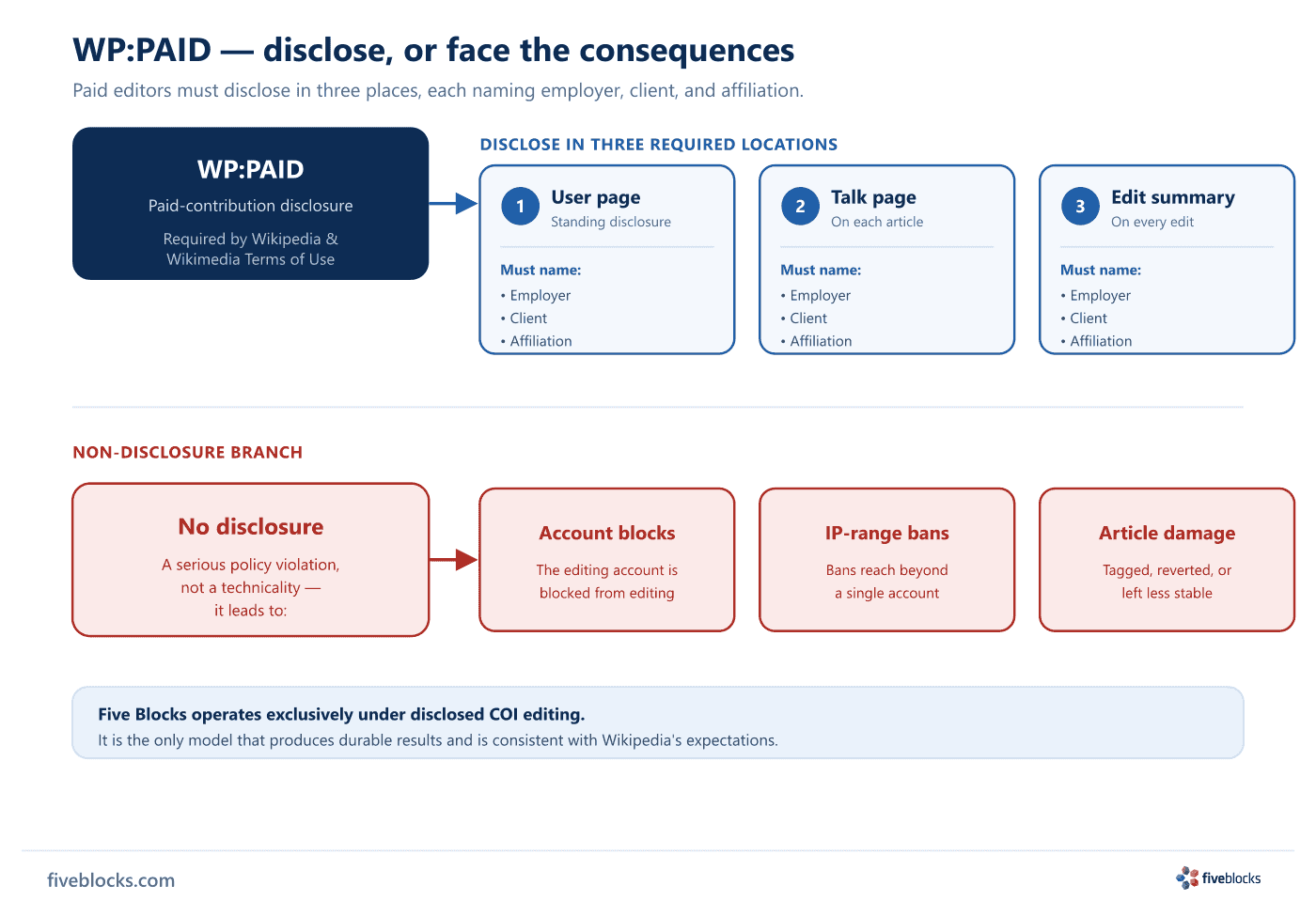
The three required disclosure locations
The paid relationship must be disclosed in all three of the following places:
- User page
- A standing disclosure on the editor’s own Wikipedia user page, naming the employer, client, and affiliation.
- Talk-page contributions
- The same disclosure on the Talk page of any article the editor works on.
- Edit summaries
- A disclosure in the edit summary of any edit the editor makes.
What happens without disclosure
Non-disclosure is a serious policy violation, not a technicality. The consequences include:
- Account blocks on the editing account.
- IP-range bans that reach beyond a single account.
- Damage to the underlying article, which can be tagged, reverted, or left less stable than before.
Five Blocks works only under disclosed COI editing. It is the model that produces durable results and the one that matches what Wikipedia expects.
Last reviewed: 19/05/2026
