How do you benchmark your AI reputation against competitors?
Run identical prompts on the same engines over the same time window for your brand and each named peer, then compare the responses on themes, source attribution, sentiment, and how often each brand is mentioned. Without holding those conditions constant, the comparison is not meaningful.
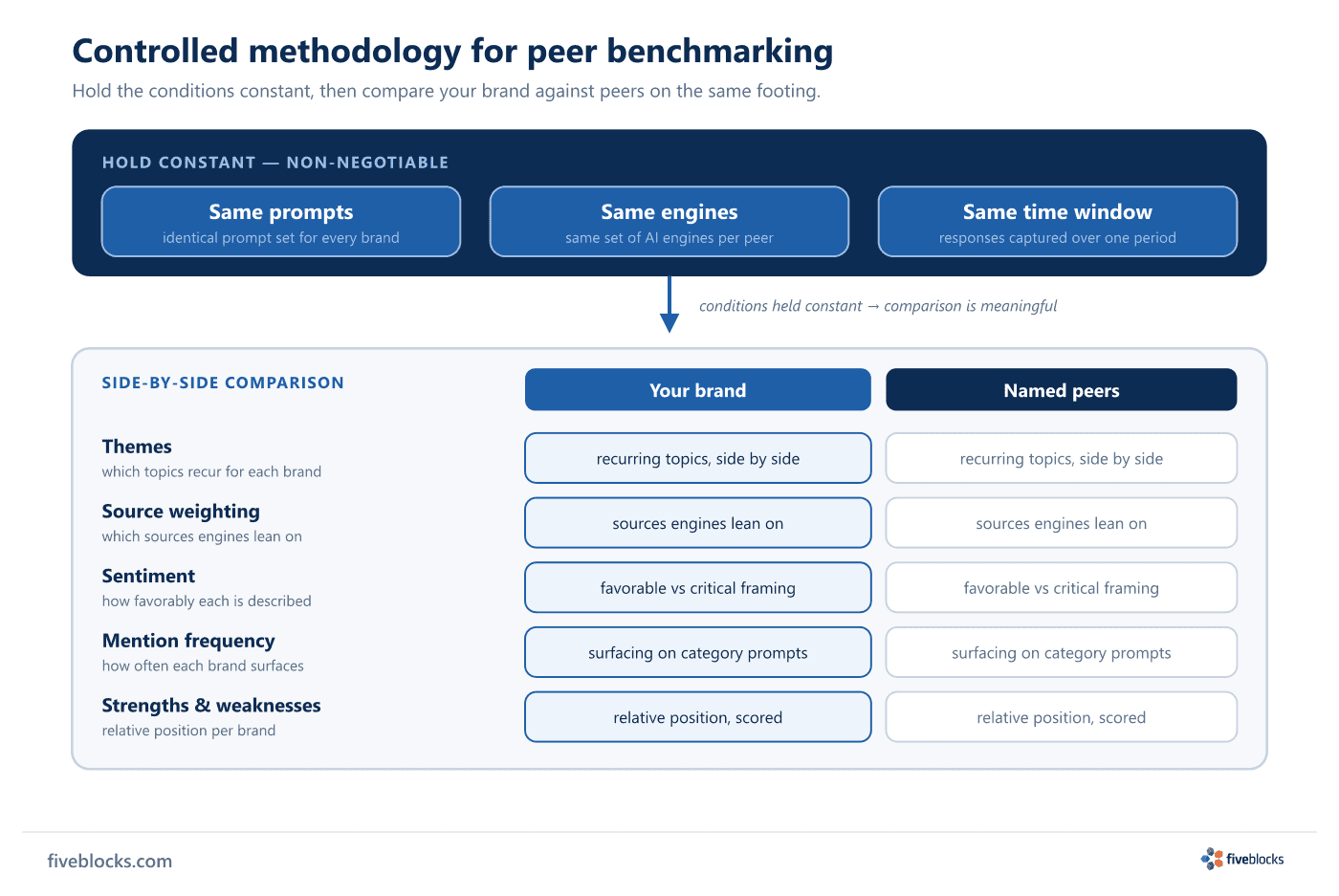
Peer benchmarking only produces useful data when the method holds the conditions constant across every brand being compared: the same prompts, the same engines, and the same time window, run against your brand and each named peer. Change any one of those between brands and the differences you see may be artifacts of the method rather than real differences in how AI describes the companies.
Hold these constant
- Same prompts, the identical prompt set for every brand, including neutral category prompts such as “what are the leading firms in X.”
- Same engines, the same set of AI engines for each peer, since engines weight sources and frame brands differently.
- Same time window, the responses captured over the same period, so you are not comparing one brand’s narrative this month against another’s from last quarter.
What you compare
With conditions held constant, you can compare the brand and its peers on:
- Themes, which topics recur for each brand.
- Source weighting, which sources each engine leans on for each brand.
- Sentiment, how favorably or critically each brand is described.
- Mention frequency, how often each brand surfaces in responses to neutral category prompts.
- Strengths and weaknesses, how the engines characterize each brand’s relative position.
Why the patterns are diagnostic
The comparison is useful because the patterns point to specific action. A brand that consistently outperforms on innovation framing but underperforms on talent narrative knows where to focus. A brand losing on peer-comparison prompts while winning on direct prompts about itself has a different problem to solve. AIQ is built for this kind of side-by-side comparison and shows it directly.
Last reviewed: 19/05/2026
