How does Five Blocks benchmark my brand’s reputation against peers?
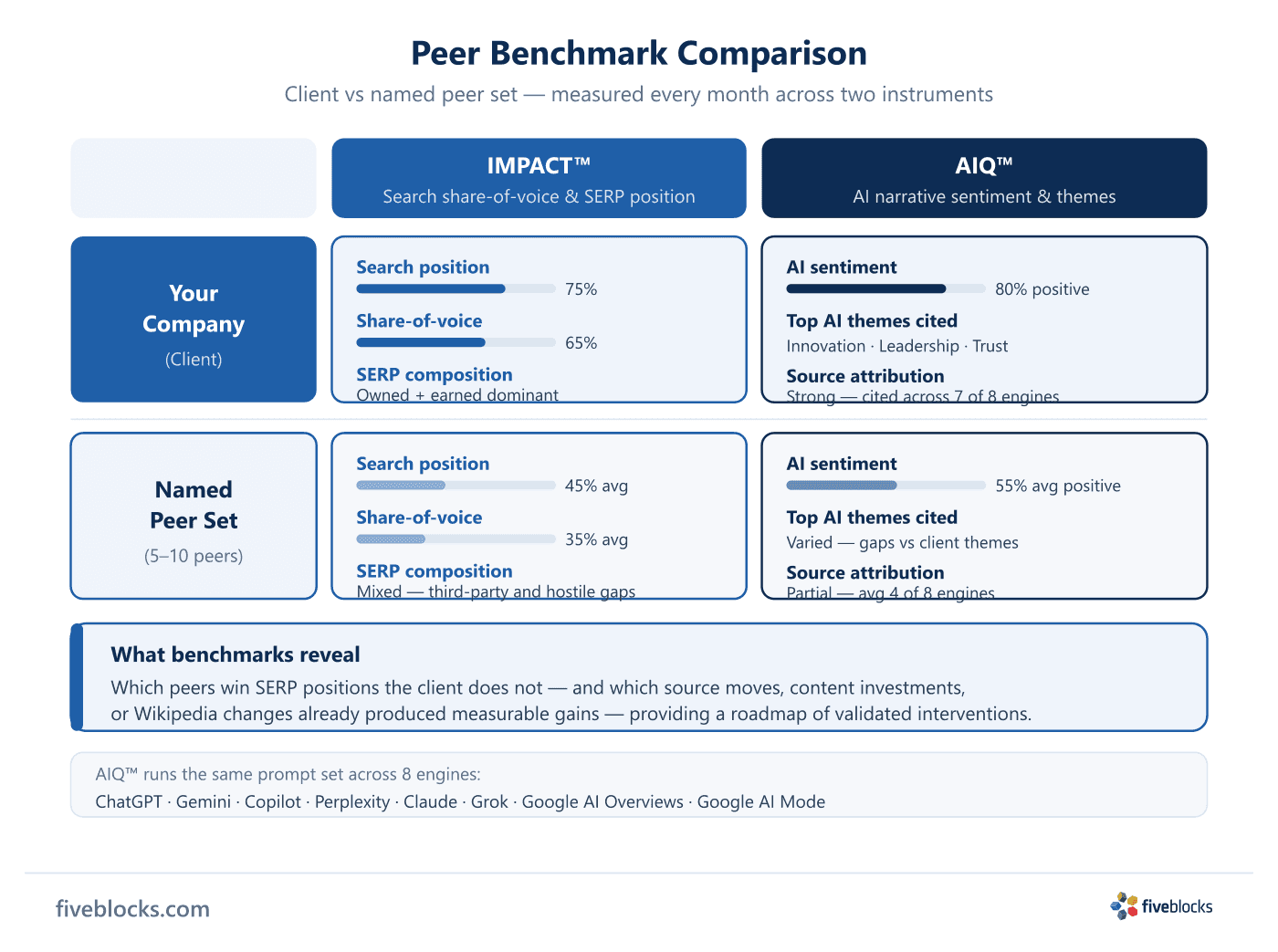
Five Blocks benchmarks reputation against a named peer set using two instruments: IMPACT™ compares search position, share-of-voice, and SERP composition across shared keywords; AIQ™ compares AI narrative themes, source attribution, and sentiment across the eight engines AIQ currently tracks. Results appear in every monthly report, giving clients a relative position rather than an absolute number.
Peer benchmarking answers the question most clients lead with: how do we look compared to the firms we compete against? Five Blocks defines a named peer set at the start of each engagement, usually five to ten competitors, financial peers, or talent-market rivals depending on the program goal, and runs the same diagnostics for the peers as for the client throughout the engagement.
How IMPACT™ benchmarks search
- Same keyword sets, same geographies
- IMPACT™ runs the client’s priority keyword set against each named peer across the same geographies and languages, so every comparison is side by side rather than an isolated snapshot.
- What gets compared
- Search position for shared queries, share-of-voice across the keyword set, and SERP composition, meaning which owned, earned, third-party, and hostile URLs appear for each brand.
- How leverage is identified
- The comparison shows which SERP positions peers are winning that the client is not, and which peer moves produced measurable search shifts.
How AIQ™ benchmarks AI narratives
- Same prompts, same engines
- AIQ™ runs the same prompt set against the eight AI engines AIQ currently tracks, ChatGPT, Gemini, Copilot, Perplexity, Claude, Grok, Google AI Overviews, and Google AI Mode, for the client and for each named peer.
- What gets compared
- AI narrative themes, the sources each engine cites, sentiment, and prominence across engines. This shows which peers are winning the AI narrative and which sources drive that outcome.
- Why the gaps matter
- AI engines often describe peers differently even for closely related queries. Those gaps point to the source relationships and narrative themes the client should prioritize.
How benchmarks are reported
- The combined peer view appears in every monthly report alongside the client’s absolute metrics.
- Relative positioning usually moves internal action faster than absolute numbers, because the board, allocators, or recruiting committee cares about competitive position, not the raw score.
- Benchmarks also surface peer experiments that have already worked, source moves, content investments, Wikipedia changes, so the client gets a set of validated interventions rather than untested hypotheses.
Last reviewed: 19/05/2026
