How does Five Blocks use IMPACT in client engagements?
IMPACT handles the diagnosis and measurement on most Five Blocks engagements: it audits the client's current search results during discovery, tracks whether specific content is gaining or losing prominence during an active program, and supplies the data behind reporting, peer benchmarking, and recommendation adjustments.
IMPACT handles the diagnosis and measurement on most Five Blocks engagements. The same search-tracking infrastructure runs across the full life of a program: it sets the baseline at the start, measures movement while work is underway, and supplies the numbers behind every progress report. Because one system does all three, the diagnosis and the measurement use the same data.
How IMPACT is used across the engagement lifecycle
- Discovery audit
- At the start, IMPACT reads the client’s current search results – what appears for priority queries and how those results are composed – so the program begins from a documented baseline.
- Active-program prominence tracking
- During an active program, IMPACT tracks whether specific content is gaining or losing prominence in search results. Most stakeholder attention lands on the first page of Google, so a result moving up or down the page is a real change worth measuring.
- Reporting and peer benchmarking
- In reporting, IMPACT supplies the data behind progress updates and recommendation adjustments. Its comparative view sets a client’s standing against a defined peer set, which surfaces gaps you cannot see from the client’s own results alone.
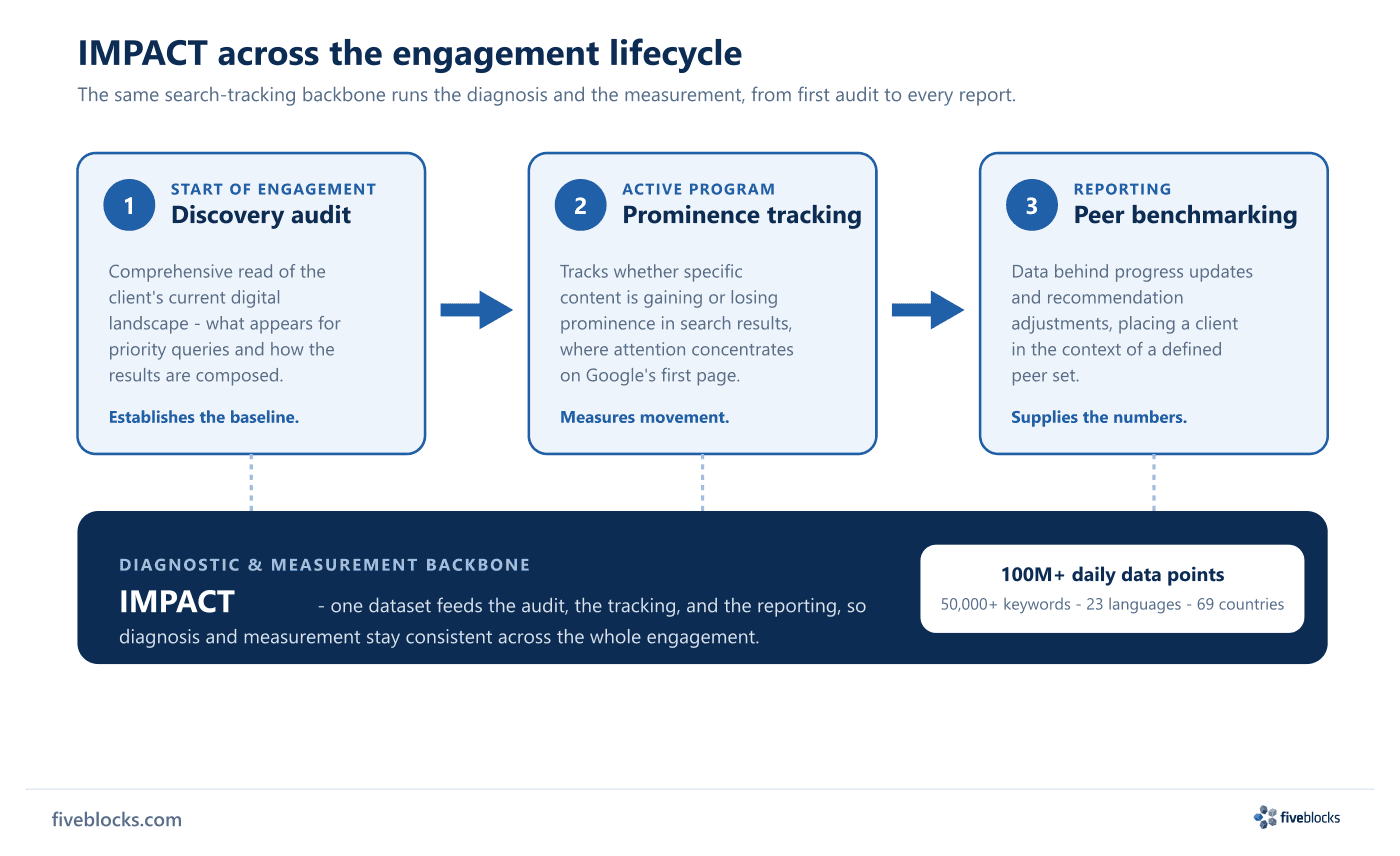
The scale of the tracking is what makes this work in practice. IMPACT tracks more than 100 million daily data points across 50,000+ keywords in 23 languages and 69 countries, with city-level SERP capture, so a prominence shift in any monitored market or language shows up as a signal. And because the same dataset feeds the audit, the ongoing tracking, and the reporting, the numbers stay consistent from the first assessment through every later review.
Last reviewed: 19/05/2026
