What reputation risks are unique to asset management firms?
Two risks are specific to asset managers: disclosure and performance-reporting accuracy, and constant competitive comparison. AI engines now answer prompts like 'best managers in this strategy' by synthesizing third-party sources, so a manager can be advantaged or disadvantaged without any input. The defensible response is accurate, compliance-aware coverage of investment philosophy and process - accuracy is the reputation strategy here, not volume.
Asset managers run a business that is measured, ranked, and compared in public, constantly. Two reputation risks are specific to the category, and the answer to both is the same: accuracy.
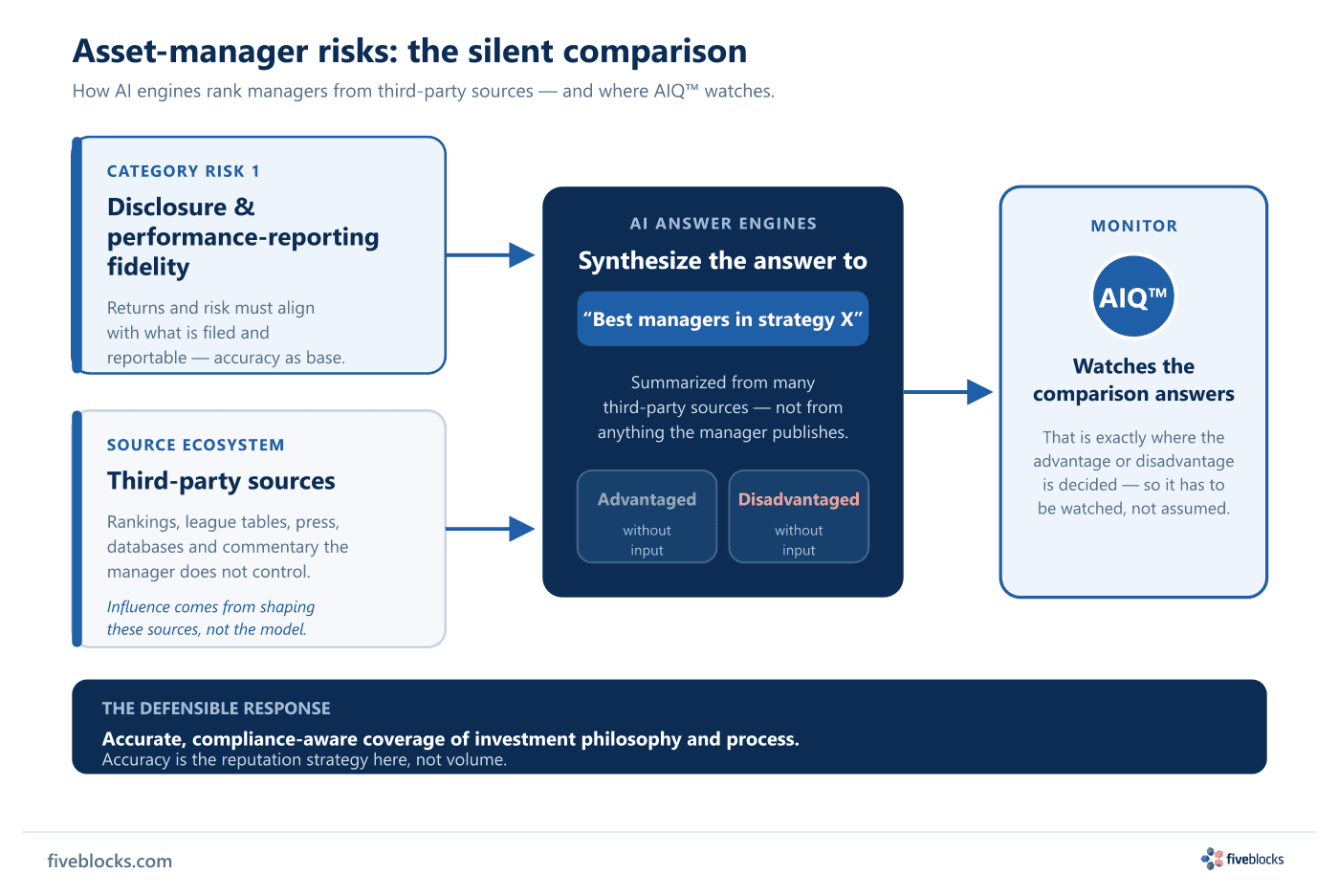
The two category-specific risks
- Disclosure and performance-reporting fidelity
- Regulators and allocators scrutinize how returns and risks are described, so reputational content has to line up precisely with what is filed and reportable. Performance claims that outrun the disclosures invite regulatory and credibility problems.
- Silent competitive comparison
- AI engines now answer comparative prompts – ‘best managers in this strategy’ – by synthesizing third-party sources. A manager can be characterized relative to peers, and advantaged or disadvantaged, without ever providing input. We monitor those comparison answers with AIQ, because that is where the advantage or disadvantage gets decided.
Why comparison is the harder risk
Generative engines satisfy these queries by pulling from and summarizing multiple third-party sources, not from anything the manager publishes directly. Their outputs cannot be edited at the model; influence comes from shaping the underlying sources the engines draw on. The comparison answer reflects whatever that source ecosystem says, so it has to be watched rather than assumed.
The defensible response: accuracy as strategy
What works is authoritative, compliance-aware coverage of investment philosophy and process that gives the engines accurate material to work from. Content that is fact-dense, clearly structured, and grounded in citations is also what AI engines are most likely to surface and cite. Accuracy is the reputation strategy here, not volume.
Last reviewed: 20/05/2026
