How does reputation management differ between sell-side and buy-side financial firms?
Sell-side firms manage regulator-aware, deal-driven narratives and executive visibility. Buy-side firms manage allocator-facing content, performance context, and evidence of team quality. Both sit on the same entity and source infrastructure, but the audiences and the risks are different.
Sell-side and buy-side firms answer to different audiences and carry different risks. The entity and source infrastructure underneath the two programs is the same; the content priorities on top of it are not, and a program built for one side is wrong for the other.
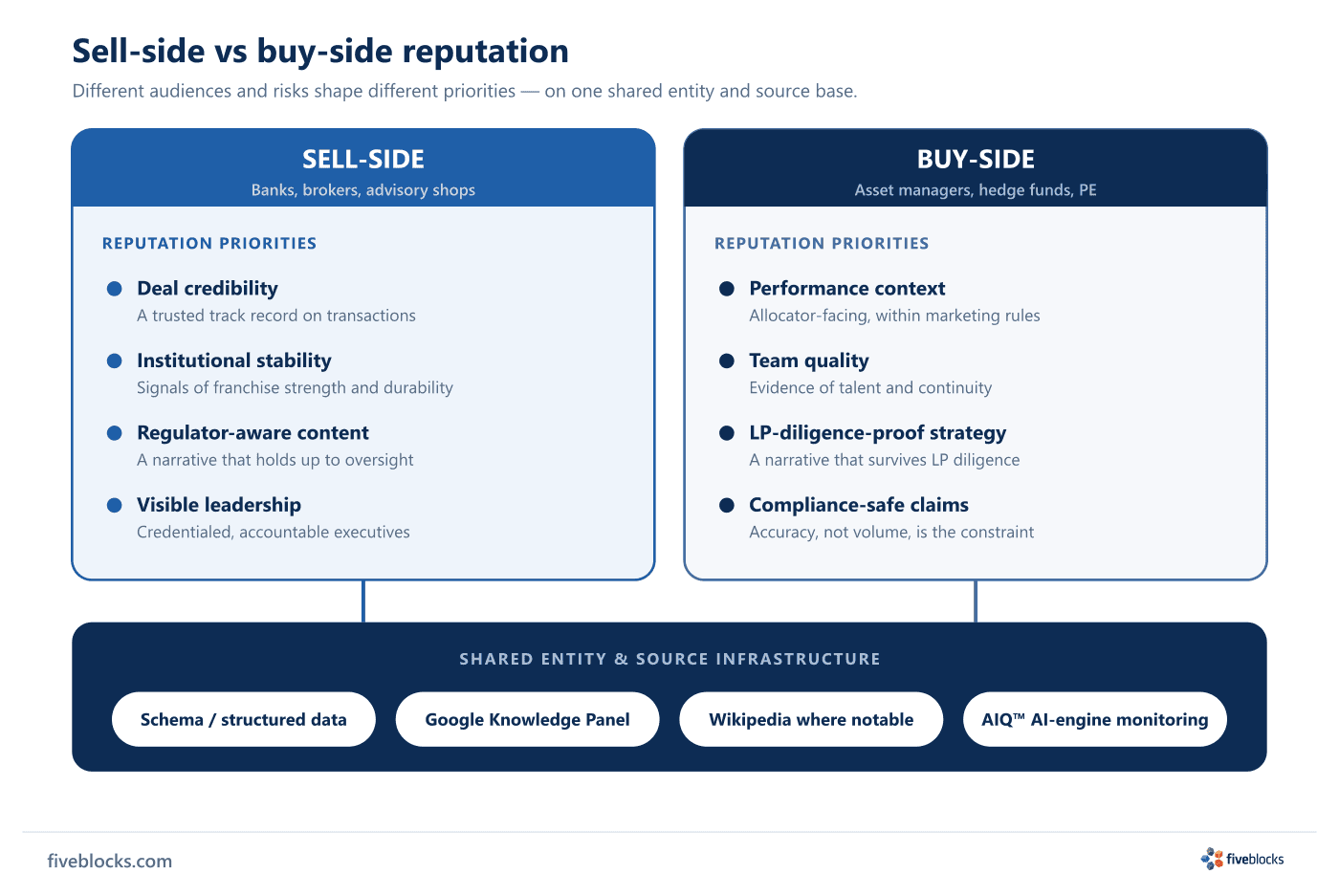
| Sell-side (banks, brokers, advisory shops) | Buy-side (asset managers, hedge funds, PE) | |
|---|---|---|
| Primary audience | Counterparties and the market, judging deal credibility and institutional stability | Allocators and LPs, judging strategy and returns |
| Content emphasis | Regulator-aware content; visible, credentialed leadership; a consistent narrative around transactions and franchise strength | Performance context that stays inside the marketing rules; evidence of team quality and continuity; a strategy narrative that holds up under LP diligence |
| Core risk | Doubts about deal credibility or stability, or leadership that looks thin or unaccountable | Performance claims that create compliance problems, or a strategy that does not survive diligence |
The shared layer
That common layer is schema, the Google Knowledge Panel, a Wikipedia article where the firm is notable, and AI-engine monitoring with AIQ. It is shared because AI engines build their answers from the sources they can find, not from anything editable inside the model. Accurate entity signals matter whichever side of the trade you are on.
Scoping the program
We scope the program to the side of the trade the client is actually on. The buy-side carries one extra constraint: how returns and strategy get described has to align with the applicable marketing rules. Regulation D and the SEC marketing rule limit how private funds and registered advisors communicate, and FINRA rules govern the marketing of financial advice. Accuracy, not volume, is the controlling constraint on a buy-side content program.
Last reviewed: 20/05/2026
