How does reputation management work for real estate developers?
A real estate developer's reputation runs at two levels: the firm and its principals, anchored by schema-marked executive bios and a track record that travels from deal to deal, and the individual project, where community sentiment and municipal coverage are intensely local. Five Blocks monitors both with GeoSearch (local results) and AIQ (AI-engine narratives) in every active market.
A real estate developer’s reputation is firm-wide and intensely local at the same time. Each project lives or dies in its own market, with its own community, regulators, and press, so the work has to run at both levels at once.
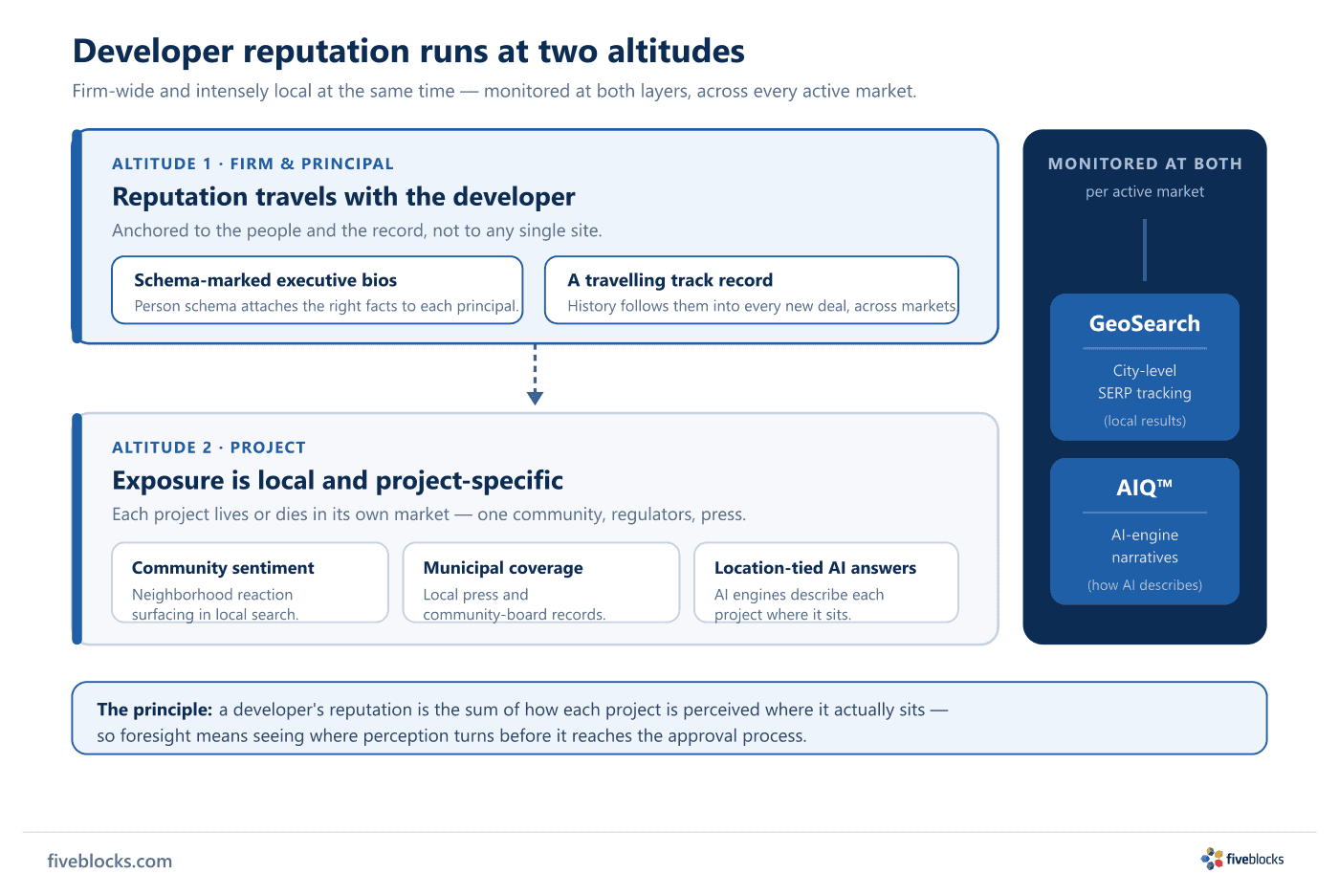
Firm and principal level
At the firm level, reputation travels with the developer from deal to deal, so it is anchored to the people and the record rather than to any single site:
- Credentialed, schema-marked executive bios. Person schema helps search and AI engines attach the right facts to the right principal and pull scattered references together into one identity.
- A track record that travels. The developer’s history and reputation follow them into every new deal, so the firm-level account has to be accurate and consistent across markets.
Project level
At the project level, the exposure is local and specific to the site. Community sentiment, municipal coverage, and neighborhood reaction surface in localized search and, more and more, in AI answers tied to the project’s location. The engines pull project-level perception from local press, community-board records, and local online discussion.
Monitoring both levels
We watch each layer with its own tool, in every active market:
| Layer | What we monitor | Tool |
|---|---|---|
| Local search results | Community sentiment and municipal coverage in each project’s market | GeoSearch (city-level SERP tracking) |
| AI-engine narratives | How the AI engines describe the developer and each project | AIQ |
The payoff is warning time: a developer can see where community perception is turning before it reaches the approval process. A developer’s reputation is the sum of how each project is perceived where it actually sits.
Last reviewed: 20/05/2026
