How should real estate developers prepare for AI-driven tenant research?
For AI-driven tenant research, real estate developers need to manage AI reputation at two levels: the firm overall and each individual project. At the project level, the work is monitoring how AI engines answer tenant- and investor-style prompts about each development, addressing community-perception narratives (local press, community-board coverage, forum discussion) at the source level, and keeping entity data accurate in Google Knowledge Panels, Wikidata, and property databases.
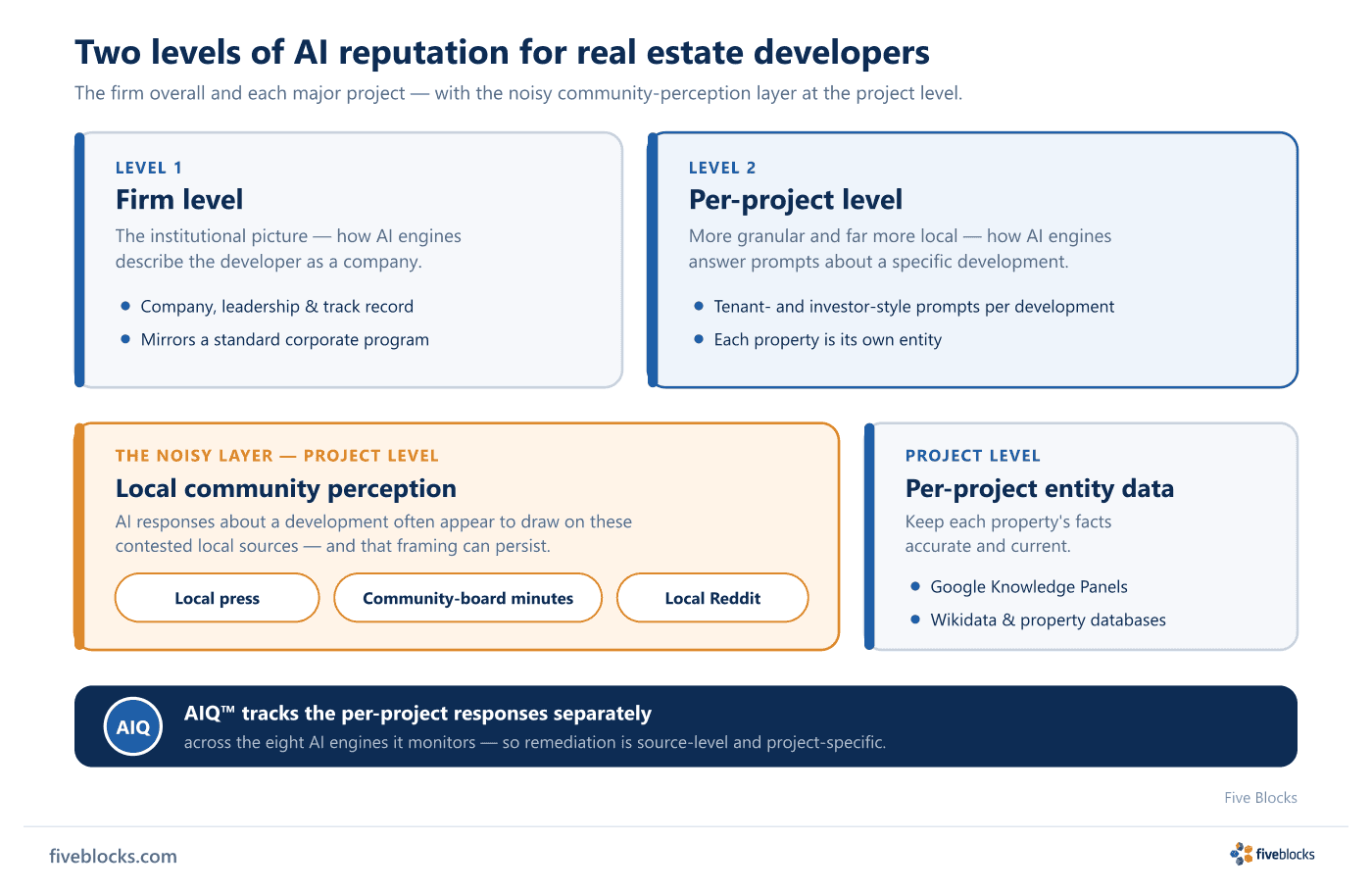
Real estate developers face AI reputation work on two levels: the firm as an institution and each major development project on its own. Firm-level work parallels a standard corporate reputation program. Project-level work is more granular and more local, and it is where the less obvious risks sit.
Two levels, two kinds of work
- Firm level, how AI engines describe the developer as a company, its leadership, and its track record. The inputs are the same as for any institutional reputation program: Wikipedia and Wikidata entity coverage, press coverage in credible outlets, and owned content with clean structured data.
- Project level, how AI engines answer prompts about a specific development. Each property is its own entity, with its own source ecosystem and its own community-perception narrative. The inputs at this level are local, and the risks differ from the firm-level picture.
Community perception is the hardest input to predict
At the project level, the least predictable input is local community perception. AI engines appear to draw on local press coverage, community-board minutes, and Reddit-style local discussion when answering prompts about a specific development. Reddit and similar community forums have become a more prominent source for AI-generated answers in recent years. The main risk is persistence: contested coverage of a zoning fight, neighborhood opposition, or an environmental concern can keep shaping engine responses long after the underlying issues are resolved, because AI engines can over-weight a single contested source when forming an answer and do not automatically update when the situation changes.
Keep per-project entity data accurate
Each property is a discrete entity in AI engine infrastructure. Google’s Knowledge Panel pulls its description and key facts from Wikipedia and Wikidata, which gives those sources a large say in what the engines report. Accurate, current entries for each development in Wikipedia and Wikidata, plus listings in major real estate databases, give the engines authoritative facts to work from instead of gaps to fill with inferred or community-sourced narrative.
Remediation is source-level and project-specific
Because community-perception narratives differ project by project, the remediation work differs too. You cannot influence AI engine output by editing the engines directly; it requires shaping the sources the engines draw on. That means identifying which outlets and forums the engine is weighting for a particular development and working at that source level. A single firm-wide PR push will not fix a project-specific framing problem. AIQ tracks responses about each project separately across the eight AI engines it monitors (ChatGPT, Gemini, Copilot, Perplexity, Claude, Grok, Google AI Overviews, and Google AI Mode), so the remediation effort can be aimed where it is needed.
Last reviewed: 19/05/2026
