How does reputation management work for luxury residential developers?
Luxury residential sells on perception, so the reputation work emphasizes visual authority (high-quality imagery and schema-marked project pages), design and architecture press, and a deliberately discreet executive presence behind the brand. AIQ monitors luxury-market and comparison prompts, because the AI-synthesized shortlist now decides which developments get considered.
Luxury residential sells on perception, so its reputation work is tuned for buyers who weigh prestige and aesthetics as heavily as fundamentals. The program leans harder on visual authority and third-party prestige than a standard developer program does, and it treats the AI-synthesized shortlist as a real gatekeeper.
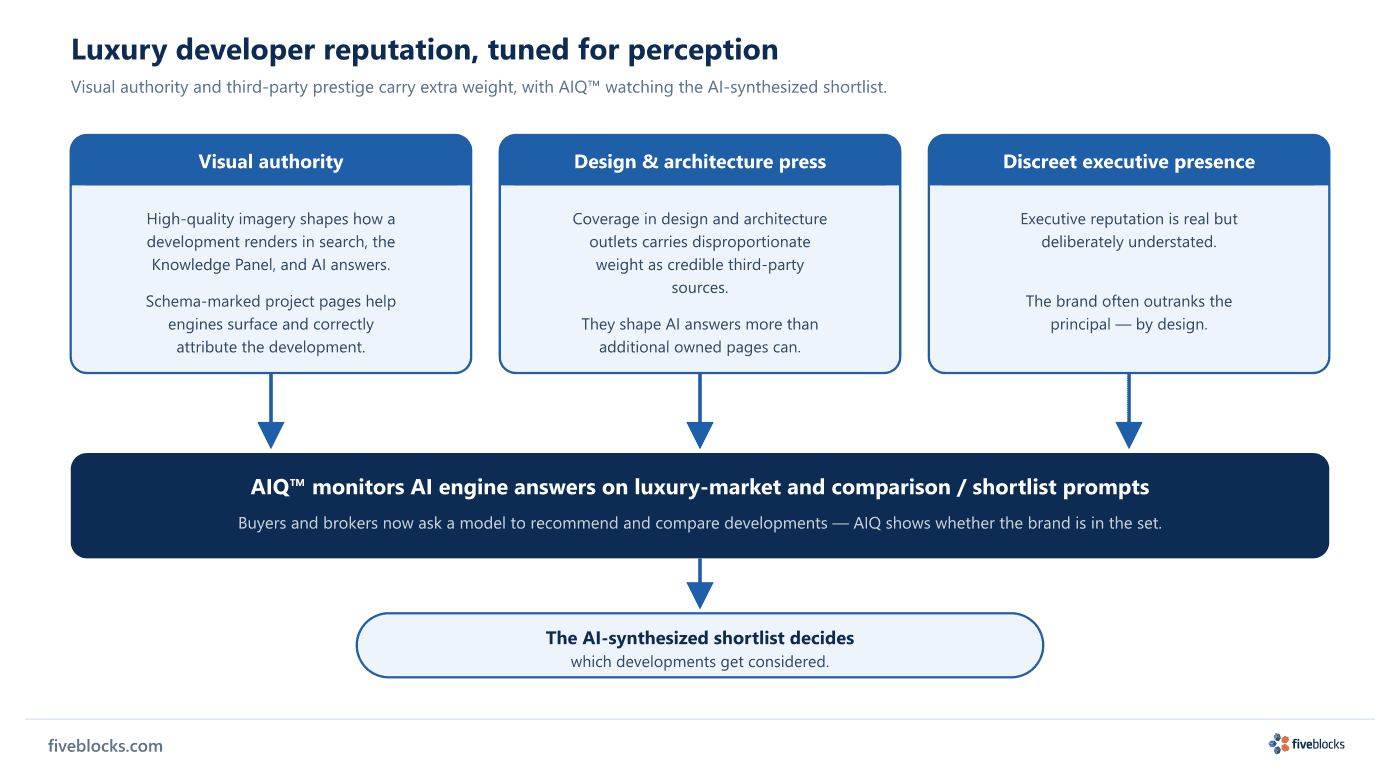
What the program emphasizes
- Visual authority. High-quality imagery and schema-marked project pages shape how a development renders in search, in the Knowledge Panel, and in AI answers. Multimodal engines describe and contextualize images, and the Knowledge Panel itself often surfaces one.
- Design and architecture press. Coverage in design and architecture outlets carries disproportionate weight: independent third-party sources move AI answers more than additional owned pages do, and these outlets are the authority this audience already trusts.
- Discreet executive presence. Executive reputation matters, but it stays understated; the brand often outranks the principal by design.
- AIQ on luxury-market and comparison prompts. We monitor AI engine answers on luxury-market and comparison prompts, because buyers and brokers now ask models to recommend developments.
Why the shortlist matters
When a buyer or broker asks a model to recommend or compare developments, the shortlist it returns is soft gatekeeping: it decides which projects get considered at all. Monitoring those answers is how a luxury developer sees whether it is in the consideration set.
Last reviewed: 20/05/2026
