How do you manage reputation for a real estate developer entering a new market?
A developer entering a new market arrives as an unknown entity, and the local search and AI environment has no record of them. Localize the entity before launch: build authoritative content tied to the market and the developer's track record, secure regional directory presence, add language-appropriate Wikipedia and Wikidata signals where applicable, and start GeoSearch and AIQ monitoring before the first project is visible. Done in that order, the developer shapes the new market's view while it is still forming.
A developer entering a new market arrives as an unknown entity, and the local search and AI environment has no record of them. That absence is a risk and an opening at the same time. Left alone, the first thing the market learns about the developer is whatever local press or community decides. Filled in early and accurately, it becomes the reference point everyone else works from. The sequence below starts before the first project is visible.
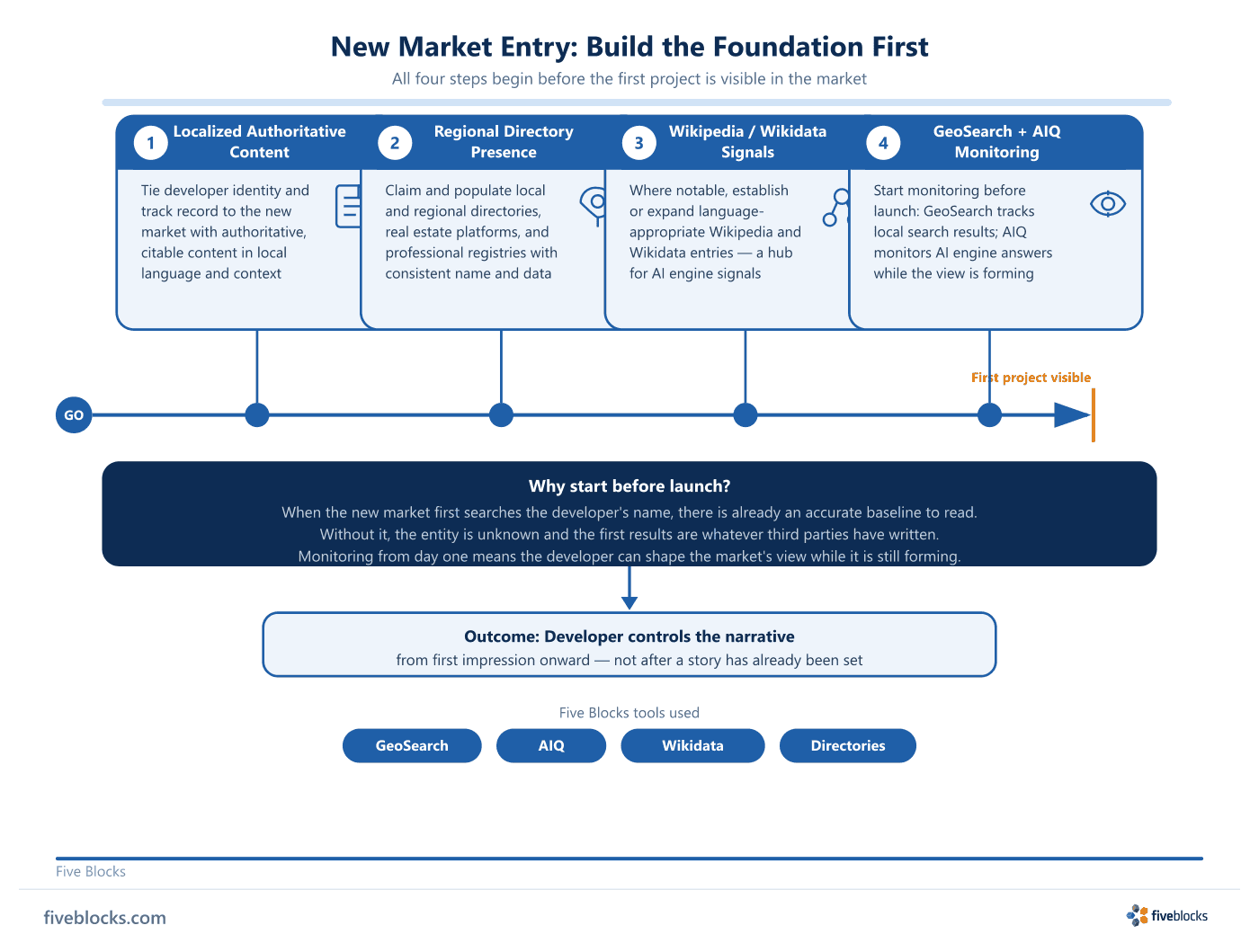
Step 1: build localized authoritative content
We create authoritative content that ties the developer’s identity and relevant track record to the new market. Search engines and AI engines then have something accurate to read the first time someone in that market searches the developer’s name. Without it, the entity has no local presence and the first results are whatever third parties have written.
Step 2: secure regional directory presence
Local and regional business directories, real estate platforms, and professional registries count heavily in local search. Claim and populate the listings that matter in the specific market, with consistent name, address, and contact data, and the entity is anchored in the local index before the developer is known there.
Step 3: add Wikipedia and Wikidata signals where applicable
Where the developer is notable and the market warrants it, we establish or expand language-appropriate Wikipedia and Wikidata entries. Wikipedia operates in roughly 300 languages, and each language version links through Wikidata to the same underlying entity, so one well-maintained Wikidata entry pushes structured, machine-readable identity signals across those language versions. Those signals feed the Google Knowledge Graph and give AI engines a verified reference point for who the developer is.
Step 4: start GeoSearch and AIQ monitoring before launch
Monitoring begins before the first project is visible in the new market. GeoSearch tracks local search results across the specific locations the developer is entering, and AIQ monitors the AI engine answers where prospective buyers, partners, and press now form their first impressions. Start early and the developer can watch the new market make up its mind, and influence it while the question is still open rather than after a narrative has set.
Last reviewed: 20/05/2026
