Why does reputation start with search and AI?
Reputation starts with search and AI because that is where the decision is made. Investors, journalists, candidates, customers, and regulators all begin a brand or executive interaction by searching or asking an AI engine, and whatever they see in the first ten seconds frames everything that follows.
Reputation in 2026 is search-and-AI-first because that is where stakeholders form their impressions, before anyone reaches out, accepts a meeting, signs a document, or writes a check. None of these audiences is reading a brochure or watching a corporate video first; they are seeing the search results page (SERP) and the AI synthesis, in that order, in under a minute. Everything else in a reputation program is downstream of that fact.
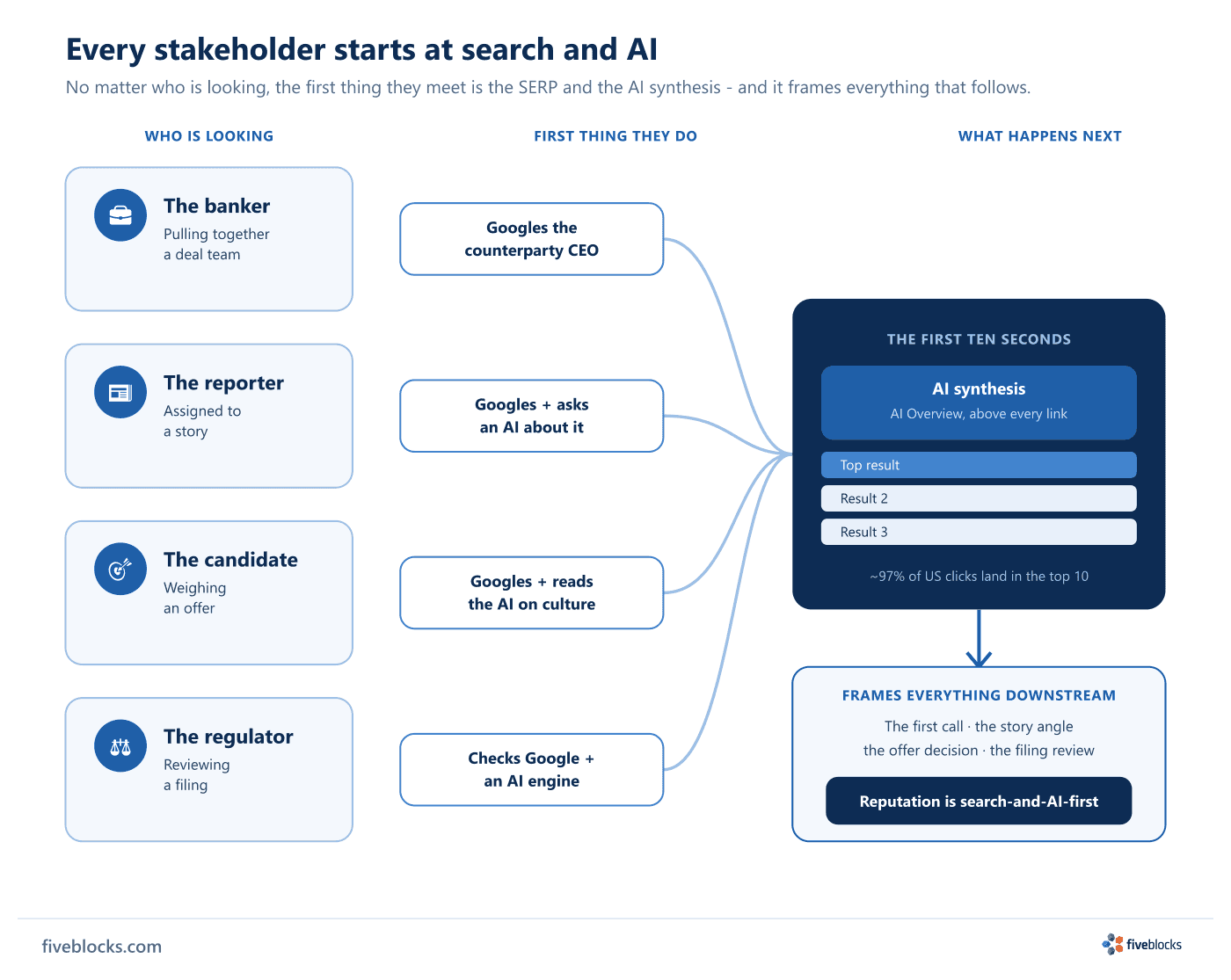
The same pattern across every kind of decision
The behavior is consistent no matter who is doing the looking:
- The banker, pulling together a deal team, Googles the counterparty CEO before the first call.
- The reporter, assigned to a story, Googles the company and asks ChatGPT about it before reaching out.
- The candidate, weighing an offer, Googles the firm and reads what Gemini says about the culture before accepting.
- The regulator, reviewing a filing, checks the entity in Google and Perplexity.
In each case the first thing they encounter is not a message you sent them. It is the SERP and the AI answer that frame the entity for them.
Why the first ten seconds decide so much
Two facts combine here. First, attention concentrates on the top of page one: in the US in 2025, roughly 97% of desktop clicks happened within the top ten Google results, and only a fraction of a percent of searchers ever clicked through to page two. Second, an AI-generated answer increasingly sits above those results. Google AI Overviews place a synthesized answer at the very top of the page, before any traditional blue link. For most stakeholders, then, the synthesis and the first few results are not the start of the research. They are the whole of it.
Last reviewed: 19/05/2026
