What is the role of news aggregators and syndication in AI search results?
Wire and aggregator syndication spreads a single origin story across many domains. Because AI engines build answers from multiple indexed sources, wide syndication raises the odds that the wire version shapes the final response. This cuts both ways: it works the same for accurate, on-message content and for errors or off-message framing.
When a press release or wire story is syndicated, the same content appears across many domains: financial news aggregators, regional outlets, industry sites. AI engines build answers from several indexed sources at once, so wide syndication raises the chance that the wire version is one of them and that the answer lines up with it. The effect runs both ways. It helps when the underlying content is accurate and hurts when the original carries an error or off-message framing.
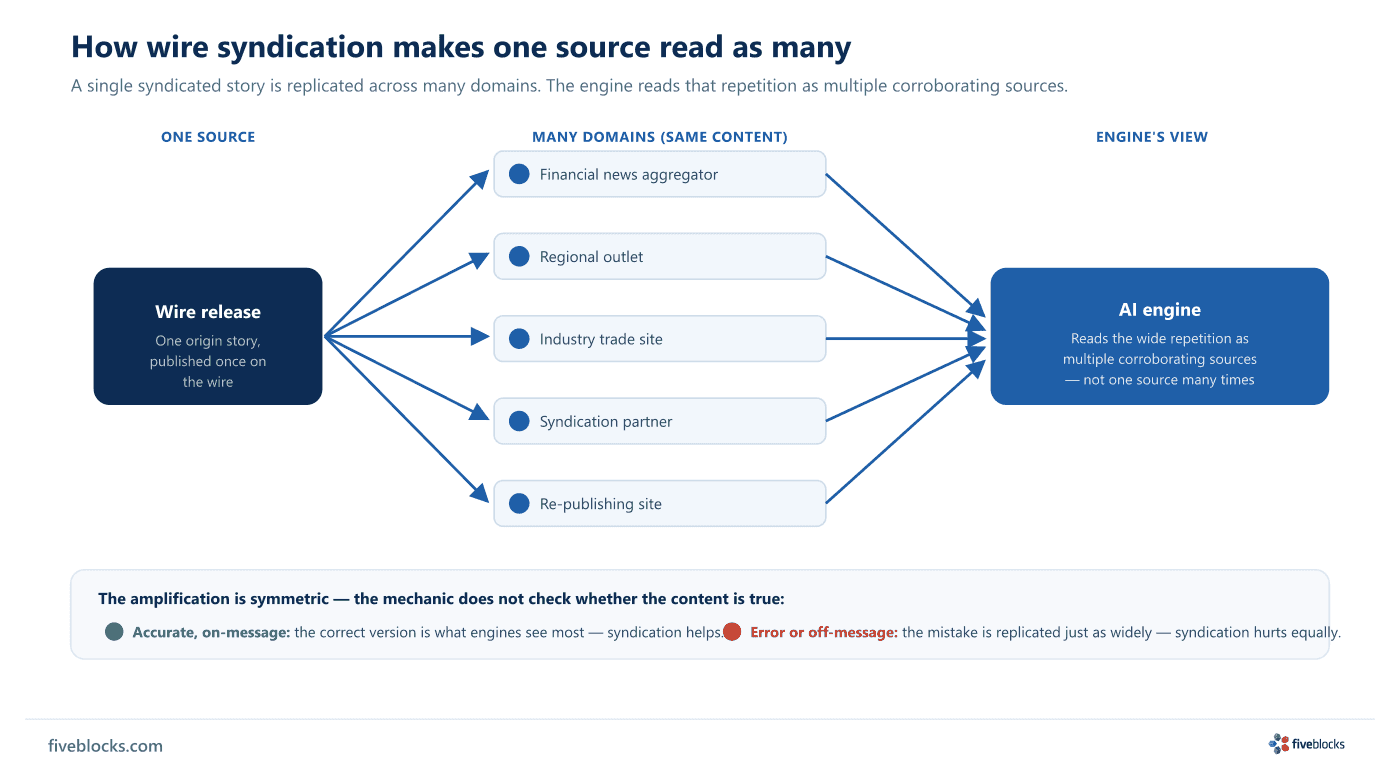
How wire distribution reaches AI engines
The major wire services are set up for AI-era indexing. PR Newswire keeps an open robots.txt that lets AI and search crawlers index all public content on its platform. Business Wire wraps each release in NewsArticle structured data, which tells engines the content type and context at a glance and speeds up indexing. Releases on the major services (PR Newswire, Business Wire, GlobeNewswire) are crawled, indexed, and increasingly surfaced by AI engines, especially for time-sensitive queries.
The amplification problem
Syndication copies one origin story across many domains that look independent. When the same claim appears on a dozen sites, an engine is more likely to surface a version of it and to read that wide presence as a sign the claim matters. This is fine when the content is accurate. It is a problem when the original holds a factual error or framing the brand would not have chosen, because syndication carries that error across many outlets before anyone can correct it. An engine cannot tell “one source many times” apart from “many independent sources once”, so breadth of coverage can read as significance.
Syndication versus earned coverage
Per outlet, wire releases carry less weight than independent earned coverage. AI answer engines tend to weight third-party earned media more heavily than brand-owned and syndicated content, because independent sources are easier to trust, retrieve, and cite. A wire release that draws downstream earned reporting in credible outlets holds up better in AI answers than one that only circulates among aggregators. Syndication is a distribution lever, not a substitute for credibility.
What to get right before you syndicate
- Verify every claim before release. Errors that reach the wire are hard to correct once they are copied across dozens of domains.
- Choose framing deliberately. The AI answer about your brand may draw on the wire version for months; off-message language in a release can persist in AI responses long after the press cycle fades.
- Pair wire distribution with earned coverage. Independent reporting that picks up and confirms wire content carries more weight in AI answers than syndication on its own.
- Monitor after release. AI narratives can shift once a release goes out; track how the engines describe your entity across the major models to catch any error amplification early.
Last reviewed: 19/05/2026
