What is the role of corporate blogs in influencing AI search results?
Most corporate blogs fail to influence AI engines because they recycle marketing copy. The ones that get cited share specific traits: substantive original analysis, regular updates, question-format structure with schema markup, named expert authorship with bio context, and engagement with the wider third-party source ecosystem.
Most corporate blogs fail to influence AI engines because they are written for the company rather than for the people and engines reading them. They recycle marketing summaries instead of saying anything substantive. The blogs that do get cited share a clear set of traits, and volume is not one of them.
What makes a corporate blog AI-citable
- Substantive original analysis
- Original analysis, named data, and useful detail rather than marketing summaries. Engines tend to extract from fact-dense content built on concrete numbers, dates, and named entities, and they reward content that carries its own citations and statistics.
- Regular updates
- Content refreshed often enough that the engines treat it as current. Sites that keep updating their best-performing content stay visible while stale competitors fade.
- Question-format structure with schema
- Clear H2 and H3 headings framed as the actual questions readers would ask, with a short two-to-three-sentence direct answer below each one, plus schema markup (Article or BlogPosting, FAQPage where appropriate, Person for the author). Engines extract answers faster from short, well-organized content than from long pages where the answer is buried.
- Named expert authorship
- A clearly identified author with credible bio context, so the engines can attribute the content to identifiable expertise. This mirrors Google’s E-E-A-T framework (Experience, Expertise, Authoritativeness, Trustworthiness), and bylines that lead to further information about the author are an explicit helpful-content signal.
- Engagement with the third-party source ecosystem
- Citing, and being cited by, authoritative third-party content. Engines weight independent, credentialed sources heavily over owned pages, so a blog that links into the wider ecosystem carries more weight than one that only talks about itself.
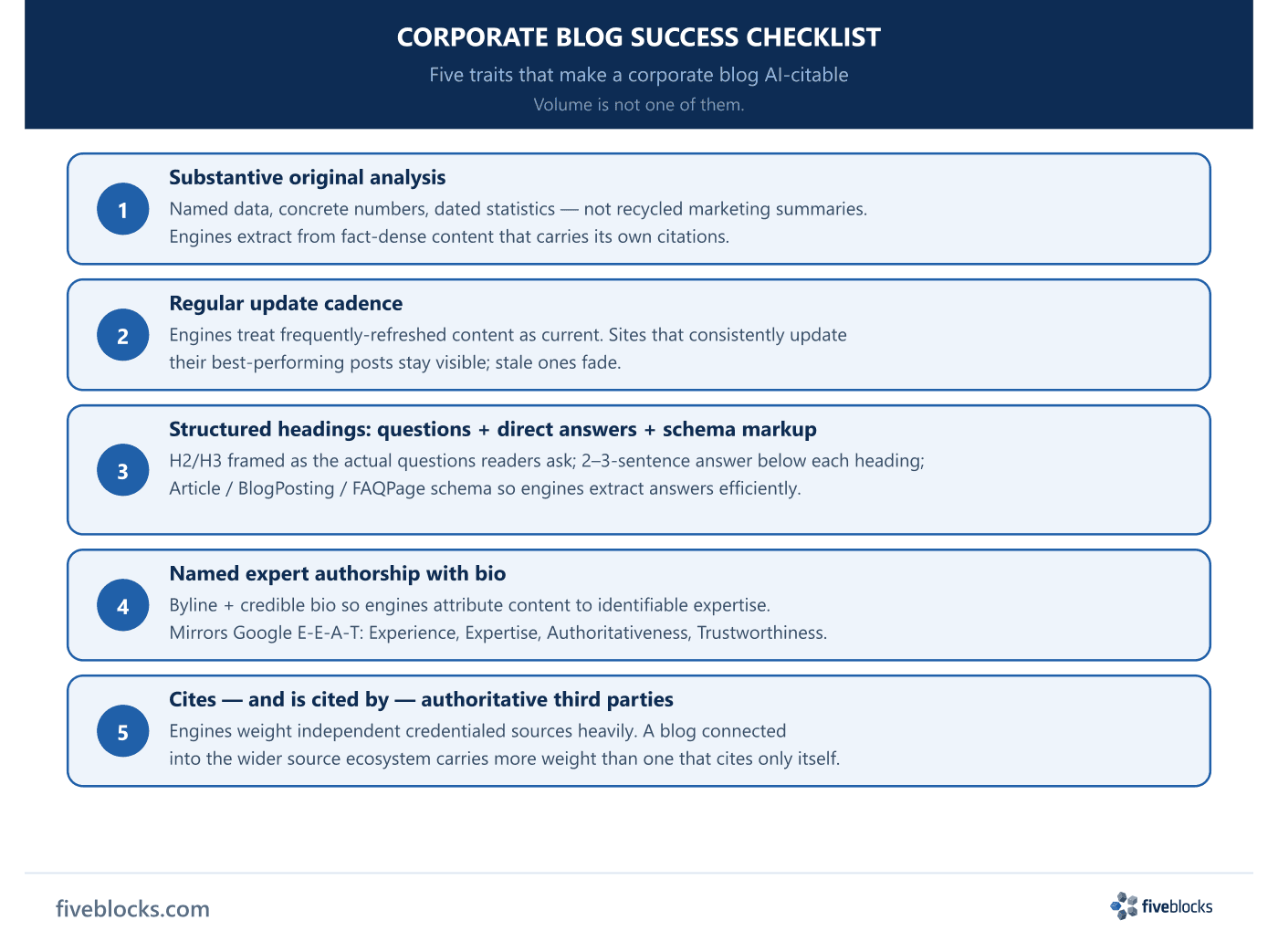
A blog that does these things gives the engines something they can quote and attribute to real expertise. A blog that recycles marketing copy does not, no matter how much of it gets published.
Last reviewed: 19/05/2026
