How does Five Blocks manage Google search results?
Five Blocks manages Google results with a Track / Analyze / Impact method: we track what currently appears, analyze what shows for peers and across geographies and languages, then help Google's algorithm find and rank the preferred, authoritative content rather than trying to trick it.
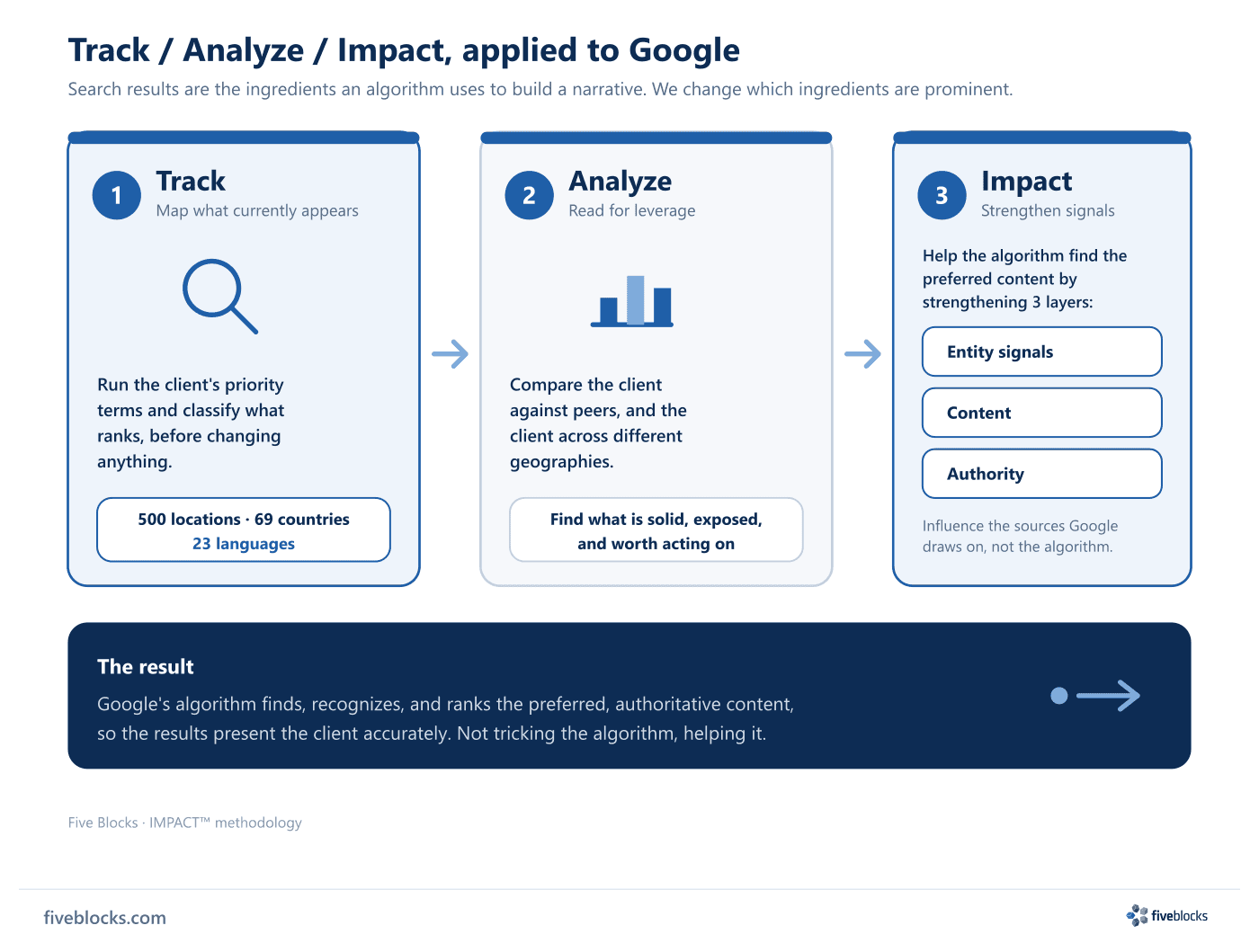
Five Blocks manages Google search results through one method, Track / Analyze / Impact. A set of Google results is the raw material an algorithm uses to build a narrative: change which sources are prominent and you change what the results say. The work is not about outsmarting Google. It is about helping the algorithm find, recognize, and rank the content and entity signals that present the client accurately.
1. Track: map what currently appears
We start by mapping the live results. Our IMPACT™ platform runs queries across the client’s priority terms and classifies what ranks, so we have a factual picture of the current results before changing anything. Tracking covers geographies and languages: IMPACT runs across 500 locations, in 69 countries and 23 languages, because Google resolves and describes an entity differently from one market and language to the next.
2. Analyze: read the results against peers and geographies
With the map in hand, we compare what appears for the client against what appears for peers, and against the same client across different geographies and languages. The differences show where the results are strong, where they are exposed, and which sources are actually driving the narrative, the ones worth acting on.
3. Impact: help the algorithm find the preferred content
We then strengthen the signals Google already weights. Google assembles and ranks results from the wider source ecosystem, weighting authority and entity recognition, so the work runs in three parallel layers:
- Entity signals: the connected web of references (Wikidata, schema markup, sameAs links, the Knowledge Graph and Knowledge Panel) that tells Google which entity a result is about and how to frame it across the page.
- Content: accurate, authoritative pages and placements that Google and AI engines prefer, so the right results earn prominence.
- Authority: credible third-party coverage and citations that build up across the ecosystem and let preferred content rank durably.
Throughout, we influence the sources Google draws on rather than manipulate the algorithm directly. We do not use link schemes, cloaking, or other tactics that violate search engine guidelines, which Google detects and penalizes. The aim is to make the algorithm’s job of finding the accurate narrative easier.
Last reviewed: 19/05/2026
