How do you create content that addresses common negative narratives proactively?
Pre-emptive content addresses anticipated negative narratives before a crisis arrives. When an organization publishes clear, accurate, well-sourced explainers on sensitive topics while conditions are calm, it creates the canonical reference that search and AI engines can draw on if questions ever escalate. Content built in advance is more credible, better structured, and harder to displace than material rushed out under crisis pressure.
It is far easier to shape a narrative before a crisis than to displace one after it has set. The approach is to anticipate the sensitive topics where questions are likely, a contested business practice, a regulatory area, a leadership transition, a known vulnerability, and to publish clear, accurate, well-sourced explainers on owned properties while conditions are still calm.
Why early publication matters for search and AI engines
Both search engines and AI answer engines favor established, authoritative content. Google evaluates content against its E-E-A-T criteria (experience, expertise, authoritativeness, and trustworthiness), and content that states facts plainly in clean, well-organized units is cited more reliably by AI engines than content drafted under pressure. Content that has already been indexed and has accumulated credibility signals, citations, structured data, clear sourcing, is much harder to displace than freshly published reactive material.
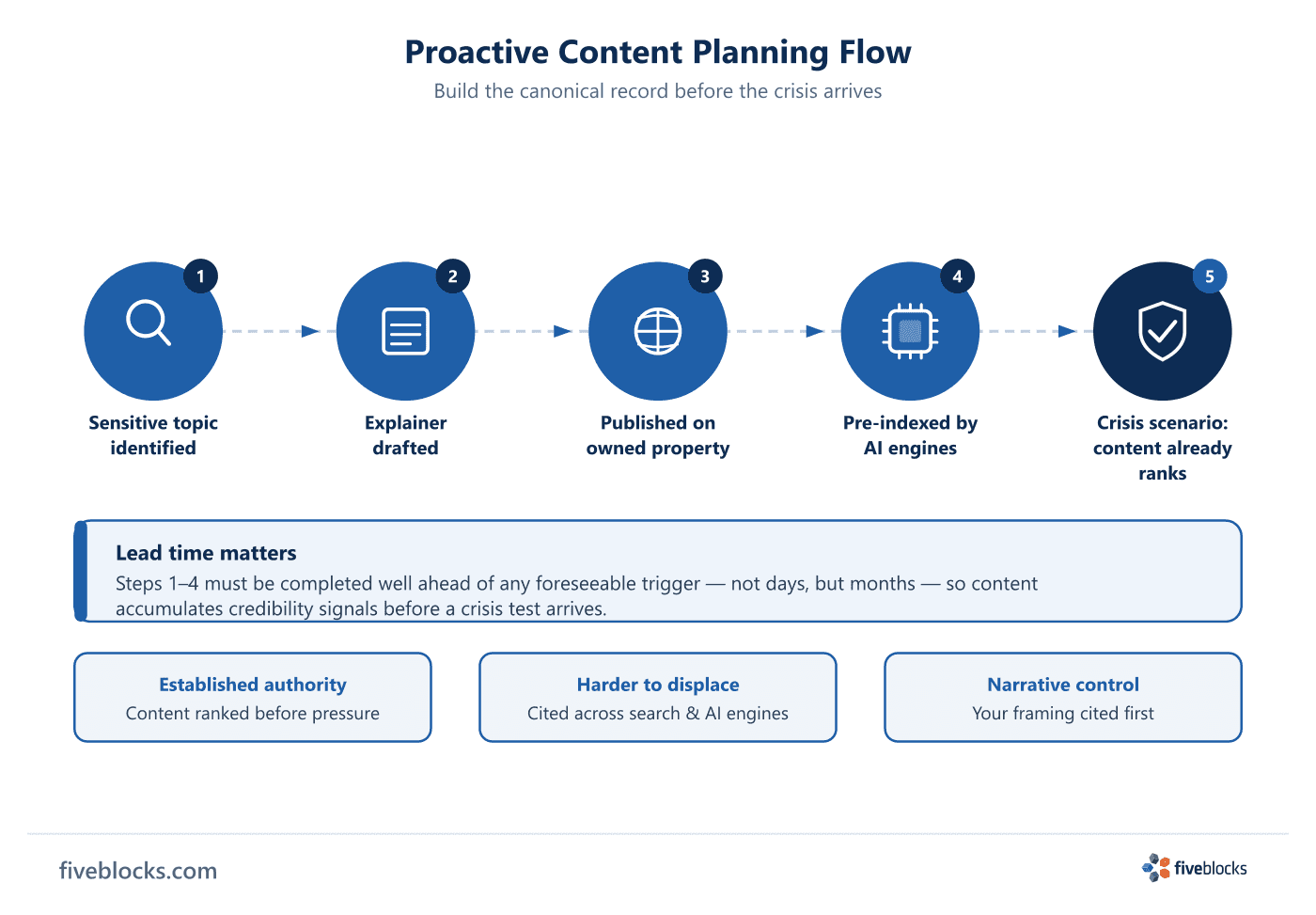
Steps to build a proactive content program
- Identify the sensitive topics. Map the issues where questions are predictable: contested practices, regulatory exposure, executive transitions, competitive vulnerabilities, or recurring media themes.
- Draft the canonical explainer. Write a clear, honest, well-sourced piece that genuinely addresses the issue, not a spin document. Proactive content only works if it holds up to scrutiny.
- Publish on an owned property. Keep the content on a domain your organization controls, with schema markup and structured data so search and AI engines can attribute it to your entity.
- Allow lead time for indexing. Publication must precede the anticipated event by enough time for search and AI engines to index, evaluate, and weight the content. Most programs need to be in place well ahead of any foreseeable trigger, measured in months rather than days.
- Monitor how AI engines treat the topic. Use a platform such as AIQ® to track how the eight major AI engines represent the sensitive topic over time, and correct course if the framing drifts.
The honesty requirement
Pre-emptive content must genuinely address the issue, not paper over it. Content that is evasive or promotional rather than informative tends to fail when the crisis tests it, and can draw criticism for the attempt itself. Aim to produce material that would hold up in front of a skeptical journalist or regulator, not only a sympathetic reader.
Last reviewed: 20/05/2026
