How do you create a reputation crisis response plan before a crisis happens?
A pre-crisis reputation plan identifies four to eight brand-specific scenarios, assigns named owners and tiered SLAs for each, holds counsel-approved draft statements and FAQ pages ready to activate, pre-loads monitoring queries in IMPACT and AIQ, and is exercised against a realistic scenario twice a year so the response muscle stays current.
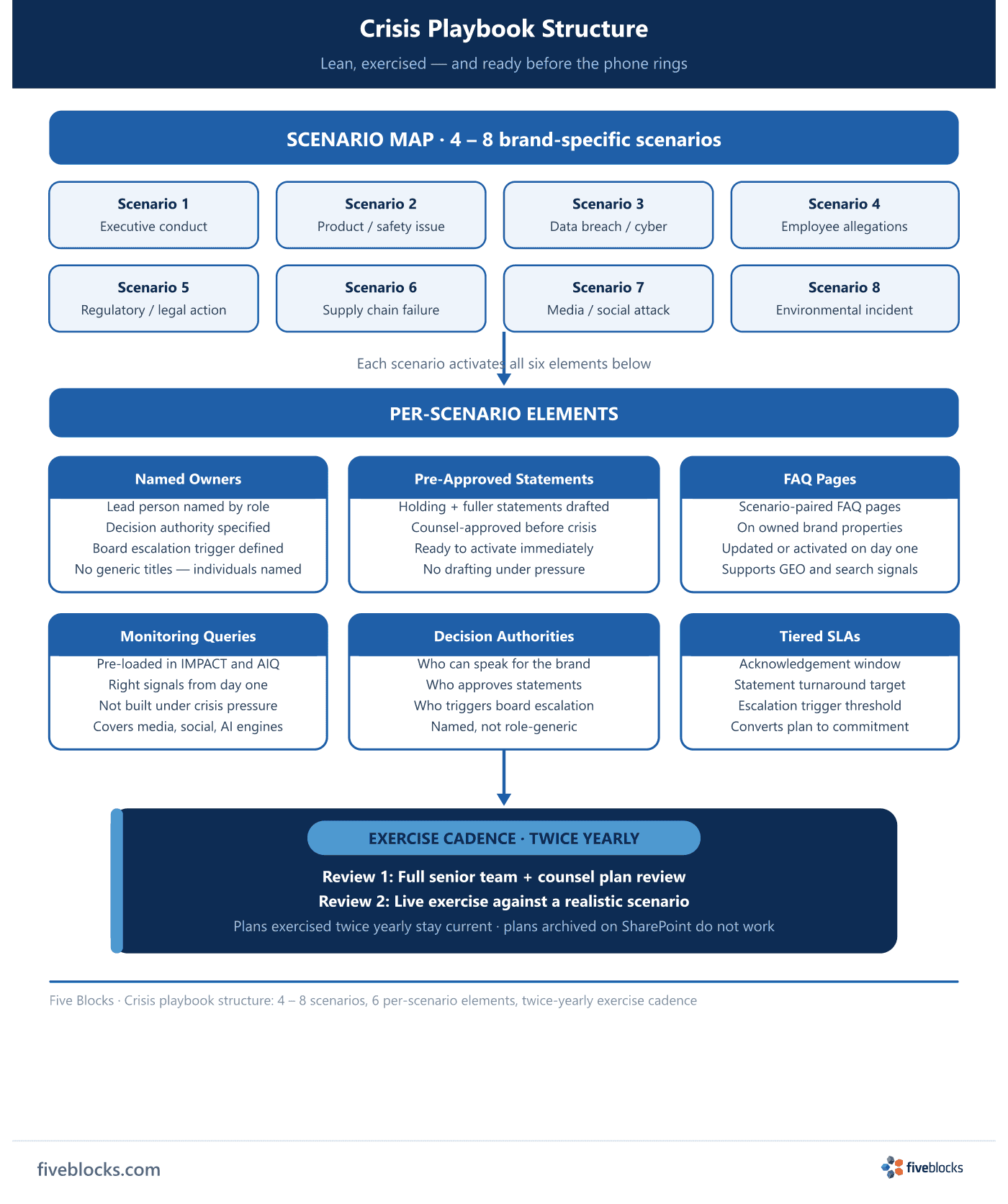
A useful crisis plan is lean and exercised, not long and archived. It identifies the four to eight scenarios most likely to affect your brand, based on industry, executive footprint, and recent history, and for each one it has everything ready to activate before the phone rings.
Step 1: Map your most likely scenarios
Identify four to eight scenarios specific to the brand, shaped by its industry, executive footprint, and recent history. Fewer than four and the plan is too generic; more than eight and it becomes a document no one reads.
Step 2: Assign named owners and decision authorities
For each scenario, name the person on point and specify who holds decision authority: who can speak for the company, approve a statement, or escalate to the board. Generic role titles are not enough. The plan names individuals.
Step 3: Prepare counsel-approved statements and FAQ pages
Draft holding statements and fuller statements for each scenario and have legal counsel pre-approve them before a crisis hits. Pair each scenario with the relevant FAQ pages on the brand’s owned properties, so those pages can be updated or activated right away.
Step 4: Pre-load monitoring queries
For each scenario, define the monitoring queries ready to activate in IMPACT and AIQ. The team then watches the right signals from day one of a situation instead of building the query set under pressure.
Step 5: Define tiered SLAs
Set explicit response-speed targets by tier: how quickly the team acknowledges, how quickly a statement goes out, how quickly escalation triggers. SLAs turn the plan from an intention into a measurable commitment.
Step 6: Exercise the plan twice a year
Review the plan with the senior team and counsel twice a year. At least one of those reviews should be a live exercise against a realistic scenario, run through the actual response sequence, so the muscle memory stays current. Plans that live on a SharePoint folder do not work; plans that get exercised twice a year and updated every time something changes do.
Last reviewed: 19/05/2026
