What should a digital reputation crisis playbook include?
A digital reputation crisis playbook is a working document that maps the four to eight most likely scenarios and, for each, names individual owners, decision authorities, SLAs, pre-approved statement templates, FAQ pages, monitoring priorities (IMPACT keyword sets and AIQ topics), vendor contacts, and explicit escalation triggers, plus post-event review procedures and twice-yearly live drills.
A useful crisis playbook is a working document, not something that sits on SharePoint until an audit. It is built around the scenarios most likely to hit a particular brand given its industry, executive footprint, and recent history, and it names individuals rather than titles so every component can be acted on in the first hour. Whether a plan works usually comes down to one thing: whether the team ever exercises it.
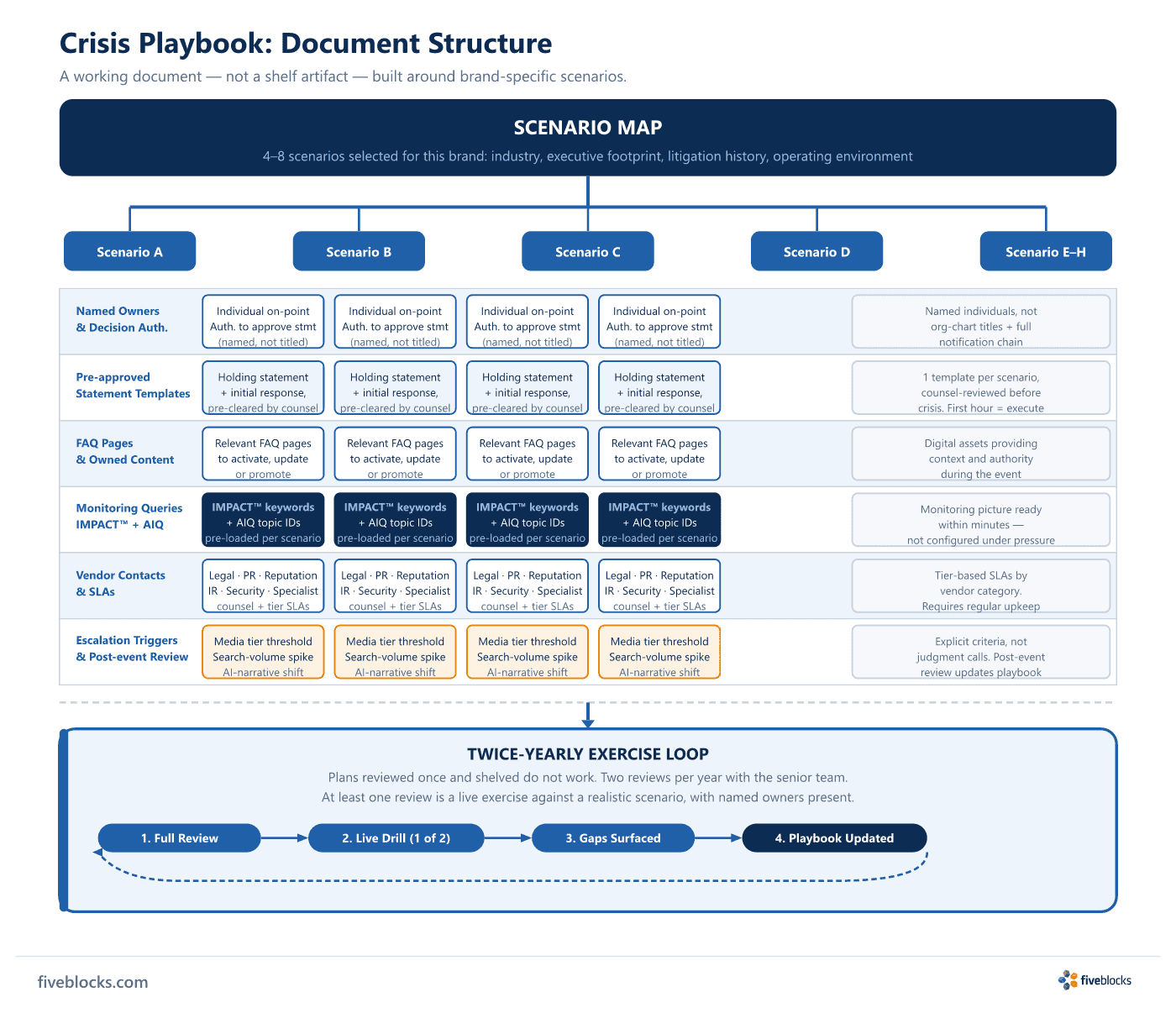
The seven components of an effective playbook
- Scenario map
- Four to eight scenarios chosen for this brand specifically: the events most likely given the company’s industry, executive visibility, litigation history, and operating environment. Tailored scenarios beat generic ones.
- Named owners and decision authorities
- Each scenario names the individual on point (not a title), the person who can authorize a public statement, and the chain of notification. It has to be named individuals rather than org-chart roles, because roles change and plans do not always get updated to match.
- Pre-approved statement templates
- Draft holding statements and initial responses reviewed by counsel before the crisis, one per scenario. The point is to spend the first hour executing a plan instead of getting language approved. Templates get updated whenever counsel or the situation changes.
- FAQ pages and owned content
- For each scenario, the FAQ pages and owned explanatory content to activate, update, or promote when it occurs. These are the digital assets that carry context and authority during the event.
- Monitoring priorities: IMPACT keyword sets and AIQ topics
- For each scenario, the IMPACT™ keyword sets and AIQ monitoring topics that get switched on immediately. Pre-loading them means you have a monitoring picture within minutes of a situation breaking, instead of configuring one under pressure.
- Vendor contacts and SLAs
- A current contact list for legal counsel, PR firm, reputation firm, IR, security, and any specialized counsel by category (defamation, employment, regulatory), with explicit SLAs for response speed by tier. Contact lists go stale, so this section needs regular maintenance.
- Escalation triggers and post-event review
- Escalation triggers are explicit criteria, not judgment calls: specific thresholds (media tier, search-volume spike, AI-narrative shift) that move the situation to the next tier of response automatically. Post-event review procedures make sure every incident produces playbook updates before the next cycle.
The exercise discipline
A plan that gets reviewed once and shelved does not work. Review the playbook twice a year with the senior team, and run at least one of those reviews as a live exercise against a realistic scenario, with named owners in the room. The exercise keeps the team sharp and finds the gaps while they are still cheap to fix.
Last reviewed: 19/05/2026
