How do you build a rapid response team for reputation emergencies?
A rapid-response team for reputation emergencies pairs named owners across communications, legal, investor relations, security, and the external reputation firm, each with defined decision authorities and 24/7 reachability, and runs twice-yearly drills to build real speed. The gaps drills most often expose are in handoffs between functions, not in any single function's capability.
A rapid-response team for reputation emergencies has to work under pressure, not just exist on an org chart. Composition matters less than practiced response, which is why teams that live only on paper fall behind in the first 24 hours of a real situation.
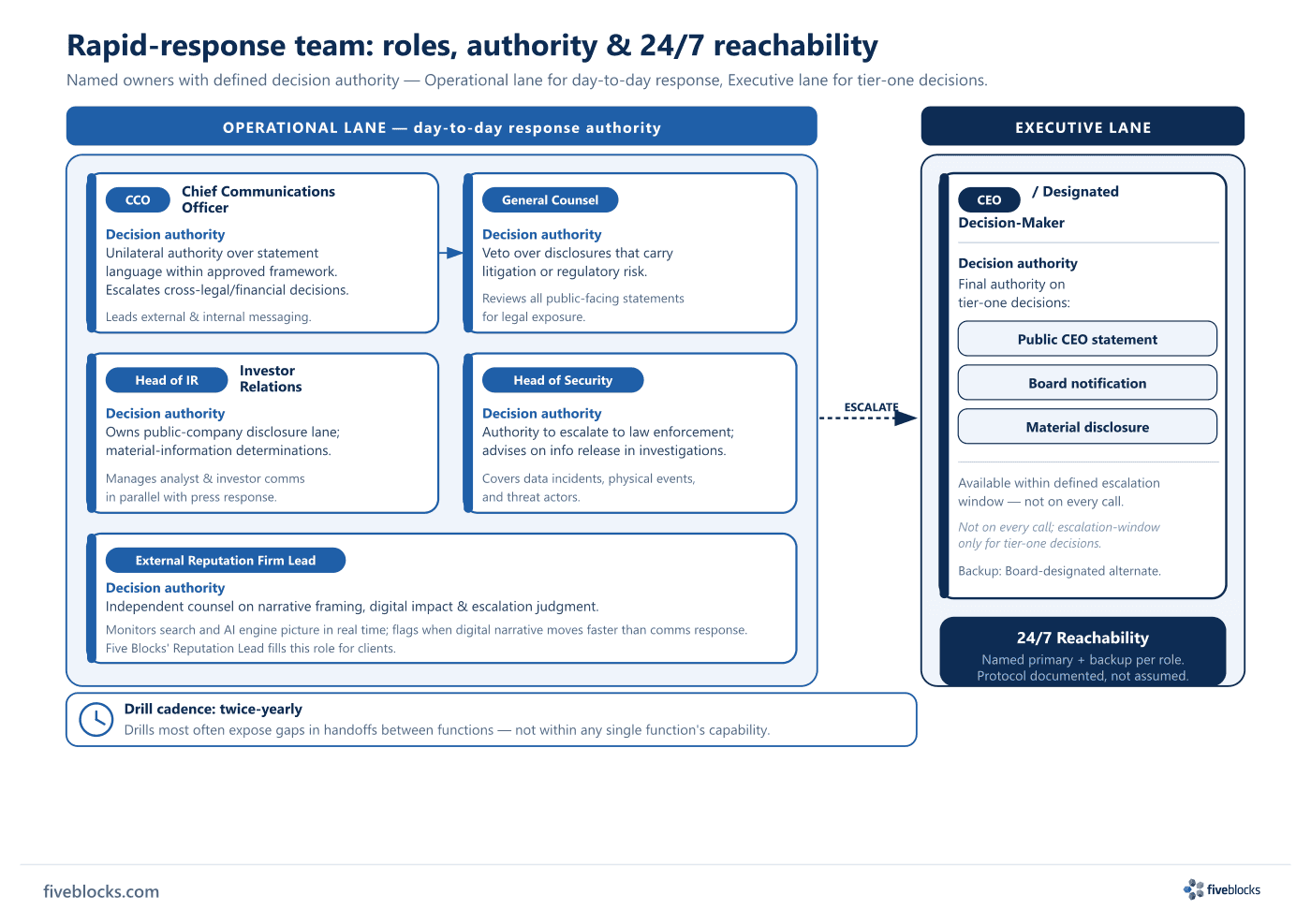
Core team roles and decision authority
- Chief Communications Officer (CCO)
- Leads external and internal messaging; has unilateral authority over statement language within the approved framework; escalates decisions that cross legal or financial thresholds.
- General Counsel
- Reviews all public-facing statements for legal exposure; has veto authority over disclosures that carry litigation or regulatory risk.
- Head of Investor Relations (IR)
- Owns the public-company disclosure lane; coordinates with counsel on material-information determinations and manages analyst and investor communications alongside the press response.
- Head of Security
- Covers situations involving data incidents, physical events, or threat actors; has authority to escalate to law enforcement and to advise on information release that could compromise an active investigation.
- External Reputation Firm Lead
- Gives independent counsel on narrative framing, digital impact, and escalation judgment; watches the search and AI engine picture in real time and flags when the digital narrative is moving faster than the communications response.
- CEO or Designated Decision-Maker
- Holds final authority on tier-one decisions, public CEO statement, board notification, material disclosure. Available within a defined escalation window, not on every call.
24/7 reachability
Each role has a named primary and backup contact with confirmed reachability during active rotation. Document the protocol rather than assume it: teams that rely on informal contact lists find the gaps exactly when they cannot afford to.
Drill cadence and what drills reveal
Twice-yearly drills against realistic, scenario-specific scripts are what make the team fast. In our experience running these exercises, the gaps that surface are almost always in handoffs between functions: the moment legal review is done and the CCO needs the statement back, or when IR needs to act before general counsel has fully signed off. They are rarely in any single function’s own capability. A drill makes those handoff delays visible in a controlled setting where you can fix them; in a real crisis, the same delay costs you the first news cycle.
Last reviewed: 19/05/2026
