What should you do if your Wikipedia page is flagged for issues?
Each Wikipedia maintenance flag points to a specific policy problem: notability tags question whether enough independent coverage exists; neutrality and NPOV tags flag biased framing; citation-needed markers request sources for unsupported claims; original-research flags require rewriting with sourced language; and weasel-word warnings flag vague, unattributed assertions. Fix each flag through the specific change it identifies, document what you changed on the Talk page, and request removal only after the underlying issue is resolved.
Wikipedia maintenance flags are signals from the editing community about a real policy problem. Each flag maps to a named policy concern and needs a targeted fix. A blanket cleanup or a unilateral tag removal will not resolve it.
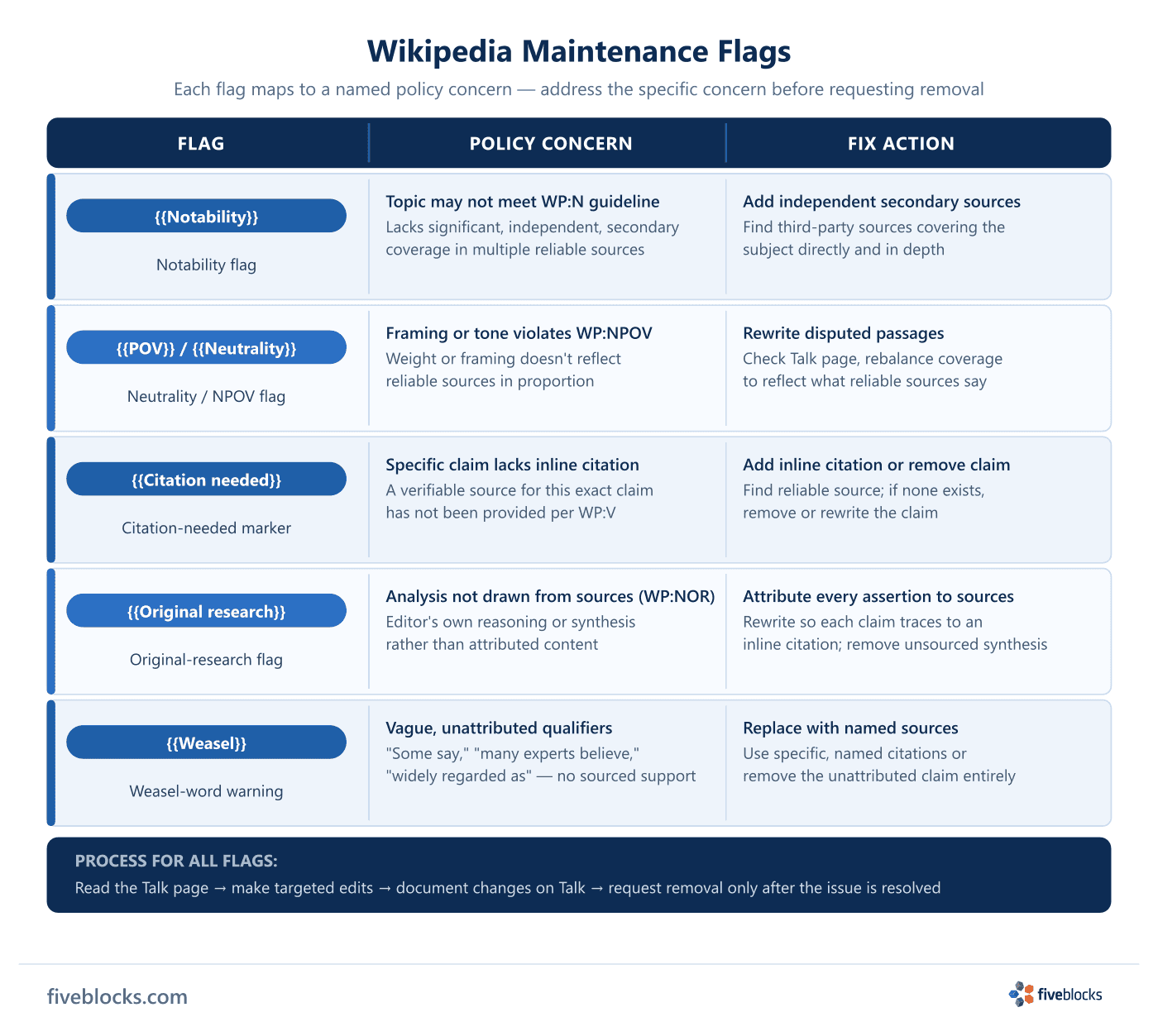
- Notability tag (
{{Notability}}) - Policy concern: The topic may not meet Wikipedia’s general notability guideline, meaning it lacks significant coverage in multiple reliable, independent, secondary sources.
Fix: Add third-party, independent secondary sources that cover the subject directly and in depth. If those sources do not exist, the article may not be viable. Do not remove the tag without addressing the sourcing gap. - Neutrality / NPOV tag (
{{POV}}or{{Neutrality}}) - Policy concern: The framing, weight, or tone of specific passages does not fairly represent the viewpoints published by reliable sources in proportion to their prominence.
Fix: Identify the disputed passages (often flagged in the Talk-page thread that triggered the tag), rewrite them to reflect what reliable sources actually say, and rebalance coverage. Do not delete opposing viewpoints; reframe them accurately. - Citation-needed marker (
{{Citation needed}}) - Policy concern: A specific claim lacks an inline citation to a reliable source.
Fix: Find a reliable, independent source that supports the exact claim and add it as an inline citation. If no source exists, the claim should be removed or rewritten to match what can be sourced. - Original-research flag (
{{Original research}}) - Policy concern: The article (or a section) contains analysis, synthesis, or conclusions not drawn directly from published reliable sources, meaning the editor’s own reasoning rather than attributed content.
Fix: Rewrite affected passages so every assertion traces directly to an inline citation. Remove or restructure any synthesis that cannot be attributed. - Weasel-word warning (
{{Weasel}}) - Policy concern: The text uses vague, unattributed qualifiers (“some say,” “many experts believe,” “widely regarded as”) that imply sourced support without providing it.
Fix: Replace vague attributions with specific, named sources and inline citations, or remove the unattributed claim entirely.
Process for resolving any flag
- Read the Talk page. The editor who placed the flag often explains the specific concern there.
- Make targeted edits that directly address the stated concern.
- Document your changes on the Talk page so other editors can follow the reasoning.
- Request tag removal on the Talk page once the underlying issue is resolved; do not remove tags unilaterally without discussion.
Editors who fix flags properly and explain their work earn trust with the community. Removing a tag without fixing the underlying issue usually gets reverted and can escalate to administrator intervention.
Last reviewed: 19/05/2026
