How do you respond to a Wikipedia Articles for Deletion nomination?
Quick answer
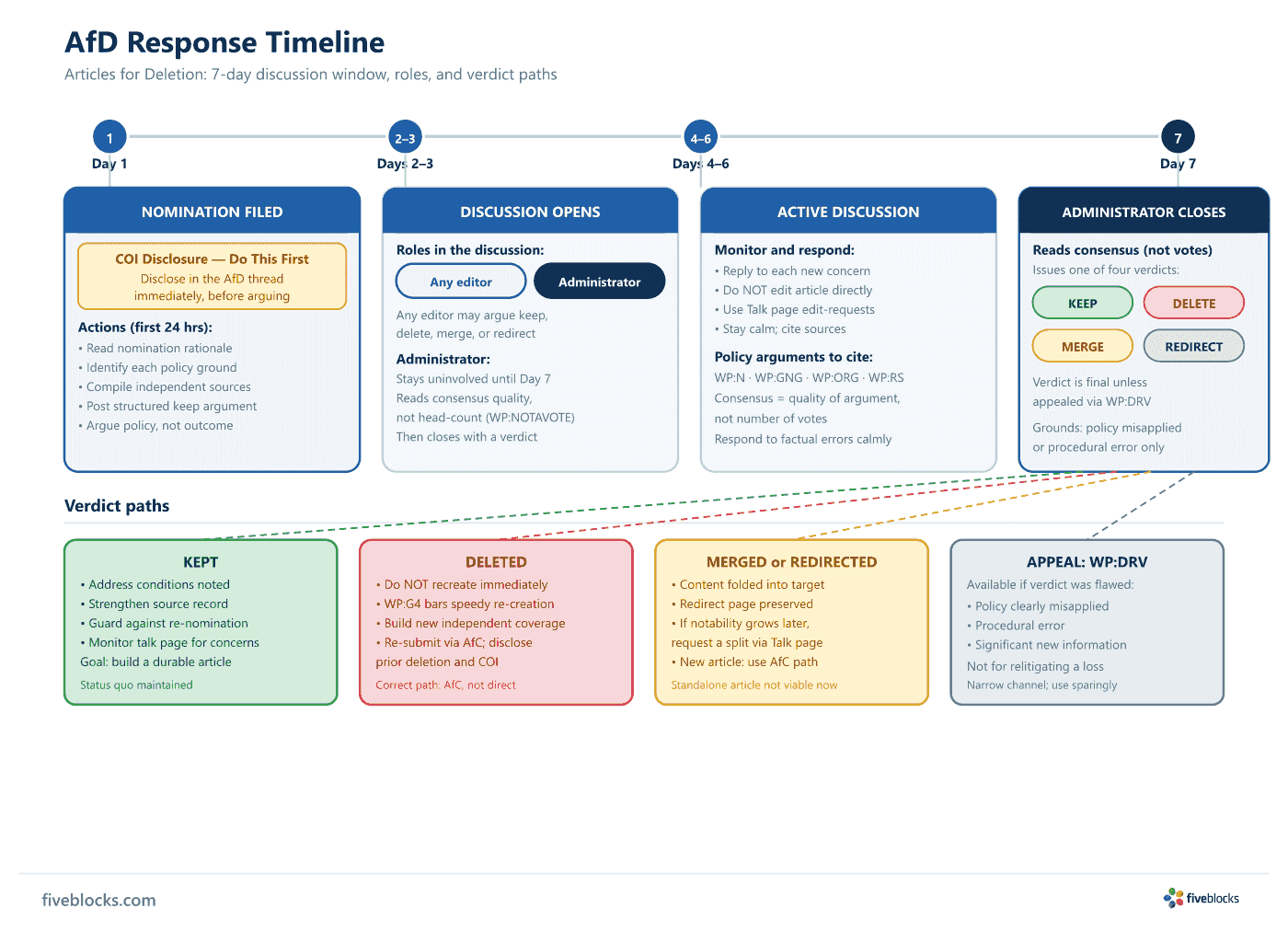
Respond to an AfD nomination by participating in the discussion on its own terms: disclose your COI explicitly in the AfD thread, address each specific deletion rationale with policy arguments and your strongest independent secondary sources, and accept the outcome. The discussion runs about seven days and is closed by consensus, not vote count.
An Articles for Deletion nomination is a formal community process with a defined procedure. Engaging it correctly, on its own procedural terms, gives the article its best chance. The responses most likely to end in deletion are working around the process, hiding the COI relationship, or ignoring the nomination.
How the AfD process works
- Any editor can nominate an article for deletion by filing a rationale on the AfD discussion page.
- The discussion runs for about seven days, during which any editor can argue keep, delete, merge, or redirect, citing policy and sources.
- At close, an uninvolved administrator weighs the consensus of the discussion, not a head count, and decides the outcome: keep, merge, redirect, or delete.
First-response checklist (within the first 24 hours)
- Read the nomination rationale carefully. Identify every specific policy ground the nominator cited (notability, sourcing, neutrality, and so on). Address each one separately.
- Disclose your COI in the AfD thread immediately. An AfD nomination draws scrutiny from experienced editors, and a COI relationship discovered partway through a deletion discussion does far more damage than one disclosed upfront. Use the standard paid-editor disclosure language.
- Compile your best independent secondary sources before posting. Assemble every substantial independent piece that covers the subject directly: major outlet profiles, analyst coverage, and industry recognition from editorially independent bodies. Gather these before you write your keep argument, not after.
- Draft your keep argument around policy, not outcome. Cite the relevant Wikipedia policy (WP:N, WP:GNG, WP:ORG, WP:RS) and show exactly how the sources satisfy it. A keep argument that reads as advocacy rather than policy reasoning carries less weight with the closing administrator.
- Post a structured keep statement that cites each source with its publication, the nature of the coverage, and the policy it satisfies.
During the seven-day window
- Watch the discussion for new concerns from other editors and respond to each one specifically.
- Do not edit the article directly during an active AfD. It shows a COI party making content changes under community scrutiny, which hurts your case.
- If other editors raise sourcing concerns, add citations through the Talk page using the edit-request process, not by editing the article directly.
- Answer factual mischaracterizations calmly and with citations. Do not argue about the outcome or accuse the nominator of bad faith.
After the decision
- If kept: address any conditions the closing administrator noted, and strengthen the source record against future nominations.
- If deleted: do not recreate the article right away. Recreating a deleted article through the same channels triggers speedy deletion under WP:G4. Instead, build materially new independent coverage first, then re-submit through Articles for Creation with the prior deletion disclosed and the COI acknowledged.
- If the deletion misapplied policy or had procedural errors: Wikipedia’s Deletion Review process (WP:DRV) lets the community revisit a closure. It is a narrow channel for process failures or significant new information, not a way to relitigate a loss.
Last reviewed: 19/05/2026
