What is the role of Wikipedia talk pages in page management?
Every Wikipedia article has a corresponding Talk page where editors discuss proposed changes rather than making them directly. For disclosed COI or paid editors, the Talk page is the only compliant entry point: propose changes there with reliable secondary sources, identify the paid relationship, and let independent community editors evaluate and implement. Direct edits from a COI account get reverted and tagged even when the underlying change is accurate.
Every Wikipedia article has a corresponding Talk page, the discussion space where editors debate changes before they reach the article itself. For work on client pages, the Talk page is where all of it happens. It is not optional, and it is the only compliant way in.
The compliant editing model
Wikipedia’s WP:COI and WP:PAID policies set out two paths for interested-party editors:
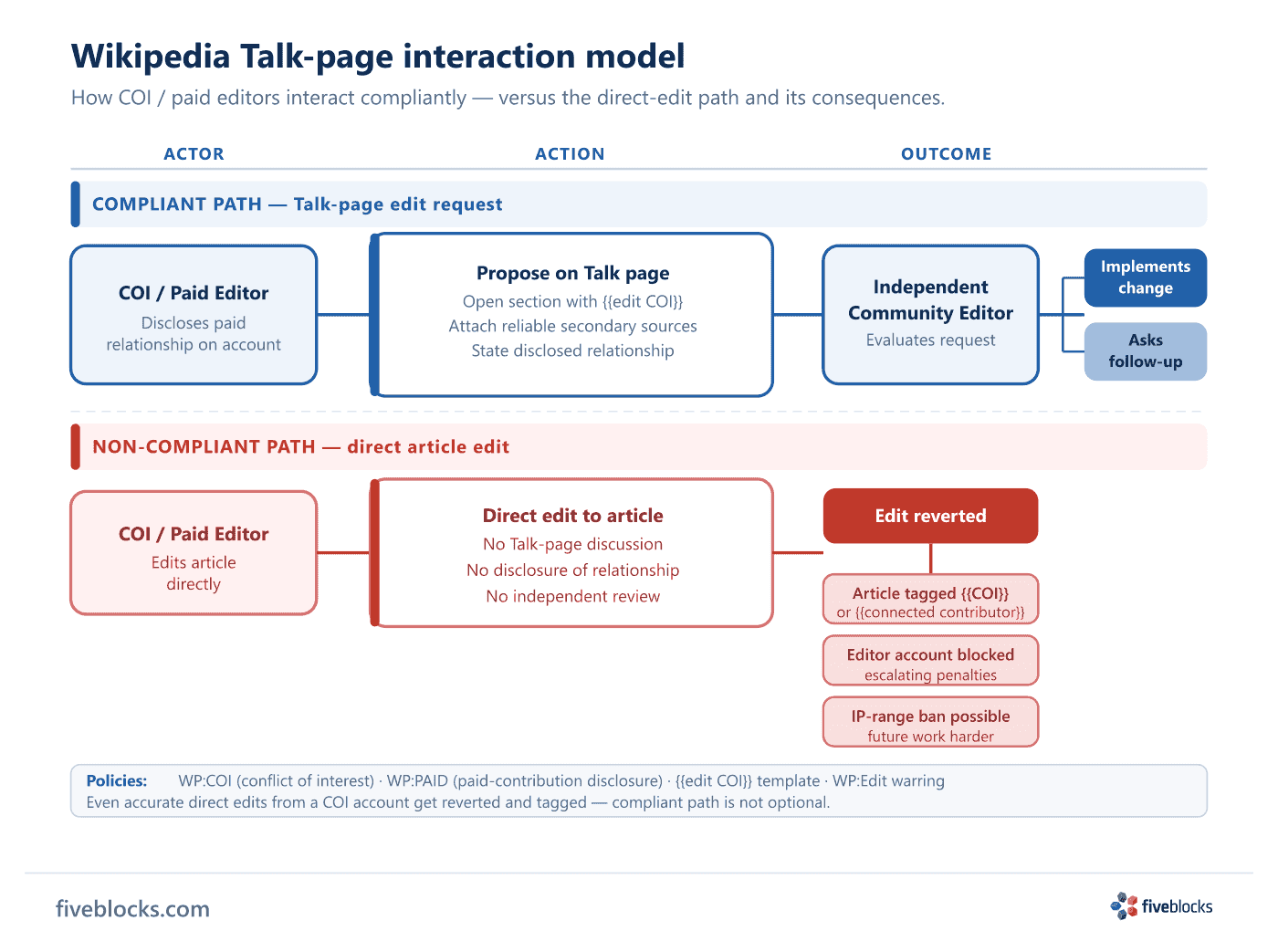
- Compliant path, Talk-page edit request: Disclose the paid relationship on the user account, open a Talk-page section using the
{{edit COI}}template, attach reliable secondary sources, and wait for an uninvolved community editor to evaluate the request and implement (or ask follow-up questions). - Non-compliant path, direct article edit: Edits made directly to an article from a COI account get reverted and the article is tagged with
{{COI}}or{{connected contributor (paid)}}, even when the underlying correction is accurate.
What the Talk-page process produces
- A documented record. Every proposal, source, and reviewer response is permanently logged, which the wider editing community can check.
- Durable consensus. A change implemented by an uninvolved editor after Talk-page discussion carries community authority; the same change pushed in directly can be reverted indefinitely.
- Credibility with page watchers. Editors who follow a page closely see every Talk-page post in their watchlist. A professional, policy-grounded tone builds goodwill; an argumentative one creates lasting hostility that follows the article for years.
Consequences of bypassing the process
Direct edits, undisclosed accounts, or repeated reverts each carry escalating consequences: article tagging, editor account blocks, IP-range bans, and community scrutiny that makes future legitimate work harder. The Talk-page model takes patience, and that patience is what produces results that last.
Last reviewed: 19/05/2026
