What should you do if a competitor edits your Wikipedia page?
Address the substance on the article's Talk page, citing the specific policy the edit breaks (NPOV, verifiability, COI, or undue weight), and propose a sourced, policy-compliant alternative. If the editor refuses to engage or keeps violating policy, escalate to the relevant noticeboards (NPOV/N, RSN, COIN) and ultimately administrator review. Never revert-war.
Competitor edits on a client’s Wikipedia article are common, and the response is a routine workflow, not an emergency. Argue the substance on the Talk page first, escalate through the proper noticeboards only if good-faith discussion fails, and never get drawn into a revert war. That last point matters: revert-warring is how disclosed conflict-of-interest (COI) editors lose credibility and get sanctioned.
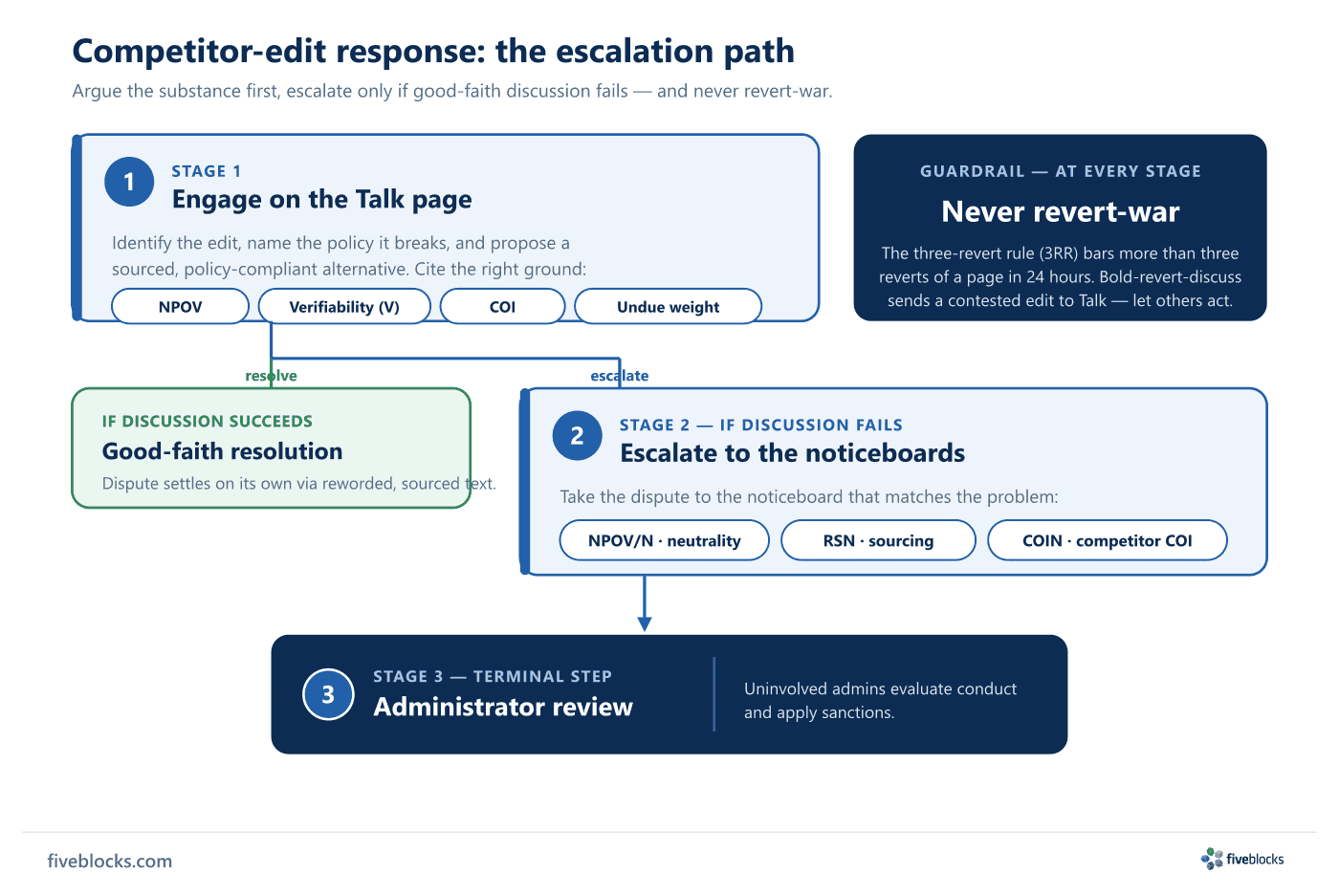
Step 1, engage on the Talk page
Do not edit the article directly. Open a section on the article’s Talk page that does three things:
- Identify the specific edit you are objecting to.
- Name the policy it breaks: neutral point of view (NPOV) for promotional or smear language, verifiability (V) where reliable sourcing is missing, conflict of interest (COI) if the editor is a disclosed competitor, or undue weight where a minor issue is overemphasized.
- Propose a policy-compliant alternative, backed by reliable secondary sources.
If the competitor editor responds and a good-faith discussion follows, the dispute often resolves through reworded, sourced text.
Step 2, escalate to noticeboards if discussion fails
If the editor refuses to engage or keeps violating policy, take the dispute to the noticeboard that matches the problem:
| The problem | Where it escalates |
|---|---|
| Neutrality / point-of-view disputes | NPOV noticeboard (NPOV/N) |
| Source reliability | Reliable sources noticeboard (RSN) |
| A competitor’s conflict of interest | Conflict-of-interest noticeboard (COIN) |
Step 3, administrator review
Where conduct rather than content is the issue, or where noticeboard discussion does not settle the matter, uninvolved administrators can evaluate behavior and apply sanctions.
The guardrail: never revert-war
Do not trade revert for revert. Wikipedia’s three-revert rule (3RR) prohibits more than three reverts of the same page within 24 hours, and its bold-revert-discuss convention sends a contested edit to the Talk page the first time it is reverted. For a disclosed-COI editor the rule is stricter: take it to Talk and let uninvolved community editors act, rather than reverting directly.
Last reviewed: 19/05/2026