What is a Wikipedia edit war and how do you avoid one?
An edit war is a back-and-forth cycle of reverts between editors without Talk-page resolution. Avoid one by following the Bold-Revert-Discuss (BRD) convention, respecting the three-revert rule (3RR), and, for disclosed COI editors, by never reverting directly: propose changes on the Talk page and wait for community editors to implement.
An edit war is what happens when editors repeatedly revert each other on a contested change without taking the dispute to the Talk page. Wikipedia handles this through three mechanisms: the Bold-Revert-Discuss (BRD) convention, the three-revert rule (3RR), and administrator enforcement. For disclosed conflict-of-interest (COI) editors, the rule is simple: never revert directly, go straight to the Talk page.
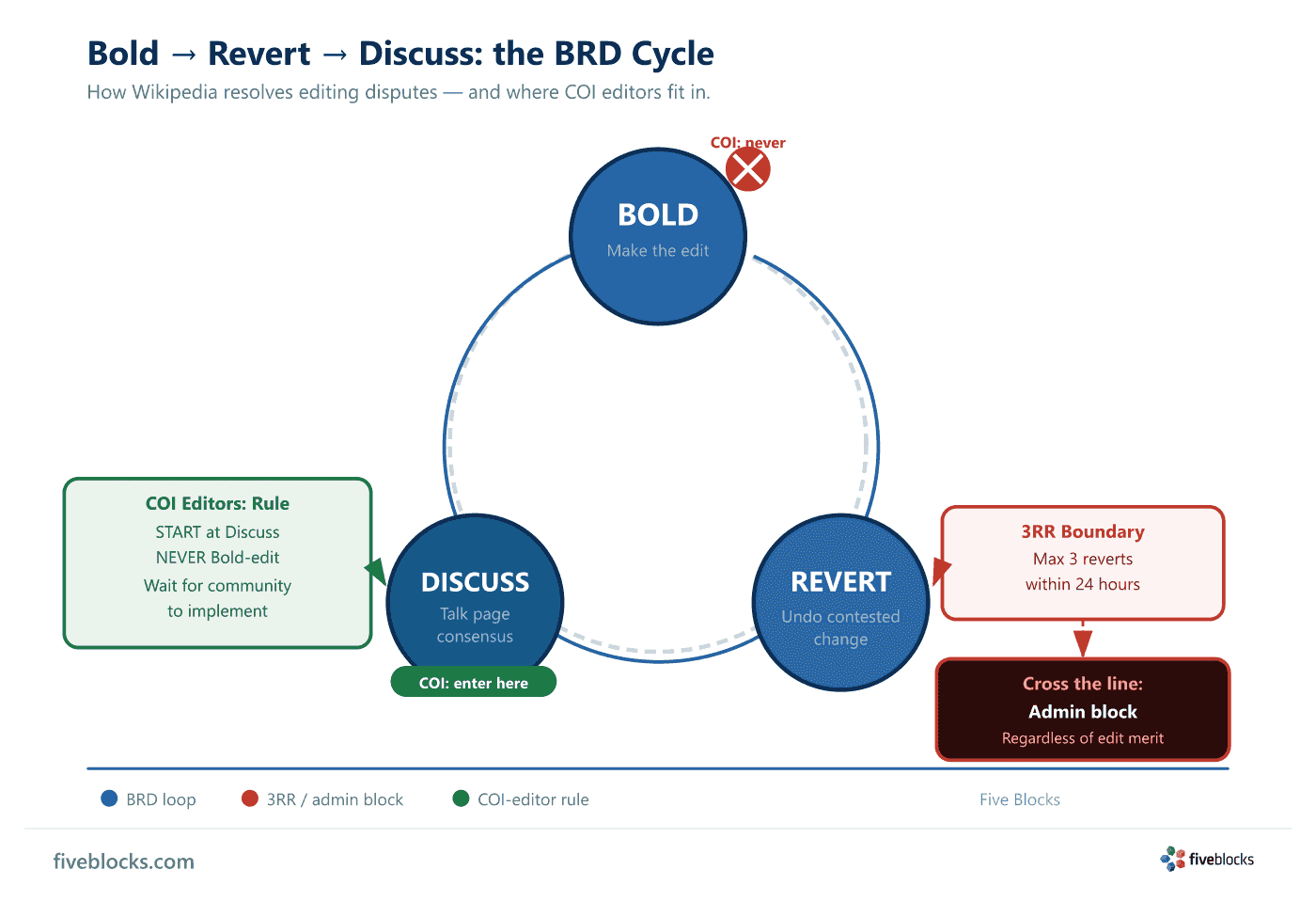
How the BRD cycle works
- Bold: An editor makes a change they believe improves the article.
- Revert: Another editor disagrees and reverts the change.
- Discuss: The editors take the dispute to the Talk page to build consensus before re-editing.
If the reverted editor skips the Discuss step and reverts back instead, the cycle becomes an edit war. Wikipedia policy is clear: after a revert, the next step is the Talk page, not another revert.
The three-revert rule (3RR)
The three-revert rule prohibits any editor from making more than three reverts on the same article within a 24-hour period. Crossing that line is grounds for an administrator to block the editor, regardless of whether the underlying edits were correct. Administrators can also block for edit warring that stays below the 3RR threshold if the pattern is clearly disruptive.
What this means for COI editors
- Never revert directly. A COI editor who reverts an edit to a client article, even a genuinely harmful one, is violating COI norms and inviting an administrator block.
- Open a Talk-page section immediately. Cite the relevant policy (NPOV, reliable sourcing, undue weight), propose the specific change with reliable secondary sources attached, and identify the COI relationship.
- Wait for community implementation. An uninvolved editor evaluates the request and implements it if policy-compliant. This produces durable consensus rather than a reverted edit.
- Report clear vandalism through proper channels. Obvious vandalism can be flagged to the article’s Talk page or to administrator noticeboards rather than self-reverted by the COI editor.
Why patience pays
The Talk-page route is slower, but it leaves a documented record and community buy-in that protect the change from future challenges. An edit war usually ends with the contested content locked, the edit reverted to a pre-dispute version, and both parties under administrator scrutiny. For a client engagement, that is the outcome you least want.
Last reviewed: 19/05/2026
