How do you handle a Wikipedia editor who is hostile to your page?
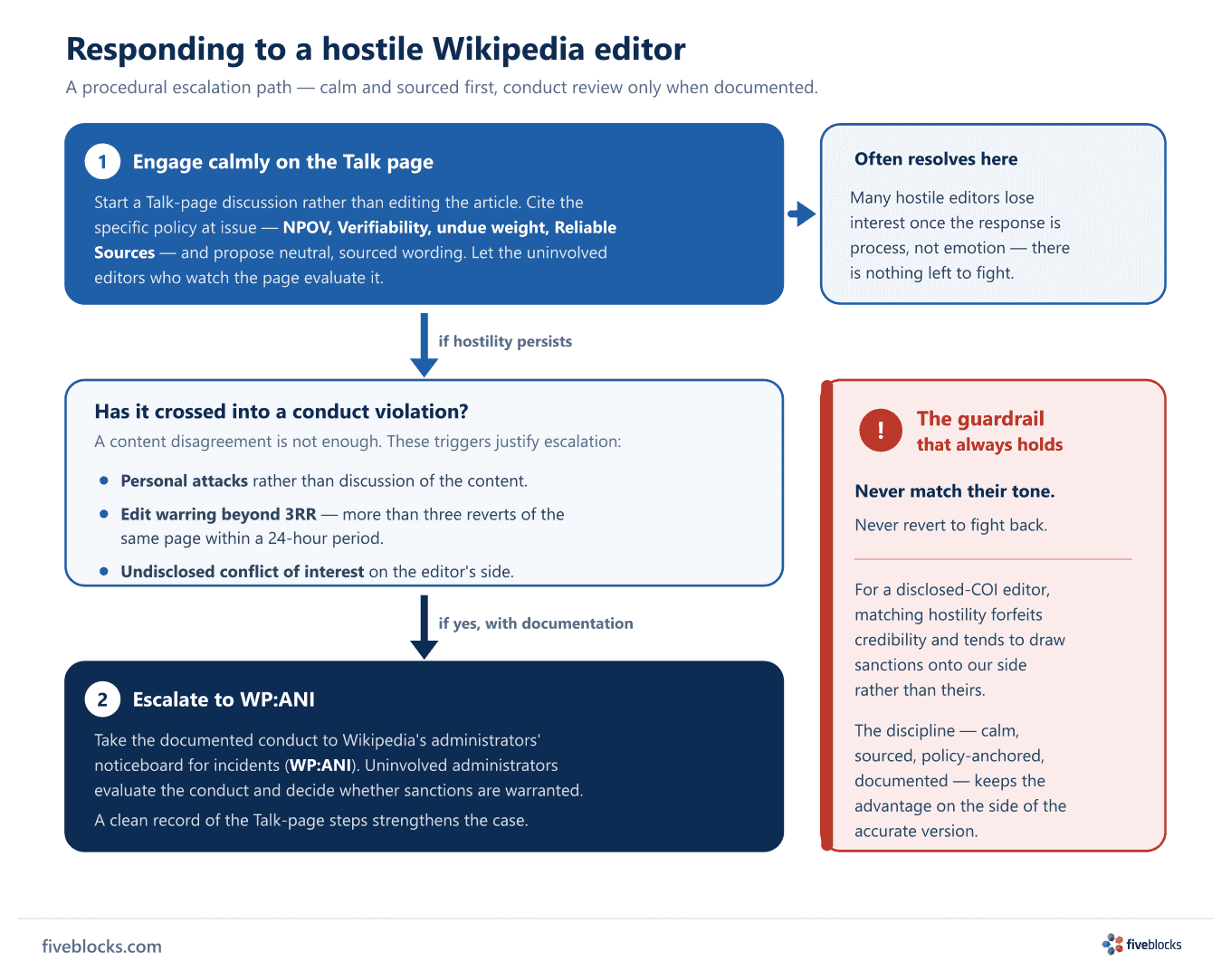
Engage calmly on the article's Talk page with specific policy citations and reliable sources, and let the editors watching the page evaluate the proposed wording. If the editor's conduct itself crosses into policy violations - personal attacks, edit warring beyond the three-revert rule, or undisclosed conflict of interest - you can escalate to the administrators' noticeboard (WP:ANI) with proper documentation. Never match a hostile editor's tone or revert to fight back; that costs a disclosed-COI editor credibility and tends to draw sanctions on our side rather than theirs.
A hostile editor on a client’s Wikipedia article is a familiar situation, and the response is procedural rather than confrontational. The goal is not to win an argument with the editor. It is to put a policy-grounded, well-sourced proposal in front of the community editors who watch the page and let the process work.
The procedural response, step by step
- Open on the Talk page, calmly. Identify the specific contested content and start a Talk-page discussion rather than editing the article directly.
- Cite the relevant policy explicitly. Name the policy at issue – neutral point of view (NPOV), verifiability (V), undue weight, or reliable sources (RS) – so the discussion is anchored to a rule, not a personality.
- Propose sourced alternative wording. Offer encyclopedic, neutral text backed by reliable secondary sources, and invite the uninvolved editors watching the page to evaluate it.
- Let the community decide. Many hostile editors lose interest once the response is process rather than emotion, because there is nothing to fight.
The point to keep in mind: when the response is procedural and sourced, hostility often fades on its own.
When to escalate to conduct review
If the hostility continues and crosses from a content disagreement into policy-violating conduct, a separate path opens. You can escalate to Wikipedia’s administrators’ noticeboard for incidents (WP:ANI), and it works when the case is documented properly. The triggers that justify it:
- Personal attacks rather than discussion of the content.
- Edit warring beyond the three-revert rule (3RR) – more than three reverts of the same page within a 24-hour period.
- Undisclosed conflict of interest on the hostile editor’s side.
At ANI, uninvolved administrators evaluate the conduct and decide whether sanctions are warranted. A clean, documented record of the earlier Talk-page steps strengthens the case.
The one move that never works
Matching a hostile editor’s tone or reverting to fight back never works. For an editor operating under disclosed-COI discipline, that behavior forfeits credibility and often produces sanctions on our side rather than theirs. Staying calm, sourced, policy-anchored, and documented is what keeps the advantage on the side of the accurate version.
Last reviewed: 19/05/2026
