How do you request a review of a Wikipedia page that has been unfairly edited?
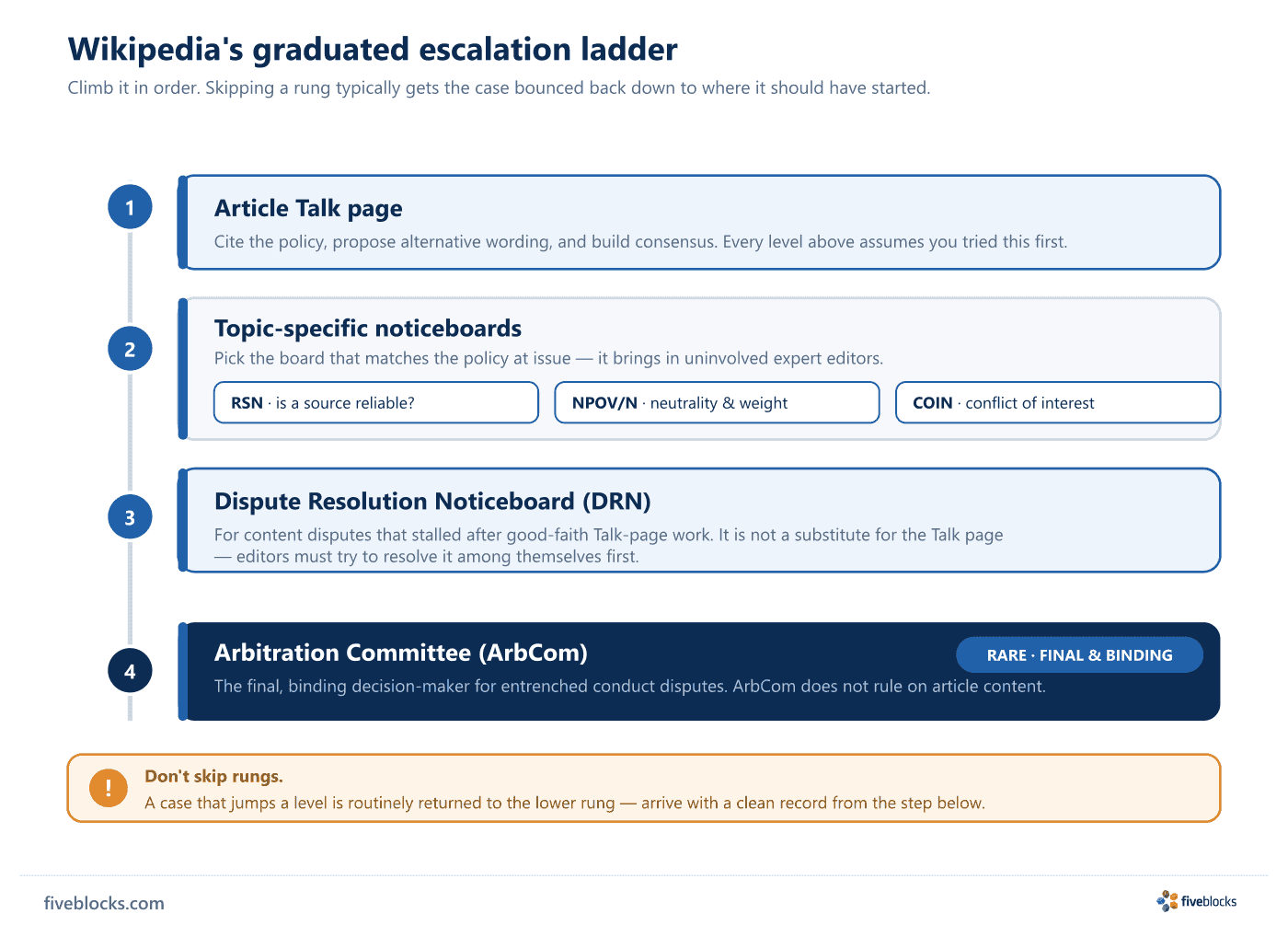
Use Wikipedia's graduated escalation ladder in order: start on the article's Talk page citing policy and proposing alternatives; if that fails, take it to the topic-specific noticeboard (Reliable Sources, NPOV, or Conflict of Interest); then to the Dispute Resolution Noticeboard for content disputes that have stalled after good-faith Talk-page work; and to the Arbitration Committee only for rare, entrenched conduct disputes. Skipping levels typically gets the case bounced back down to where it should have started.
Wikipedia has a graduated escalation system for disputes, and the order matters: skipping levels typically gets a case dismissed and sent back down to where it should have started. Each rung also exists for a different kind of problem, so a review request succeeds when you name the right one and arrive with a clean record from the rung below.
The escalation ladder, in order
- The article’s Talk page. Identify the specific edits at issue, cite the policy they violate, propose alternative wording, and try to build consensus with the editors already involved. Every other level assumes this step was attempted first.
- The topic-specific noticeboard. If the dispute turns on a particular policy, take it to the matching noticeboard, which brings uninvolved expert editors into the discussion:
- Reliable Sources Noticeboard (RSN) – for disputes about whether a source is reliable.
- NPOV Noticeboard (NPOV/N) – for neutrality and undue-weight concerns.
- Conflict of Interest Noticeboard (COIN) – for questions about whether an editor has a conflict of interest.
- The Dispute Resolution Noticeboard (DRN). For content disputes that have stalled after good-faith Talk-page discussion. It is explicitly not a substitute for the Talk page – editors are expected to have tried to resolve the dispute among themselves first.
- The Arbitration Committee (ArbCom). The final, binding decision-maker, reserved for entrenched conduct disputes that the lower levels have failed to resolve. ArbCom does not rule on article content, so it is rarely the right venue for a content-edit complaint.
Why order matters
The ladder is enforced. The Dispute Resolution Noticeboard is documented as being for disputes that have already been extensively discussed on the Talk page, and it states plainly that editors must attempt to resolve the dispute themselves before seeking outside help. A case that jumps a rung is routinely returned to the lower level.
Doing it properly also leaves a useful record. Wikipedia logs page history and Talk-page discussion publicly, so a documented trail of careful work at the lower levels strengthens the case if higher escalation does become necessary.
Last reviewed: 19/05/2026
