How does Wikipedia’s editorial process actually work?
Wikipedia's editorial process is community-driven: anyone with an account can propose a change by editing directly or posting a Talk-page edit request, and consensus is worked out through Talk-page discussion. When editors cannot agree, the dispute escalates - from the Talk page to content noticeboards like the Dispute Resolution Noticeboard, to the administrators' incidents noticeboard (ANI) for conduct, and ultimately to the Arbitration Committee for the most entrenched cases - with notability, NPOV, BLP, and reliable-sourcing policies governing what is allowed throughout.
Wikipedia’s editorial process is community-driven and procedural: there is no editor-in-chief who approves changes. Anyone with an account can propose a change, the community works toward consensus on the Talk page, and unresolved disagreements move up a defined escalation path. A small set of core content policies decides what is allowed at every stage.
How a change moves through the process
- Propose. Anyone with a Wikipedia account can propose a change, either by editing the article directly or by posting a Talk-page edit request. Other editors then review it and accept, modify, or revert it.
- Discuss toward consensus. When editors disagree, the article’s Talk page is where positions are argued against policy and sources. By convention, a contested edit goes to Talk-page discussion the first time it is reverted rather than being re-reverted.
- Escalate if consensus fails. If Talk-page discussion stalls, the dispute moves up a defined ladder of noticeboards and, as a last resort, to the Arbitration Committee.
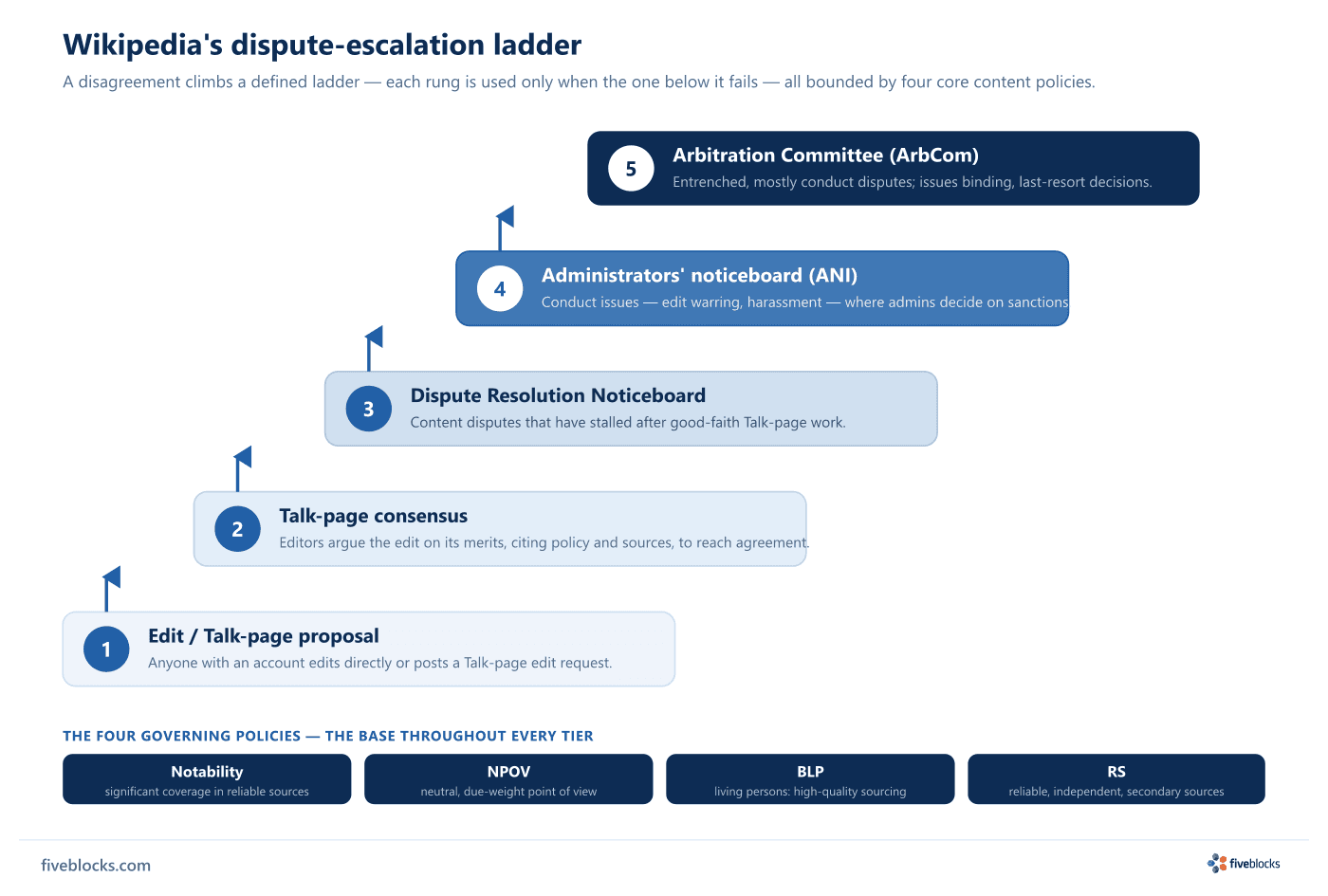
The escalation ladder
| Tier | Forum | What it handles |
|---|---|---|
| 1 | Talk page | First-line discussion; editors argue the edit on its merits against policy and sources. |
| 2 | Content noticeboards (e.g. Dispute Resolution Noticeboard, NPOV/N, RSN) | Content disputes that have stalled after good-faith Talk-page work. |
| 3 | Administrators’ noticeboard (ANI) | Conduct issues, edit warring, policy circumvention, harassment, where uninvolved administrators decide whether sanctions are warranted. |
| 4 | Arbitration Committee (ArbCom) | Entrenched, primarily conduct-related disputes that all other processes have failed to resolve; it issues binding decisions. |
The policies that govern it
The same core content policies apply at every tier:
- Notability, a topic needs significant coverage in multiple reliable, independent secondary sources to merit an article.
- Neutral point of view (NPOV), articles must represent significant viewpoints in proportion to their weight in reliable sources.
- Biographies of living persons (BLP), any contentious claim about a living person must be backed by high-quality reliable sources.
- Reliable sources (RS), content is built from independent, secondary sourcing such as established media coverage, not press releases or self-published material.
The practical takeaway: a Wikipedia change that respects consensus, the escalation ladder, and these policies holds up. One that tries to skip them does not.
Last reviewed: 19/05/2026
