What is Wikipedia’s neutral point of view policy?
Quick answer
NPOV is Wikipedia's core editorial standard: articles must represent every significant viewpoint in proportion to its weight in reliable sources, without editorial advocacy or undue weight to fringe positions.
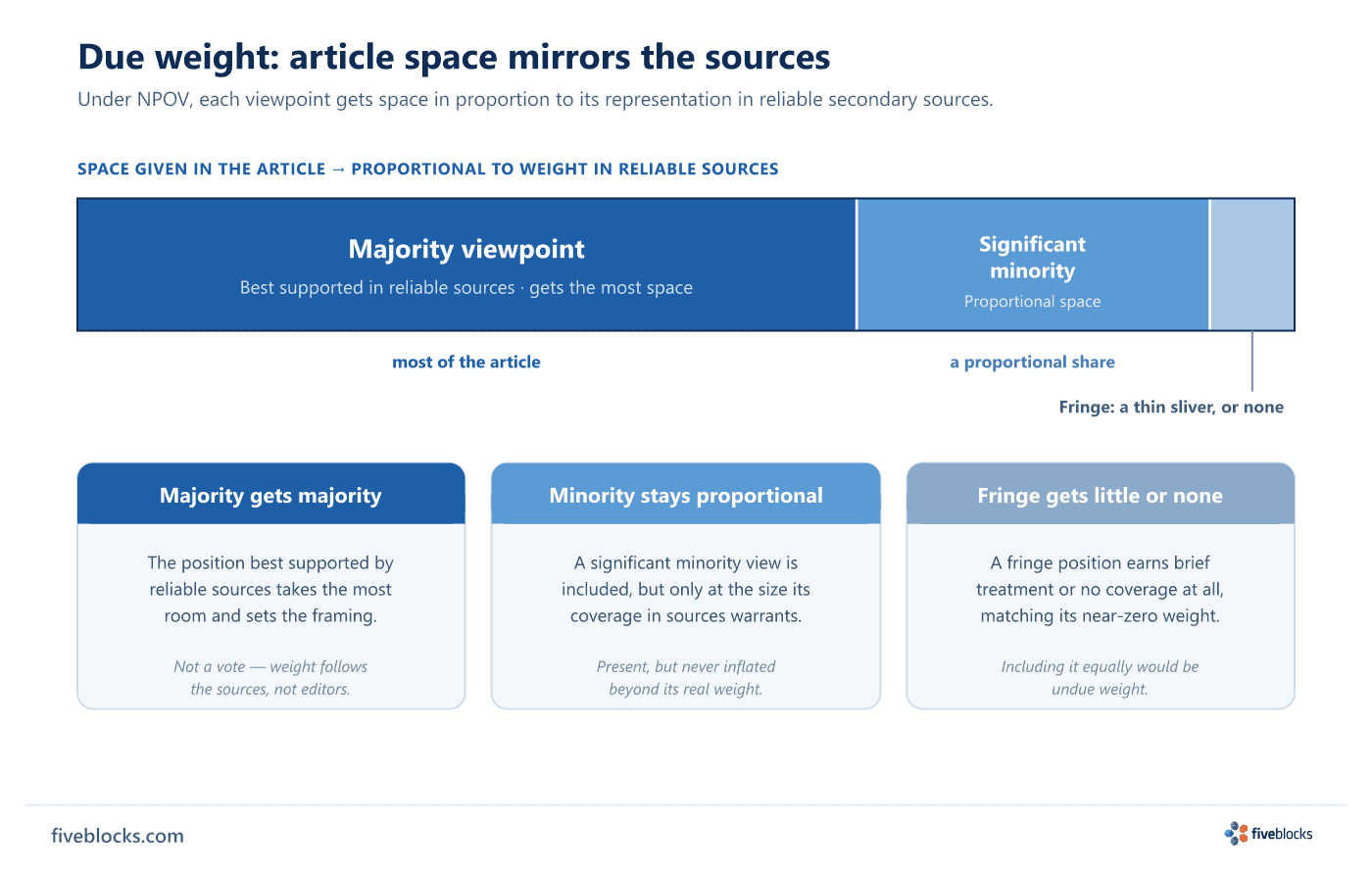
Neutral Point of View (NPOV) is Wikipedia’s core editorial policy. It requires articles to represent every significant viewpoint on a topic in proportion to its representation in reliable secondary sources.
That principle has two practical consequences:
- No advocacy. An article cannot argue for or against its subject. The editorial voice has to stay neutral, presenting positions as positions rather than as facts.
- Proportional weight. The space given to each viewpoint has to mirror the weight that viewpoint carries in reliable sources. Majority positions get majority treatment, minority positions get proportional treatment, and fringe positions get brief treatment or none at all.
Why NPOV matters for reputation work
For reputation work, NPOV is both a constraint and a tool.
- As a constraint, it limits what we can propose. We cannot suggest language that omits a documented controversy or that frames the subject more favorably than reliable sources do.
- As a tool, it is the policy for fixing imbalance. When an article gives undue weight to a single critical source, NPOV is the basis for getting that imbalance addressed. The standard requires proportionality, not the removal of well-sourced material.
Last reviewed: 19/05/2026
