What are Wikipedia’s notability guidelines?
Notability requires significant coverage in reliable, independent secondary sources. For companies and people, that means substantive press in authoritative outlets, not press releases or self-published material.
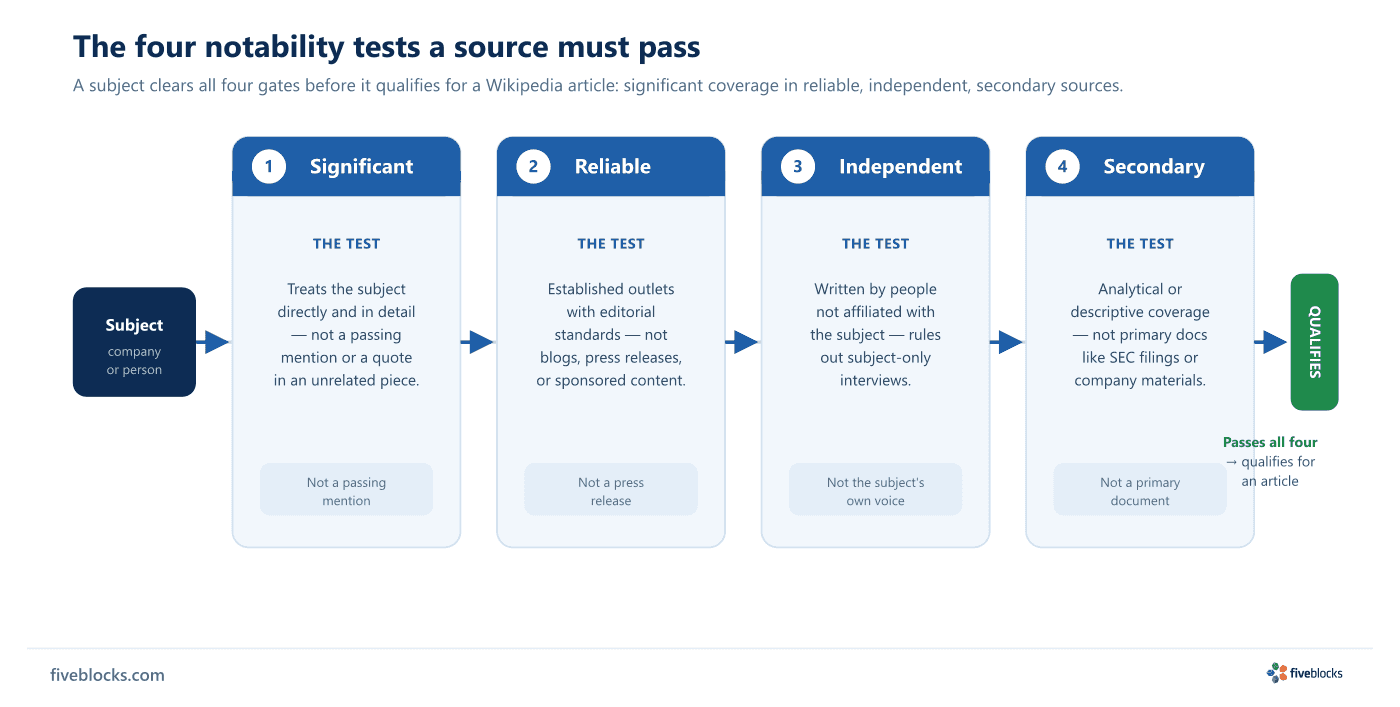
Notability is the threshold a subject has to clear before Wikipedia will host an article about it. The general notability guideline states it as significant coverage in multiple reliable, independent, secondary sources. Each of those four words does specific work.
The four words that define notability
- Significant
- Substantive treatment of the subject directly and in detail – not a passing mention or a quote inside an unrelated piece.
- Reliable
- Established outlets with editorial standards – not blog posts, press releases, sponsored content, or wire-service syndications of company announcements.
- Independent
- Written by people not affiliated with the subject, which rules out interviews where the subject is the only source.
- Secondary
- Analytical or descriptive coverage rather than primary documents like SEC filings or a company’s own materials.
People need similar coverage of their professional or public activities. The assessment is qualitative rather than quantitative: Wikipedia sets no fixed number of sources required, though multiple sources are generally expected, and a single piece in a top outlet rarely suffices on its own. Companies face a stricter bar still under the dedicated guideline for organizations and companies (WP:NCORP).
Without that record, an article either gets declined at submission or gets nominated for deletion later – a topic lacking sufficient independent coverage is unlikely to keep a stand-alone article.
Last reviewed: 19/05/2026
