What are Wikipedia’s reliable source standards?
A reliable source on Wikipedia is independent of the subject, secondary, published, professionally edited, and has a reputation for fact-checking. Press releases, sponsored content, native advertising, a company's own website, social media, and wire-service syndications of company announcements do not qualify.
Wikipedia’s reliable-source standard is specific, and it is the standard most conflict-of-interest Wikipedia work fails against. A source qualifies only when it meets all five of the attributes below. The categories brands most often reach for – their own announcements and paid distribution – are the ones that do not count.
The five attributes of a reliable source
- Independent
- The author and publisher have no affiliation with the subject being covered.
- Secondary
- It analyzes or describes the subject rather than restating primary information.
- Published
- It has gone through an editorial or publication process.
- Professionally edited
- It carries the editorial standards of an established outlet.
- Reputation for fact-checking
- The outlet is known to verify claims before publishing them.
What qualifies vs. what does not
| Reliable sources | Not reliable sources |
|---|---|
| Independent, professionally edited outlets with a fact-checking record | Press releases |
| Secondary coverage that analyzes or describes the subject | Sponsored content and native advertising |
| Established newspapers and wire services (e.g., the Wall Street Journal, Financial Times, Bloomberg, Reuters, the New York Times, the Washington Post, the Associated Press) | The company’s own website and materials |
| Academic and peer-reviewed publications for claims in their field | Social media posts |
| Books from established publishers and authoritative reference works | Wire-service syndications of company announcements |
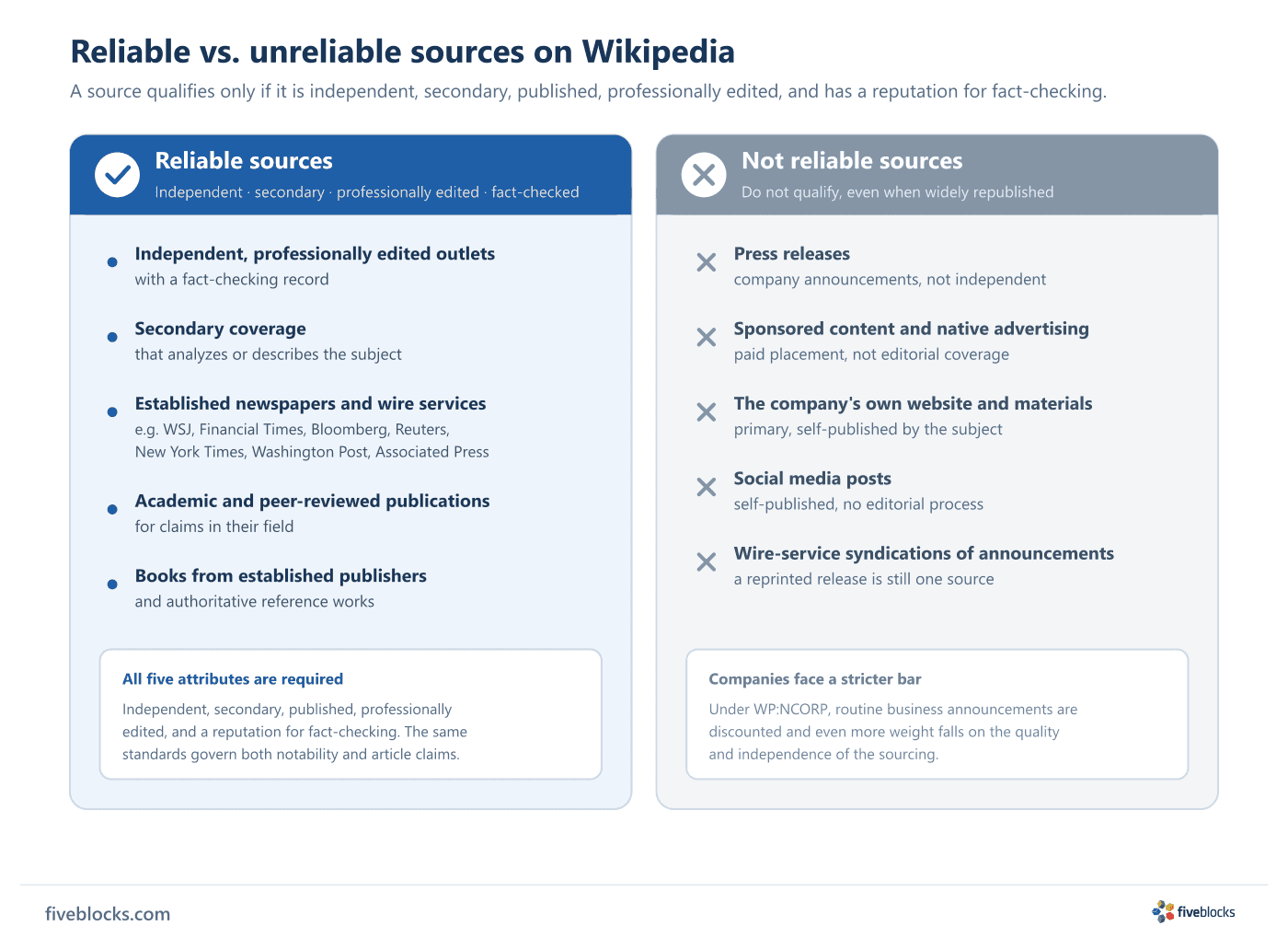
Two practical points. First, syndication does not multiply sources: a single wire story reprinted across many newspapers still counts as one source, not several. Second, companies are judged against a stricter bar (WP:NCORP) that puts more weight on the quality and independence of the sourcing and discounts routine business announcements. The same standards govern both whether a subject is notable enough for an article and whether a specific claim inside an article can stand.
Last reviewed: 19/05/2026
