Who edits Wikipedia and how are edits reviewed?
Wikipedia is edited by a global community of volunteer editors who review one another's work through watchlists, recent-changes patrols, and topical attention. Non-compliant edits are reverted within minutes on high-traffic articles and within days on lower-traffic ones, and disagreements are resolved through Talk-page discussion.
Wikipedia is written by a global community of volunteer editors. There is no central editorial board: anyone with an account can propose a change, and other editors review, accept, modify, or revert it. That distributed structure is what makes the encyclopedia hard for any single interested party to control.
Who does the editing
The most active contributors are a mix of subject-matter experts, retired professionals, hobbyists with deep topic knowledge, and administrators who hold elevated permissions. They work independently of one another, so no one editor or group controls a given article.
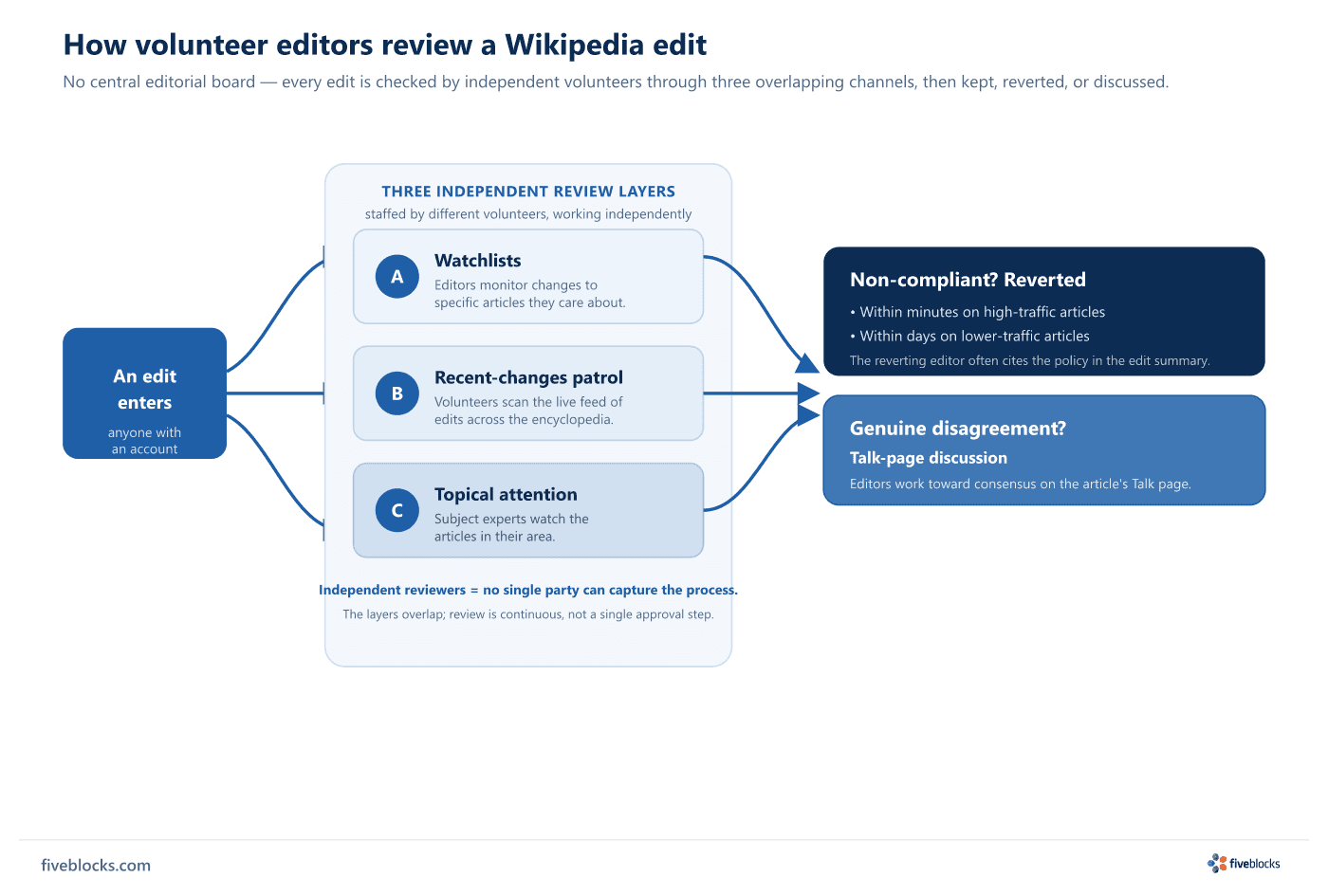
How edits are reviewed
Review happens continuously through several overlapping channels rather than a single approval step:
- Watchlists, editors monitor changes to specific articles they care about.
- Recent-changes patrol, volunteers scan the live feed of edits across the encyclopedia for inappropriate changes.
- Topical attention, editors with subject expertise watch the articles in their area.
When an edit fails policy, it gets reverted, typically within minutes on high-traffic articles and within days on lower-traffic ones, and the reverting editor often cites the relevant policy in the edit summary. Where there is genuine disagreement, the discussion moves to the article’s Talk page, where editors work toward consensus.
What this means for conflict-of-interest work
For anyone with a conflict of interest, this structure sets the rules of engagement. Direct edits by interested parties are routinely reverted. A well-formulated Talk-page edit request, backed by reliable sources, is a different matter: uninvolved editors judge it on its merits and decide whether to implement it. Working with the process gets results; trying to route around it does not.
Last reviewed: 19/05/2026
