An editor keeps adding our lawsuits to our Wikipedia article and we can’t stop them. What are our options?
When one editor keeps adding the same content over others' objections, you have two paths. The content path: open a Talk-page discussion that names the policy concern and builds consensus, which then limits further unilateral edits. The conduct path: report edit warring or harassment to the Administrators' Incidents noticeboard (ANI). Start with the content path; use the conduct path when an editor refuses to engage at all.
When a single editor keeps adding the same content over the objections of other editors, you have two paths. In most cases the content path resolves the situation. The conduct path is what you fall back on when an editor refuses to engage with the community process at all.
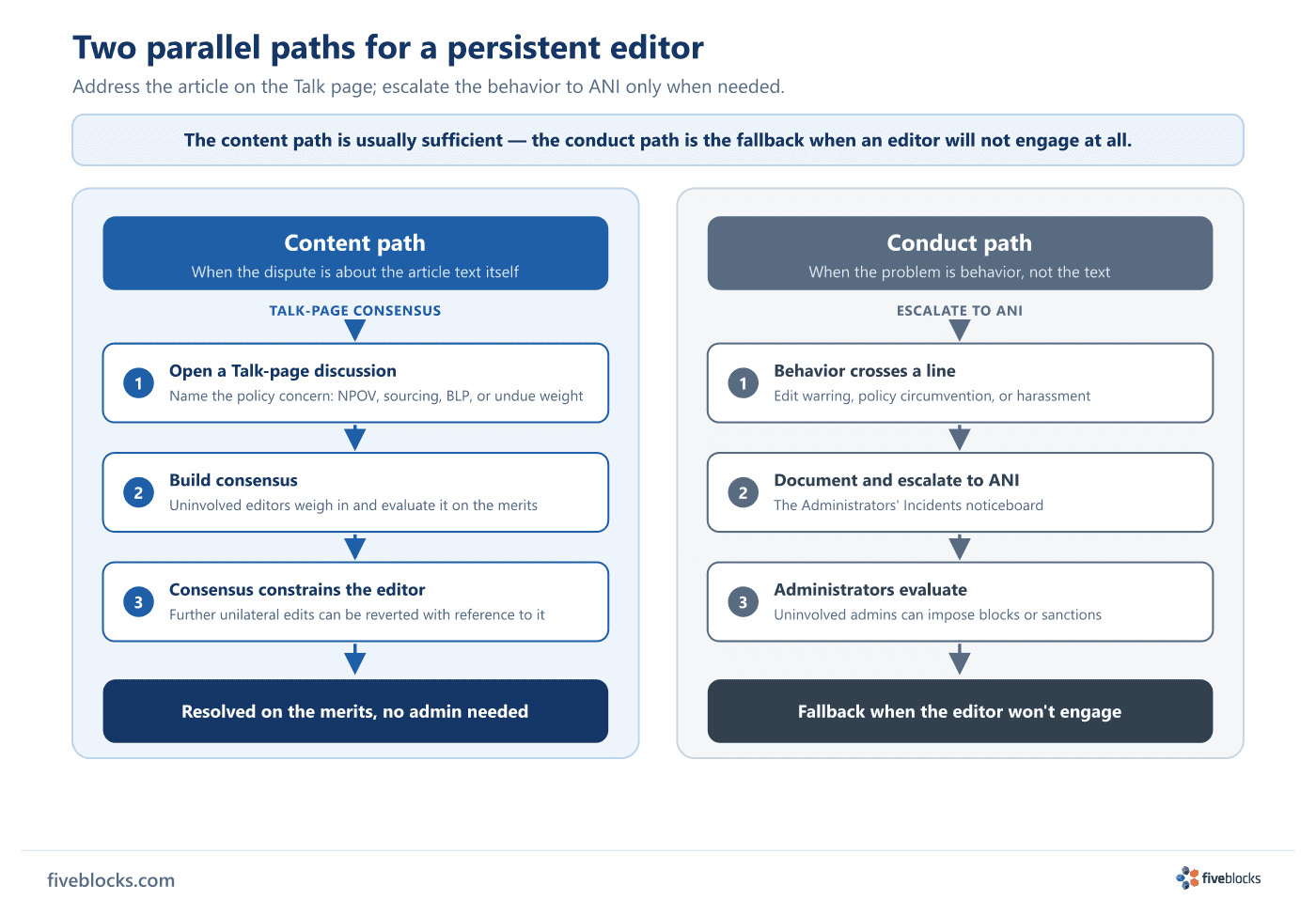
Two paths for handling a persistent editor
| Content path | Conduct path | |
|---|---|---|
| When it applies | The additions raise a policy concern with the article text itself. | The editor’s behavior crosses into edit warring, policy circumvention, or harassment. |
| Where it runs | The article Talk page. | The Administrators’ Incidents noticeboard (ANI). |
| What you do | Open a discussion that names the policy concern (NPOV imbalance, sourcing weakness, BLP application, undue weight), propose the policy-compliant treatment, and invite uninvolved editors to weigh in. | Document the conduct and report it so uninvolved administrators can decide whether sanctions are warranted. |
| How it constrains the editor | If community consensus supports the policy-compliant version, the persistent editor is bound by it, and further unilateral additions can be reverted by pointing to that consensus. | Administrators can impose blocks or other sanctions when conduct policy is violated. |
Start with the content path
The content path is usually enough on its own. A Talk-page discussion that identifies the specific policy problem and proposes the compliant wording lets uninvolved editors judge the dispute on the merits. Once consensus forms around the policy-compliant version, that consensus is what binds the editor, not your individual reverts.
Use the conduct path as the fallback
The conduct path applies when the problem is behavior rather than text. Persistent edit warring, breaching the three-revert rule (no more than three reverts on the same article within 24 hours), policy circumvention, or harassment can be reported to ANI, where uninvolved administrators decide whether intervention or blocks are warranted. Take this route when an editor will not engage with the community process at all.
Last reviewed: 19/05/2026
